Friday, June 11, 2021

Parasol thief

This classified advertisement from a century ago, in the January 11, 1921, edition of The Bucyrus (Ohio) Evening Telegraph, made me laugh. I wonder how it turned out. Did the parasol thief read the newspaper and exclaim, "Crikey! They're on to us, Martha!"

This is from the classified section called "The People's Want Column." Some other items from that day include:
  • FOR SALE — Anyone wishing a car of good yellow ear corn, write F. W. Weimer, Cedarville, O.
  • WANTED — Lady to demonstrate gas appliances at Logan Gas office. Apply to Miss Bickel at the Gas office.
  • WANTED — The public to know that Mrs. Steinhelfer's name was omitted from the telephone directory, and her phone No. is 4607.
  • LOST — An umbrella in North Bucyrus Saturday forenoon while convassing [sic] for books. Finder please leave at this office and receive reward.
  • WANTED — The person who took the lantern from the Mary St. dump to return to Ohio Power Co. Phone 5477.
  • WANTED — All kinds of junk, and live poultry, also eggs, by Silverstein Junk & Poultry Co. Phone 5952.
And, yes, I'm curious about Silverstein Junk & Poultry Company. How did that business start? "Let's get into buying and selling junk. Also, chickens. That seems like a profitable mix."

Alas, the only information I found about the company was that same classified advertisement, being published over and over.

Wednesday, June 9, 2021

Posters of last 5 movies we watched

The Hound of the Baskervilles (1959)
Director: Terence Fisher
Starring: Peter Cushing, Christopher Lee

Twenty-Four Eyes (1954)
Director: Keisuke Kinoshita
Starring: Hideko Takamine
School of Rock (2003)
Director: Richard Linklater
Starring: Jack Black, Joan Cusack
Mon Oncle (1958)
Director: Jacques Tati
Starring: Jacques Tati, cute dogs
Isle of the Dead (1945)
Director: Mark Robson
Starring: Boris Karloff, Ellen Drew

Tuesday, June 8, 2021

That time Tony Pérez mailed me his autograph

This is how I remember it...

Around 1983 I went through a short phase of mailing letters (plus a SASE, of course) to baseball players and asking them for their autograph. 

Not many responded. But in 1983, I wrote to Tony Pérez, who had signed with the Philadelphia Phillies that January to join what would become the National League champion Wheeze Kids.1

We moved from Pennsylvania to Florida that summer, so it must have been sometime in late spring or early summer when I received a reply in our Montoursville mailbox from the 41-year-old Pérez, who had 1,500+ career RBIs under his belt at that point. Inside the envelope was Pérez's autographed 1983 Donruss card, which still showed him as a member of the Boston Red Sox. (He had played for the Red Sox from 1980 through 1982. In those days, your baseball card almost always showed who you had played for in the previous season.)

This was an extremely cool thing for a kid to receive in the mail in 1983. A quarter-century later, it was still extremely cool when I would help Ashar write letters to his favorite Phillies — his letters were longer and nicer than anything I had ever written — and we'd get a slick photo back from Jimmy Rollins or Chase Utley or someone else from the 2008 World Champions. By that point, it had surely become a more streamlined system involving the Phillies' public relations department (and probably no necessary action on the player's part). Maybe that was the case in 1983, too. I'm pretty sure that's Pérez's actual autograph, but we can imagine that he just sat down once a month, signed a bunch of cards, and then let the PR interns do their thing and mail them out. 

Of course, in my 12-year-old mind, Tony read all of his mail, unfolded the SASE, tucked the signed card inside, licked the envelope and walked it over to the mailbox. 

A few years later — this part is hazier but let's say it was 1989 —  I discovered the magic of machines at the drug store that would laminate stuff for just a couple quarters. If it's laminated, it's FOREVER, I thought. And so, yes, I had my autographed Tony Perez baseball card laminated (along with a 1983 Fleer Wade Boggs, IIRC). This is, of course, a disastrous thing to do to a baseball card or any other ephemeral collectible. But Young Chris wasn't always the sharpest tool in the shed. 

Collectible-wise, the value of the Pérez card is now close to nil. But the upside, I reckon, is that I never intended to sell it, anyway. Tony Pérez mailed it to me! So I can be content that it's safe from spills and almost impossible to crease.

Footnote

1. In 2013, Philadelphia Daily News columnist Stan Hochman wrote about the origin of Wheeze Kids as the moniker for the 1983 Phillies: "They were old. So many guys in their 40s. Old baseball guys creak when they run and they run a step slower. They make a whistling, tea-kettle sound when they go first to third or second to home. Wheeze Kids, that's what I nicknamed that 1983 Phillies team, and it stuck. A spinoff of Whiz Kids, the nickname for that swaggering, young Phillies bunch that won the pennant in 1950, only to get swept by the Yankees in the World Series. Throw enough mud at the wall and some of it sticks."

Monday, June 7, 2021

I like my root beer ... sanitary

OK, I have some questions: What marketing genius came up with Sanitary Brand Root Beer? Did they think that fairy tale illustrations would help make up for the lame name? Why not just call it Fairy Tale Root Beer? Would this be the first root beer you grab off the shelf?

At least the public could be assured that the beverages from the Sanitary Bottling Works in Indiana Harbor, Indiana, were sanitary, right? Right??

Alas, the first article I found in a search on Newspapers.com was this one, from the June 12, 1914, edition of The Times of Munster, Indiana.

HARBOR MEN ARE FINED

The wrath of the law was visited upon a pop bottling firm, three groceries and five bakeries on one street in Indiana Harbor yesterday by J.T. Willett, state food and drug inspector, with the assistance of Frank O'Rourke of Hammond, and Justice Funkhouser. The nine fines amounted to $317.70. Willett was loud in his praise of the judge.

Those fined are:

The Sanitary Bottling Works, convicted on five cases of charging pop with soda and saccarine, the last a substance 500 times as sweet as sugar, costing $2.25 as against $25 for a like amount of sugar sweeting. Total fine $110.50.1 Samuel Meyers, bakery; Trkman & Sherpter [sic?], bakery; M. Hodiesski, bakery; F. Fiedrwicz, grocery; Fred Speisak, bakery; Abe Padi, grocery; Michael Chaswood, bakery. Each fined $25.90.

All these merchants hail from Cedar street. Inspector Willett says that there are other streets and he is back in Indiana Harbor today with blood in his eye. "I have warned these fellows repeatedly to clean up," said he this morning. "There is no place in the country that needs a city inspector as bad as East Chicago and Indiana Harbor. The conditions are the worst in Indiana. The walls, floors, windows and cases of the bakeries were filthy. Food was uncovered and thousands of flies were attracted to it. These things don't happen where there is inspection."
1. From the Wikipedia page on the artificial sweetener saccharin, which was first produced in 1879: "Starting in 1907, the United States Food and Drug Administration began investigating saccharin as a result of the Pure Food and Drug Act. Harvey Wiley, then the director of the bureau of chemistry for the FDA, viewed it as an illegal substitution of a valuable ingredient, sugar, by a less valuable ingredient. In a clash that had career consequences, Wiley told President Theodore Roosevelt, 'Everyone who ate that sweet corn was deceived. He thought he was eating sugar, when in point of fact he was eating a coal tar product totally devoid of food value and extremely injurious to health.' But Roosevelt himself was a consumer of saccharin, and, in a heated exchange, Roosevelt angrily answered Wiley by stating, 'Anybody who says saccharin is injurious to health is an idiot.' The episode proved the undoing of Wiley's career."

Saturday, June 5, 2021

Mars miscellanea & great podcasts

1. Hello there, Mr. Angelino, aka Banjo.

2. Hello, Mars! is a 1989 book for children about space exploration that was written by Geoffrey T. Williams and illustrated by Yvonne Cherbak. I bring it up tonight, because Cherbak is the subject of a heartbreaking but also life-affirming episode of the podcast Ephemeral. (It will hardly surprise you learn that something titled Ephemeral is one of my favorite podcasts.) The short May 14 episode "Five Paintings" deals with Cherbak and her narrow escape from the devastating Woolsey Fire in California in late 2018. It's an episode that will also leave wondering what you would do if you had to leave behind 99.9% of your life's possessions on short notice.

Ephemeral, hosted by Alex Williams, is current in the middle of its second season, so it wouldn't take you long to listen through all of the previous episodes. But if you only want a sampling, these two are my absolute favorites so far:
  • "Diaspora" (May 20, 2019), which looks at some of the rare musical recordings made by immigrants who came to the United States in the early 1900s.
  • "Reputation" (June 17, 2019), which comes with this teaser: "When a song just hits you, it’s a powerful thing. ... But what if this song – that you just discovered and can’t get enough of – was a mystery? You don’t know who wrote it, you don’t know who performed it, and you have no evidence to go on. You just have the music… looping endlessly… asking questions but answering none."
Meanwhile, because I love interconnected tangents, another favorite podcast of mine is Eric Molinsky's Imaginary Worlds. And it recently had a great episode about music, too: "Embracing the Spooky Spooky" is about the fascinating life of Russia's Leon Theremin (1896-1993) and the haunting instrument that bears his name.

3. But wait, there's more! These Mars buttons are pretty cool relics. And sooooo 1970s.

The bottom button has small type that reads "American Revolution Bicentennial 1776-1976." Indeed, these buttons are related to NASA's Viking 1 and Viking 2 orbiter-lander missions to Mars, which launched in 1975 and arrived at the Red Planet in the summer of 1976 

There was originally a hope that Viking 1's lander could touch down on Mars on exactly the Fourth of July, 1976. But that attempt proved prohibitive, and the successful landing had to wait until July 20.

Bicentennial pins were a big thing in 1976. (Well, bicentennial everything was a big thing.) I'm not 100% sure what the story is behind these specific pins and their "Smile" theme. Anyone have more info? The smiley face had been around since the 1960s (or perhaps even earlier). But it was in the 1970s when the smiley face became ubiquitous in American culture, alongside its exact opposite: the green Mr. Yuk sticker created by UPMC Children's Hospital of Pittsburgh.

Strange recipes, including sheep sorrel pie

Here's a fun clipping from Wayne Guthrie's "Ringside in Hoosierland" column in the October 18, 1948, edition of The Indianpolis News.
As you can see, it contains references to sheep sorrel pie, pumpkin-blossom pie, sugar pie, eggplant and salted carp slung over the fence. 

I was very pleased to discover that sheep sorrel pie does not contain any sheep. Sheep sorrel is one of the names for Rumex acetosella. Apparently the taste of the leaves is not too far removed from lemon. Dusty Old Thing, which has a recipe for the pie, notes: "Citrus fruit was hard to get in the U.S. and lemon pie was an extremely popular dessert. The pioneers used the herb, sheep sorrel, to flavor their pies and the taste is supposedly very close to lemon pie. But, we’ve heard it does take a fair bit of sheep sorrel to get the flavor."

Another recipe for sheep sorrel pie can be found at The Oklahoman. 

Columnist Wayne Guthrie (1896-1977) is a member of the Indiana Journalism Hall of Fame. His career included covering multiple atomic test explosions, including two at Bikini Atoll in 1946. In the years afterward, he gave more than 800 speeches to groups interested in hearing about what he witnessed. (Learn more at the Indiana Journalism Hall of Fame website.)

As for "Ringside in Hoosierland," the Indiana Historical Society notes that the longtime column "dealt with Indiana and its folklore and history: how places got their names, how long people had been doing their jobs, how to make things like vinegar pie. There was a good deal of reader response; sometimes this produced material for future columns; sometimes it turned into a campaign. Two successful campaigns resulted in naming a state park after Col. Richard Lieber and changing the name of the Indianapolis baseball park from Victory Field to Bush Stadium. An unsuccessful campaign in the 1950s tried to rename 38th Street in Indianapolis after General Douglas MacArthur."

Thursday, June 3, 2021

Sculpted door frames ... ornamentation of a bygone era

This is the 900th post that falls under the "Postcards" label.
This postcard, which was published in 1908, features the Kreuzbrunnen Colonnade in Mariánské Lázně (perhaps better known by the German name Marienbad). Mariánské Lázně is now in the Czech Republic. At the time of this postcard — well, it's complicated. I'd need an expert on European history to explain it all. Is it best to just say this was Bohemia at the time?

The structures to the center and right are part of Kreuzbrunnen, which was built in 1888-1889 in the Baroque style. Circa 1951, it was renamed Maxim Gorky's Colonnade.

I can't tell what year the postcard was mailed, but it was sent to Miss Blanche Applegate in Williamsport, Pennsylvania.

The cursive note reads:
Dear Blanche — Have outlined the roof of the hotel in which I am staying and which is just visible over the Brunnen. My address during August will be — Adelheitstr 73, Wiesbaden, Germany. Am at present down here in Austria getting up strength for next winter. Best wishes for western trip. Lovingly, [indecipherable]

Wednesday, June 2, 2021

Book cover: "Investigating UFO's"

This is the 500th post that falls under the "Book covers" label. Also, it's nice and timely, given how much UFOs are in the news this year. (For example: This May 30 USA Today article.)
  • Title: Investigating UFO's
  • On a scale of 1 to 10, how unhappy does "UFO's" with an apostrophe make Otto? In 2019, I rated it an "11," but that was just for the error appearing in the text. Its presence in the title of this book is an off-the-scale punctuation abomination.
  • Author: Larry Kettelkamp
  • About the author: According to the bio included in the book, Kettelkamp was born in Harvey, Illinois; graduated from the University of Illinois with a B.F.A. in painting in 1953; served two years in the Army; eventually moved to Cranberry, New Jersey; and had his lifelong hobby turn into his first published book: Magic Made Easy. Other books by Kettelkamp include Dreams; Drums, Rattles, and Bells; Haunted Houses; Kites; The Magic of Sound; Puzzle Patterns; Shadows; Sixth Sense; and Spooky Magic.
  • Cover designer: Unknown
  • Publisher: William Morrow and Company, New York
  • Year: 1971
  • Pages: 96
  • Format: Hardcover
  • Price: Unknown. Dust jacket is price-clipped
  • Dust jacket excerpt: "Are Unidentified Flying Objects real or imaginary? Much investigation has been done on this question, but there still is no clear answer. Feeling that the objective data gathered should be made as widely available as possible, Larry Kettelkamp has written this survey on what government and civilian groups have learned to date." 
  • Provenance: It was clearly a library book, but the only clue I can find is a lone stamp on the inside back cover for "BINFORD I.M.C." IMC likely stands for Instructional Materials Center.
  • Thanks from the author: "The author wishes to thank the following researchers for contributing materials and offering helpful suggestions:"
  • First sentences: In 1966 a nationwide Gallup poll questioned Americans about UFO's, or Unidentified Flying Objects. According to the poll, more than five million Americans have seen something they believe was a flying saucer. [For context, the population of the U.S. in 1966 was about 196 million.]
  • Last sentences: Many UFO reports indicate that such visitors may have been here already. This exciting possibility is what makes the study of UFO's so important and so fascinating.
  • Random excerpt from middle: Unfortunately, photographs of flying saucers can be faked.
  • Online review excerpt #1: Kirkus had this to say in 1971: "Overall, it's a concise if somewhat weighted summary of saucer lore, well organized and attractively laid out, by a master of far-out subjects; but the need for still another rehash is debatable."
  • Online review excerpt #2: Writing on Pamphlets of Destiny in 2019, Lawrence Burton states: "Investigating UFOs is a children's book, so the language is clear, with the subject simplified to some degree, and thankfully free of the crankier tone which informs most of the writing on this topic — because this was the era of children's books being written with some sense of educational responsibility. It took me about an hour to read it cover to cover, and at no point did I feel ridiculous, and it was very enjoyable; so there you go."
  • Full disclosure: I have a couple other UFO-related ephemera items in the ever-full hopper of upcoming posts, so prepare for more saucer shenanigans in 2021.
  • Other full disclosure: I have never, to my knowledge, seen a UFO. 
But wait, there's more!

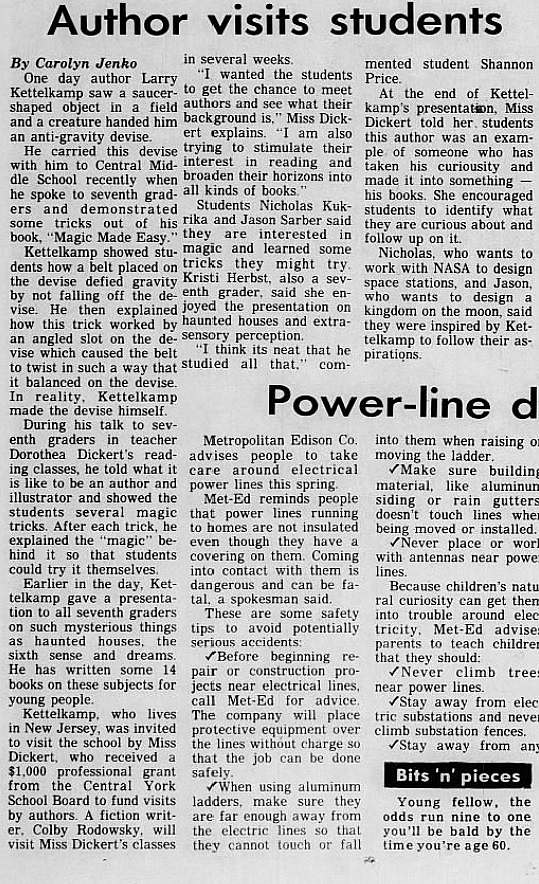
We used to have a saying that "all news leads back to York, Pennsylvania." To that end, I found a news clipping about an appearance by Larry Kettelkamp at Central York Middle School in the April 13, 1987, edition of The York Dispatch:
Postscript