Friday, July 29, 2011

Jack and Jill magazine & "Helmet for my Pillow"

(Versions of these two posts originally appeared on Relics in January 2010.)

Detroit longs for the return of these days

Here's a reader letter from the February 1955 issue of Jack and Jill children's magazine. (The cover price was 25 cents and a one-year subscription cost $2.50.)

I'm sure the Ledgerwood family had a much nicer experience flying into the Motor City back in the 1950s than air travelers do today. And I'm sure the days of people traveling to Detroit to pick up a shiny new American automobile and then drive it across half the country to get home are long since over.

Know anyone who ever did that?

By the way, here's an interesting piece of trivia about the history of Detroit: Five people have been awarded the key to the city -- James Earl Jones, Jerome Bettis, neurosurgeon Benjamin Carson, businessman Christopher Ilitch and, in 1980, "in recognition of large donations to a church," Saddam Hussein.

"The real combat experience..."


A while back, I came across a 1965 paperback copy of Robert Leckie's "Helmet for My Pillow."

It's Leckie's memoir of the Pacific campaign of World War II. The back-cover description states that it's "the true, agonizing, brutal story of the fighting and the dying, the wild sprees of sex and drinking in Australia, the murderous assaults on island after island. ... A brave, tough, sardonic and beautiful book."

It was Pearl Harbor that catapulted Leckie into the war. As he writes on the opening page:
"I had sought to enlist the day after Pearl Harbor, but the Marines had insisted that I be circumcised. It cost me a hundred dollars, although I am not sure to this day whether I paid the doctor or not. But I am certain that few young men went off to war in that fateful time so marked."
The book -- creased, shelfworn and tanned like any other well-read paperback -- contains another, more personal, stamp of approval. On the first page of the book, someone has scrawled in ink: "Right on for the real combat experience. Have been there also -- WWII. 2nd Marine Div."

That anonymous note-writer wasn't the only one who believed "Helmet for My Pillow" was a great non-fiction book. Leckie's memoir is one of two books (Eugene Sledge's "With the Old Breed: At Peleliu and Okinawa" is the other) that served as the basis for "The Pacific," a 2010 HBO miniseries about the Pacific campaign.

Thursday, July 28, 2011

Some history of The Regal Store in York

Back in May, I blogged about a pair of bookseller labels from here in York, Pennsylvania. It was a downright lazy blog for me. My research consisted of: "I'm not familiar with either of these former stores. Can anyone shed any light?"

Happily, this turned out be another one of those cases where I got other people to do my homework for me.1

The readers of my wife's blog, Only in York County, were able to provide some great information and memories of The Regal Store, home of one of the two bookseller labels I featured on May 11.

Go to Joan's blog to read all the great information that was submitted by her readers. Here are a couple snippets:
  • "I worked at the Regal Stationary Store in 1943, repairing umbrellas. I was 14 years old and worked for Wilbur Cross, the owner."
  • "It sold stationery supplies and umbrellas, attaches, fountain pen, pads of legal column paper, businessmen's supplies. ... I think they had some books, but not many."

Footnote
1. For another example of crowdsourcing blog research, see "Mystery solved: Dietz's Lawn and Garden Store."

Wednesday, July 27, 2011

Rounding up another batch of reader comments

Here are some recent comments and updates from readers regarding Papergreat posts. As always, thank you for all of the awesome responses and additional information that you send my way!

Reader submission: "I pray you never get scaly leg": Blake Stough of Preserving York writes: "Up until now, I never really looked closely at the image of the lady with the hand that doesn't seem to go with her body. I have a different theory of how it came to be. I feel there may be a man crouching behind her, and out of the camera's view, who is holding the chicken for her. Just my thoughts, but a possibility." (Editor's note: Our in-depth analysis of this 1922 photo and it's likely manipulation has become one of my favorite things on this blog.)

Coupons from the E.H. Koester Bakery Co.: Jeannine (Deville) McCarrick writes: "My father, Dillard 'Frenchie' Deville, worked for Koester's from 1954 until they sold it to Schmidt's in 1977. (He was one of the few men that Schmidt's kept on as salesmen.) Dad loved his job and was often the company's top salesman. Koester's was very good to my father. I was born in 1963 and as a toddler my photo won a company contest as the 'Koester Baby', or something like that...I'm looking for the paperwork/certificate to prove it! I have a plaque that was awarded to my Dad in his 9th year of employment with the twins logo on it...I've got fond memories growing up of ALWAYS having fresh bread in the house and I always wanted to ride to work with my father in his bread truck, but he always told me he couldn't do that...instead, he let me go grab the packet of bread off the truck! Thanks for the warm memories of Koesters!!!"

Delving into Henry K. Wampole & Company: Sabra Smith writes: "Ah, how the internet takes us down lanes and paths! I'm putting together a chronology of the architectects Schermerhorn & Phillips in an effort to save a local 1917 school building they designed. In 1906 it appears they designed a factory building for Mr. Wampole... but as you note above, he killed himself. I'm beginning to wonder about these architects.... in 1902 they were designing a house for a Mr. Acuff who suddenly dropped dead due to 'paralysis of the heart.' Thanks for sharing your Wampole insights!"

An all-star lineup of Camel smokers from 1954: Mel Kolstad of Ephemeraology writes: "WOWIE!! Look at how young Mickey Mantle is - I didn't recognize him! It's so weird to see cigarette ads like this - and how odd is it that something so ubiquitous has turned so 'evil' in a very short amount of time? Growing up ALL of my friends' parents smoked, including mine. I'd love to go back in time and be able to smell what our schoolrooms smelled like, not to mention restaurants and other people's homes. Yet I don't recall being bothered by the smoke smell as a kid."

Over 1,000 tested and proved ideas for making money at home*: Jeffrey Smith writes: "Don't be too quick to write off the mail order ideas. The 50's and 60's were the golden age of mail order, and I remember knowing and dealing with people who turned hobbies into extra income that way. Advertising was cheap, even in the dozens of nationwide specialty magazines. I remember being fascinated by things like '10 old postcards for $1.00' or 'tumbled gemstones for 10 cents each.' To be honest, I rather miss them."

Top of an old box of Tiddledy Winks: JT Anthony of A Pretty Book writes: "In a non-disparaging tone, I must ask, 'There's a North American Tiddlywinks Association with a song committee?' Oh the things you learn on Papergreat."

Advertisements from 1891 issue of North American Review: Vince Gotera writes: "Thanks for posting a link to this in our Facebook group 'Friends of the North American Review.' To clinch the date of this issue, you can browse Cornell University Library's 'Making of America' website, where all the 19th-century NAR issues are available on screen. Oh, incidentally, I've also posted a link to this blog post in the NAR's Facebook page. Thanks again!"

Tuesday, July 26, 2011

Some super summer baseball reading

Here are some suggestions for great reads involving the national pastime that you might have missed or never heard of. Share your favorite baseball reads (fiction and non-fiction) in the comments below, and we'll make this a nice repository for everyone's favorites.

Great magazine articles

Lesser-known great baseball books

Other "Baseball Tuesdays" posts

Footnotes
1. I have no idea why the separate stories of Moe Berg, Tacks Latimer and Allan Travers haven't been made into amazing baseball movies by Hollywood.
2. I'm sorry. I couldn't help myself. Here's a blog post I wrote in 2007 about Daulton's book, which is nothing if not interesting.

Monday, July 25, 2011

Who are these guys? (Puppet Edition)


I found this small photo of a trio of colorful puppets tucked away inside the card pocket of a copy of the 1972 hardcover edition of "Perchance to Dream," an anthology edited by Damon Knight.

The book had once been part of the collection of the Vineland Free Public Library, before behind discarded.

Editor Knight is probably best known for his 1950 short story "To Serve Man," which was adapted into a classic "Twilight Zone" episode and has been parodied in everything from "The Simpsons" to "The Naked Gun 2½."

Among the short stories included in the anthology are "An Occurrence at Owl Creek Bridge" by Ambrose Bierce (one of my favorites) and "The Circular Ruins" by Jorge Luis Borges.

But what about those puppets? Any ideas?

Sunday, July 24, 2011

100th anniversary of Bingham "rediscovering" Machu Picchu


This month, I've been reading Mark Adams' entertaining and informative "Turn Right at Machu Picchu," which I checked out from our local library.

I've always had a bit of an interest in Machu Picchu, but it wasn't until I began reading Adams' book that I realized that this month -- today, in fact -- marks the 100th anniversary of the rediscovery1 of the awe-inspiring Peruvian site by Hiram Bingham III.

It was on this date that Bingham was guided on a precarious expedition to the ruins by Peruvian farmer Melchor Arteaga; Sergeant Carrasco, a policeman who was his guide and interpreter; and an 11-year-old Quechua boy named Pablito Alvarez.2

But what was Machu Picchu?

That's a question that has continued to interest academics and archaeologists ever since Bingham's rediscovery of the site. The best thinking now is that Machu Picchu, which was constructed in the 1400s3, was simply one of the primary estates of the Incan emperor Pachacuti.

But there are other theories about the site:
  • Bingham believed it was the traditional birthplace of the Incan "Virgins of the Suns."4
  • It was an important religious site. It is positioned relative to sacred landscape features such as its mountains, which are purported to be in alignment with key astronomical events. From Wikipedia: "At the highest point of the mountain in which Machu Picchu was named after, there are 'artificial platforms [and] these had a religious function, as is clear from the Inca ritual offerings found buried under them' (Reinhard 2007). These platforms also are found in other Incan religious sites."
  • It was an Inca llaqta - a settlement built to control the economy of conquered regions.
  • It was a prison for the baddest of the bad Incan prisoners. (Sort of an Incan supermax.)
  • It was an agricultural testing station. There wasn't enough space for large-scale agriculture, but there were plenty of terraces for small-scale experimentation in varying climates.
My grandmother, Helen Adams Ingham, traveled to South American and Machu Picchu in 1978. Here are some of her snapshots from the Peruvian site, which is nearly 8,000 feet above sea level.


Footnotes
1. While it was Bingham who announced his discovery of Machu Picchu to the world and thus claimed credit, he was almost certainly not the first modern explorer to encounter the site. Some maps as old as 1874 show references to Machu Picchu. Two separate German explorers - Augusto Berns and J.M. von Hassel - may have been to Machu Picchu in the 1860s. And there are other reports of explorers climbing to the site in the early 20th century, between 1901 and 1906.
2. This website contains a good summary and narrative of Bingham's journey. Bingham himself documented his discovery in the April 1913 issue of National Geographic. The entire issue, with its 244 illustrations, was devoted to Machu Picchu.
3. Coincidentally, Machu Picchu was originally built around the same time period (perhaps a couple decades earlier) as the Amsterdam site I wrote about yesterday. Two locations on separate continents, more than 6,000 miles apart.
4. According to Encyclopædia Britannica, the "Virgins of the Sun" (also known as as Chosen Women, Quechua Aclla Cuna, or Aklya Kona) were:

"[Incan women who] lived in temple convents under a vow of chastity. Their duties included the preparation of ritual food, the maintenance of a sacred fire, and the weaving of garments for the emperor and for ritual use. They were under the supervision of matrons called Mama Cuna. At the time of the Spanish conquest in the early 16th century, the Virgins numbered several thousand and were governed by a high priestess, the Coya Pasca, a noblewoman who was believed to be the earthly consort of the sun god. The Virgins, not of noble birth, were village girls selected by officials for their beauty and talent; they were chosen at the age of 8 or 10 and shut up in the temples, which they were not allowed to leave for six or seven years. Of these girls, some became sacrificial victims, whereas others were sometimes made imperial concubines or the wives of nobles."

Saturday, July 23, 2011

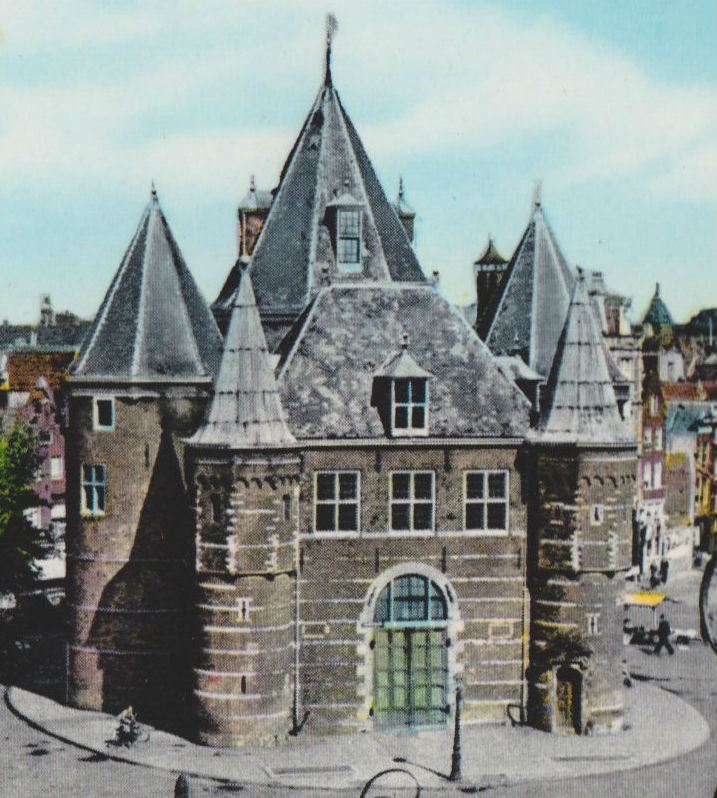
Saturday's postcard: Nieuwmarkt and the Waag in Amsterdam


Today's postcard is undated (1960s?) and unused. The text on the back comes conveniently in several languages:
AMSTERDAM-C
Nieuwmarkt met Waaggebouw.
Newmarket with Weighing-house.
Nouveau marché avec poids public.
Neuer Markt mit Wagegebäude.
This square in central Amsterdam is called Nieuwmarkt ("New Market") and the building in the center is called the Waag. It was originally built in 1488 and was one of the main gates of walled Amsterdam.1

Here's some history of Nieuwmarkt and the Waag, culled mostly from Wikipedia2:
  • In the late 16th century, Amsterdam expanded, the walls were torn down and the Waag lost its function as a city gate. In 1614, the defensive canals around the gate were filled in and the Nieuwmarkt square was created. The weighing scales for the market were placed inside the former gate.3
  • In 1691, an anatomical theatre was added to the Waag and paying members of the public were allowed to witness human dissections.
  • In the early 1800s (and surely at other times in history), executions were staged in the square.
  • Also in the 1800s, there were spring and autumn village fairs in the square. The spring fairs were small and quiet, but the autumn fairs regularly degenerated into brawls and scuffles, and they were prohibited by authorities in 1876.
  • The Nieuwmarkt was within Amsterdam's Jewish district. During World War II, the square was used by the Nazis as a collection point for Jews who were to be sent to concentration camps.
  • In the 1970s, many historic buildings near the square were torn down to make way for a planned train station and highway, which were to run right through the Nieuwmarkt neighborhood. In 1975, however, there was rioting over this proposal, forcing the abandonment of the highway. The train station was eventually built, though.
  • The square has had its current appearance since about 1990, when cars were banned from parking there. Nieuwmarkt and the Waag are now aimed more at tourists and filled with cafés and markets.4

Here are some public-domain images of Nieuwmarkt and the Waag over the years:

From 1902:


A close-up of the Waag from today's postcard:


Side view from 2007:


Front view from 2007:


Footnotes
1. The building houses the oldest plaque in Amsterdam, which states: "On 28 April 1488 the first stone of this gate was laid." The gate, part of the walls that surrounded Amsterdam at the time, was called the Sint Anthoniespoort. For more, check out this 2009 entry on the Tales of a Technogypsie blog.
2. Primary sources are the Wikipedia pages for weigh house and Nieuwmarkt, and the Yahoo! translation of the Dutch Wikipedia page for Nieuwmarkt.
3. Another fascinating note from Wikipedia: "Between 1550 and about 1690, people accused of witchcraft were at times brought to a weigh house in order to be subjected to a 'witch test'. If a person was found to be lighter than a set weight, he or she was deemed guilty."
4. There is also apparently a market for antiques and books on summer Sundays!

Friday, July 22, 2011

Potluck Friday: Harlequins, a hotel and a summer sweepstakes

Can you dig it? Let's travel back in time to the 1970s for a quick assortment of books and ephemera.

Scenes from the Palmer House of Chicago

Here are some totally tubular snaps from a 1979 brochure for the Palmer House of Chicago. You know you're jealous of the outfits and the interior decorating.


1977 Summer Sweepstakes

Here's a big-money raffle ticket offered in the summer of 1977 to help raise money for the former Corpus Christi Abbey in Sandia, Texas. The Benedictine abbey eventually changed hands in 2005, when it was purchased by the Coptic Orthodox Diocese of the Southern United States and became St. Mary & St. Moses Abbey. No word on whether they still have raffles.


A trio of Harlequin romances

Does anyone want a bunch of paperback romances from the 1970s? Please let me know, because I have a bunch. It seems that doctor-nurse story lines were popular during this time, as evidenced by these covers:

From the back cover blurb: "Mary McEwan was the quiet one and unlike Marty, her twin sister, she wasn't supposed to have adventures. But Doctor John Smith's attentions brought her out of her shell. Her heart rebelled when she believed that the doctor regarded her only as an entity in his special research on twins. She was through with being a guinea pig!"

Here's the cover of "The Hand of Fate" -- not to be confused with "Manos: The Hands of Fate."

This is a romance?!? The way Doctor Mark Rylie is putting those gloves on makes this look more like a Thomas Harris novel.