Friday, September 11, 2015

Ye Grand Olde York Fair postcard from 1914


The York Fair begins today and is celebrating a big anniversary this year — 250 years of existence. This year's event will include old favorites like the racing pigs, a hypnotist, "I Got It," the butter sculpture, many chickens, goat mountain, carnival rides, Alabama, and ridiculous amounts of food.

This vintage postcard goes back 101 of those 250 years, to 1914. Back then, the York Fair was held slightly later in the year (October 5-9) and for fewer days (five days as compared to the current ten days).

The card dubs it Ye Grand Olde York Fair and is labeled "Bird's Eye View No. 2, York Fair Ground." It was published by "Fair & Square" Bargain House of York.

For your browsing pleasure, the York Daily Record has put together a trio of great galleries of historic York Fair ephemera:

Also, here are some links to previous posts related to the York Fair and similar events...

You can catch me at this year's York Fair, if you've always wanted to meet an obscure blogger. I'll be playing the key role of "4-H Farm Animal Learning Center (aka Petting Zoo) Attendant" from noon to 6 p.m. on Sept. 17. (It's really just an excuse to be near goats.)

Thursday, September 10, 2015

Ephemera for Lunch #25:
Kanko Hotel in Nagoya


And today we're off to Nagoya, Japan — home of many unique festivals, including this week's Chrysanthemum Day, throughout the year — for this modest luggage tag from the Kanko Hotel.

The Kanko Hotel, according to its English-language website, was established in 1936. Its aim? "The mission of Nagoya Kanko Hotel is to continue having guests spend a magnificently relaxing moment."

That's a pretty good mission.

Rooms range from 16,000 yen (about $132) for single occupancy on the Comfort Floor, to 44,000 yen (about $365) for double occupancy on the Deluxe Floor, to 350,000 yen (about $2,906) for the Royal Suite.

The Royal Suite had better be a magnificently relaxing moment.

Wednesday, September 9, 2015

Ephemera for Lunch #24:
Nara Hotel


Today, we have two 1960s luggage stickers from the Nara Hotel in Nara, Japan.1 The Nara Hotel is quite famous and is still very much in business.

According to the hotel's website:
"Nara Hotel was founded in 1909 to serve as the premier guest house in the Kansai region for visiting dignitaries. It has accommodated many guests during the course of its history, imbuing its tranquil setting among the hills of Nara Park with a tangible sense of legend. Through the Meiji, Taisho, Showa, and Heisei eras, the hotel's elegant beauty has grown more pronounced with the passage of time. ... The splendor of Nara Hotel's stately appearance has not faded since its construction 100 years ago, and the place continues to evoke the era of its founding in compelling fashion through an imposing and magnificent presence that seems to blend seamlessly with the unique elegance of the ancient capital."
This summer, the hotel has been undergoing some "seismic retrofitting," to bring it up to current national codes.

I don't see current room rates listed on the website, but the cost of an extra bed in a room is listed at ¥5,940, which would be about $930. So I'm thinking this place might be out of my price range. Parking is free, though.

According to the hotel's Wikipedia page, famous guests over the years have included Edward VIII, Albert Einstein, Charles Lindbergh, Charlie Chaplin, Helen Keller, Richard Nixon, Pope Paul VI, and the 14th Dalai Lama (not all at the same time).

Footnote
1. Nara is famous for its free-roaming tame deer, which, according to legend, can be traced to the god Takemikazuchi, who arrived on a white deer to protect the ancient capital city of Heijō-kyō.

Tuesday, September 8, 2015

Ephemera for Lunch #23:
Hakone Kanko Hotel


On the heels of yesterday's Hotel Minaguchi-Ya luggage tag, here is another piece of hotel ephemera from my great-grandmother's trip to Japan in the 1960s.

This one is for the Hakone Kanko Hotel in Hakone National Park.1 Hakone is a beautiful town that thrives primarily on its tourist and hot-springs industries. This time of year, tourists might travel there to see the Miscanthus sinensis (pictured at right) in its autumn bloom.2

I cannot determine whether the Hakone Kanko Hotel is still in existence.3 I might need some assistance from someone in Papergreat's Tokyo Bureau on that matter. But I was able to discover these tidbits...

  • It was designed in 1961 by the architectural firm of Yamashita Sekkei.
  • Its offerings, according to an old advertisement I found on Flickr, included "new modern comfortably furnished rooms each with a scenic view," "large new swimming pool," and "excellent Western and Japanese food which makes you wish for second helpings."
  • In November 1961, the Hakone Kanko Hotel was host to a secret meeting between U.S. Secretary of State Dean Rusk and Japan Foreign Minister Zentaro Kosaka. The uncomfortable topic was the stationing of tactical missiles on the U.S. military base in Okinawa. The meeting is detailed in a 2012 article in The Japan Times by Jon Mitchell.
  • In October 1986, the hotel hosted "Microclusters: Proceedings of the First NEC Symposium on Fundamental Approaches to New Material Phases."4

BONUS

Here's one more of my great-grandmother's luggage stickers, from a different hotel in Hakone...


Footnotes
1. Hakone National Park is officially known as Fuji-Hakone-Izu National Park.
2. In North America, however, Miscanthus sinensis is considered an invasive species.
3. I did, however, discover something called the Funspace Ashinoko Camp Mura Lake-Side Villa.
4. At the Microclusters symposium, "about 40 partic­ipants stayed together at the symposium sites during this period. They enjoyed intense and wide-ranging discussions in a conference room facing Mt. Fuji and the beautiful lake Ashinoko extending from the foot of the slope in the old crater." There's a whole eBook about it for just $69.99.

Monday, September 7, 2015

Ephemera for Lunch #22:
Hotel Minaguchi-Ya

This week's theme of "Ephemera for Lunch" will be some of the things that my great-grandmother kept and scrapbooked during a mid-century trip to Japan. These mostly fall under the category of luggage tags and stickers. And it's a colorful, interesting lot. Here's the first one...


I'm assuming that the logo for Hotel Minaguchi-Ya is supposed to be stylized representation of Mount Fuji.

This is the same Hotel Minaguchi-Ya, I believe, that had its centuries-old history chronicled in the 1961 book Japanese Inn, by Oliver Statler.1 The inn was located in Okitsu-juku, along the Tōkaidō (East Sea Road), one of Japan's most historic and written-about paths.

The Minaguchi-Ya has been closed for many years. According to the Samurai Archives Wiki:
"Unfortunately, the inn is no longer an inn. It went out of business in 1985, and by spring of the next year was being used by an area corporation for its private use. However, there is now a picture gallery open to the public on the grounds."

Footnote
1. The reviews on the Goodreads page for Japanese Inn are especially insightful.

Friday, September 4, 2015

Ephemera for Lunch #21:
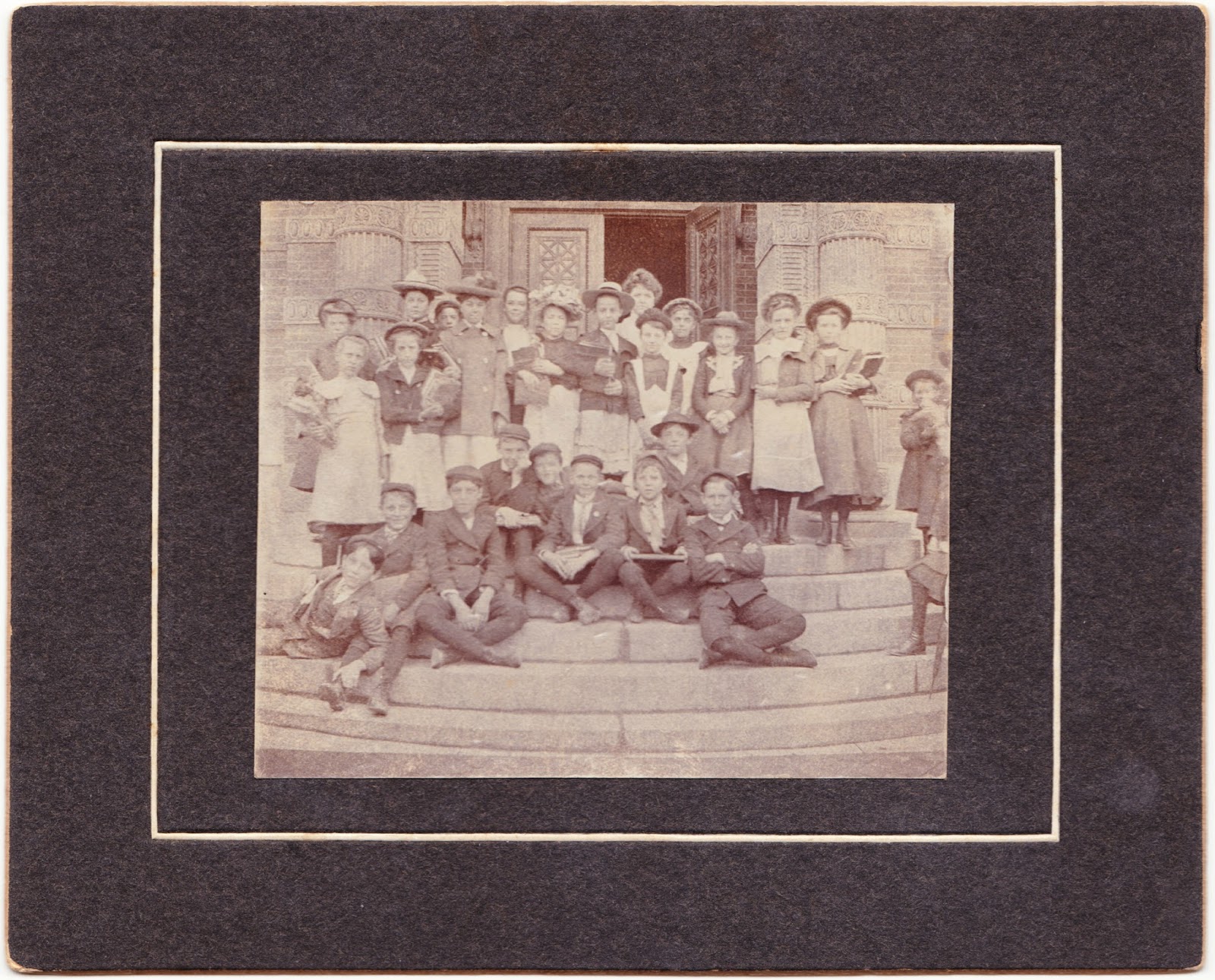
Class photo on the outside steps


We'll cap this week "Ephemera for Lunch" theme with what is possibly the oldest photograph of the lot. It's a group of schoolchildren and their teacher standing and sitting on the wide stone steps in front of what is probably their school.

The only identifying information is a stamp on the back that states: "G. Bernard Lohmuller, 1908 Bank Street."

There are several references to a G. Bernard Lohmuller living in the Baltimore, Maryland, area in the late 19th and early 20th centuries. He might have been married to a woman named Bertie — Bernie & Bertie, how cute! I also found references to a G. Bernard Lohmuller associated with the Baltimore Polytechnic Institute and the University of Maryland.

Most interestingly, assuming it's the same person, there's a G. Bernard Lohmuller listed as one of the architects associated with the Cedarcroft Historic District in Baltimore. It was a residential subdivision that was built between 1848 and 1937 and features the work of at least seven architects, including Lohmuller.

The only citation I found that connected a Lohmuller with 1908 Bank Street is that there was a Bessle C. Lohmuller listed as a registered Notary Public at that address, circa 1911.

None of that, of course, helps us figure out who these schoolchildren are and what school they attended, other than the strong possibility that it was located in Baltimore.

Here's a look at just the photograph...


And here are a couple of close-ups of schoolchildren. Maybe one of them is the child of Bernie and Bertie...


Thursday, September 3, 2015

Ephemera for Lunch #20:
Mystery classroom (1907-1929)


This one's a mystery, for sure. And possibly forever.

It's a real photo postcard featuring a large group of schoolchildren and their teacher in a nondescript classroom. The postcard was never used or written on. And there is no identifying information in the classroom.

All we know, since this is a NOKO postcard (per the logo in the stamp box), is that it was produced sometime between 1907 and 1929. (I suppose it's possible that a couple of these kids could still be alive and in their 90s, but that might be a stretch.)

Here are some closer looks at the students...


Wednesday, September 2, 2015

[Blank] Victorian advertising card: Man eating in front of dogs


OK, let's use The Match Game format to describe this old Victorian advertising card for "N.W. Appleton, stationer."1

Gene Rayburn: "The man in this vintage illustration looks BLANK."

So how would you describe this smiling gentleman sitting upon a fence with a plate of food, surrounded by some begging dogs hoping for scraps.

Would you go with this...


Or this...


My hunch is that an overwhelming majority of us would agree with Betty White (and not just because she's a much safer bet than Charles Nelson Reilly). While this Victorian illustration might have seemed funny and comic in its time, within the cultural context of 2015, it's just plain creepy. A very early example of the uncanny valley effect.

These days, it seems, there's even more general creepiness around smiles. We can blame pop culture, I reckon, from Conrad Veidt in The Man Who Laughs to The Joker2 and everything in between.

Here are some links, best read in daylight perhaps, on how smiles have become horror icons.


Footnotes
1. N.W. Appleton was likely located in Boston, Massachusetts.
2. Slightly related post — Scholastic Fest: #6, The Phantom Brakeman and Other Railroad Stories