Sunday, August 7, 2022

Kipple 'n bytes: Thoughts on what we do and don't preserve

In recent days, I've coincidentally read two things about adult children cleaning out a house full of their late parents' belongings. The first is the short story "Cleanout" in Naomi Kritzer's stellar 2017 collection, "Cat Pictures Please and Other Stories." It's ultimately a sci-fi story, but buying into the fantastical part isn't necessary to appreciate the truth of a passage like this:
"Because there was a lot to go through. Our parents were immigrants from some former Soviet republic with a lot of mountains, and after coming to the U.S. with just the clothes they were wearing, they apparently never threw anything away ever again. We all started in random spots. Magda with the kitchen, packing up bags of warped cookie sheets and chipped frying pans with the nonstick coating peeling off to donate to whichever local charity took housewares. Nora in the basement, because so much down there was water-damaged and mold-saturated she could just haul it straight out to the Dumpster we'd rented."
The other piece I read, which was part of my editing work for LNP | LancasterOnline but didn't feel like work at all, was "What is kipple, and how did it take over my life?" by Los Angeles Times columnist Robin Abcarian. In the August 3 piece, she writes about the long, slow process of cleaning out her late father's house, including the seemingly endless drawers she has come to dread going through.

And what is kipple? Well, here comes the sci-fi element again. It's an invented word from Philip K. Dick's 1968 novel Do Androids Dream of Electric Sheep? — the book that served as the basis for the 1982 movie Blade Runner

"The word is used by the book’s protagonist, Rick Deckard, a bounty hunter assigned to kill some uncannily human-like robots who have escaped involuntary servitude on Mars and returned to Earth, where they try to pass as people.

"So what, exactly, is kipple?

"'Kipple,' Deckard explains in the book, 'is useless objects, like junk mail or match folders after you use the last match or gum wrappers or yesterday’s homeopape. [Dick’s incredibly prescient vision of a digital newspaper.] When nobody’s around, kipple reproduces itself. For instance, if you go to bed leaving any kipple around your apartment, when you wake up the next morning there’s twice as much of it.'"
For Abcarian, the kipple she must deal with involves exhausting numbers of tiny decisions. Should she keep various roles of tape that might come in handy? A magnifying glass? Rubber bands? The "electric cords for ancient tech" or "all those stick-on felt circles that protect the wood floors from scratches"? 

I think many of us can relate to this. I was fortunate, in way. I was able to tackle about 95% of Mom's possessions while she was still alive. My sister Adriane and other family members helped, too. Over the course of many weekends over many years, we cleaned out the house on Oak Crest Lane in Wallingford that was filled with four generations' worth of stuff. Floor by floor, room by room, closet by closet, shelf by shelf and drawer by drawer. And we got to do it with Mom there. So it wasn't a funereal atmosphere, and we were able to ask her about the things we were sorting through to determine whether it was trash, something to donate or something to keep. We got to hear the stories and the context. So that made it almost fun, even it it meant a labor-intensive weekend of moving trunks and filing cabinets in the damp basement, going through three dozen half-used spice bottles, battling cobwebs in the garage and shed, and half-crouching to avoid banging one's head on the beams in the super-humid attic, which had the highest percentage of stuff that went straight to the trash.

And, yes, so many drawers. But with Mom there, they were fun to sort through. Each one a tiny adventure into the past. A chance to laugh, wonder or shake our heads. Perhaps all three at once. 

I can fully understand how the joy would be mostly absent if you had to go through all those drawers alone, though I'm probably an outlier in that I still find such excavation fascinating. (Hence this blog.)

So, I have a Catch-22 of sorts. I'd love to be around as a participant/observer, like Mom was, when my accumulation of stuff is sorted through and sent off to wherever it best belongs. I want to share in the rediscoveries and explain the meanings and provenance behind certain things. I can consult on what's junk and what might have some shreds of value. 

On the other hand — and this is the part that's never fully in our control — I fear leaving others with the job of having to sort through everything without me. The thought of leaving them all that stressful work that's my fault for being a ... well, packrat isn't quite the word. How about I call myself a "history hoarder"? So much of what I've accumulated is paper. There are the books, yes. But also the ephemera. So much ephemera. So many printouts, too. Printouts of articles, blog entries, emails, Facebook posts and tweets. My envelopes full of this stuff are semi-jokingly referred to as the printernet. As in, "Chris prints out the internet."

But am I wrong to do so?

I've written often about the preservation of online content. It's the thrust of the whole Lost Corners subsection of posts. I'm far from the only one with these concerns. I mean, it appears that we can't even preserve crucial digital information at the highest levels of government and national security these days; what hope is there for all those bytes of data that are culturally relevant but far less critical to democracy?

To that end, I recently read (and will be printing out!) a Twitter thread by The Cultural Tutor (@culturaltutor) about the Digital Dark Age. Some key points made there:
"99.9% of the world's information is stored digitally, and one day it might either be lost or inaccessible. ... It's tempting to imagine that people in the future will know more about the 21st century than any previous era in human history. After all, the internet and digital technology has allowed us to document literally everything. But that's not necessarily true... 

"So what is the Digital Dark Age? It's the idea that the 21st century will one day become an 'informational black hole,' that there'll be a scarcity of records from our era. How? This has two elements: the longevity and the accessibility of our current forms of data storage.

"Hard drives last for three to five years before they begin to degrade and eventually fail, while solid-state drives rarely last longer than a decade. So unless you transfer the data on your laptop or phone - it'll be gone in a dozen years.

"What about the cloud? Information on the cloud is stored on servers, which is also where most digital information is now stored. But servers last for ten years at most before they need to be replaced.

"All of which means that, without constant maintenance and management, most digital information will degrade and be lost in less than two decades. So all that content online which documents life in the 21st century is far from permanent. Quite the opposite..."
The full thread goes into much great detail on just how worried we should be about the preservation of digital information. So, yes, I'll keep printing things and putting them into envelopes. The questions then become: Will the envelopes ever be opened? And who will open them?

* * *

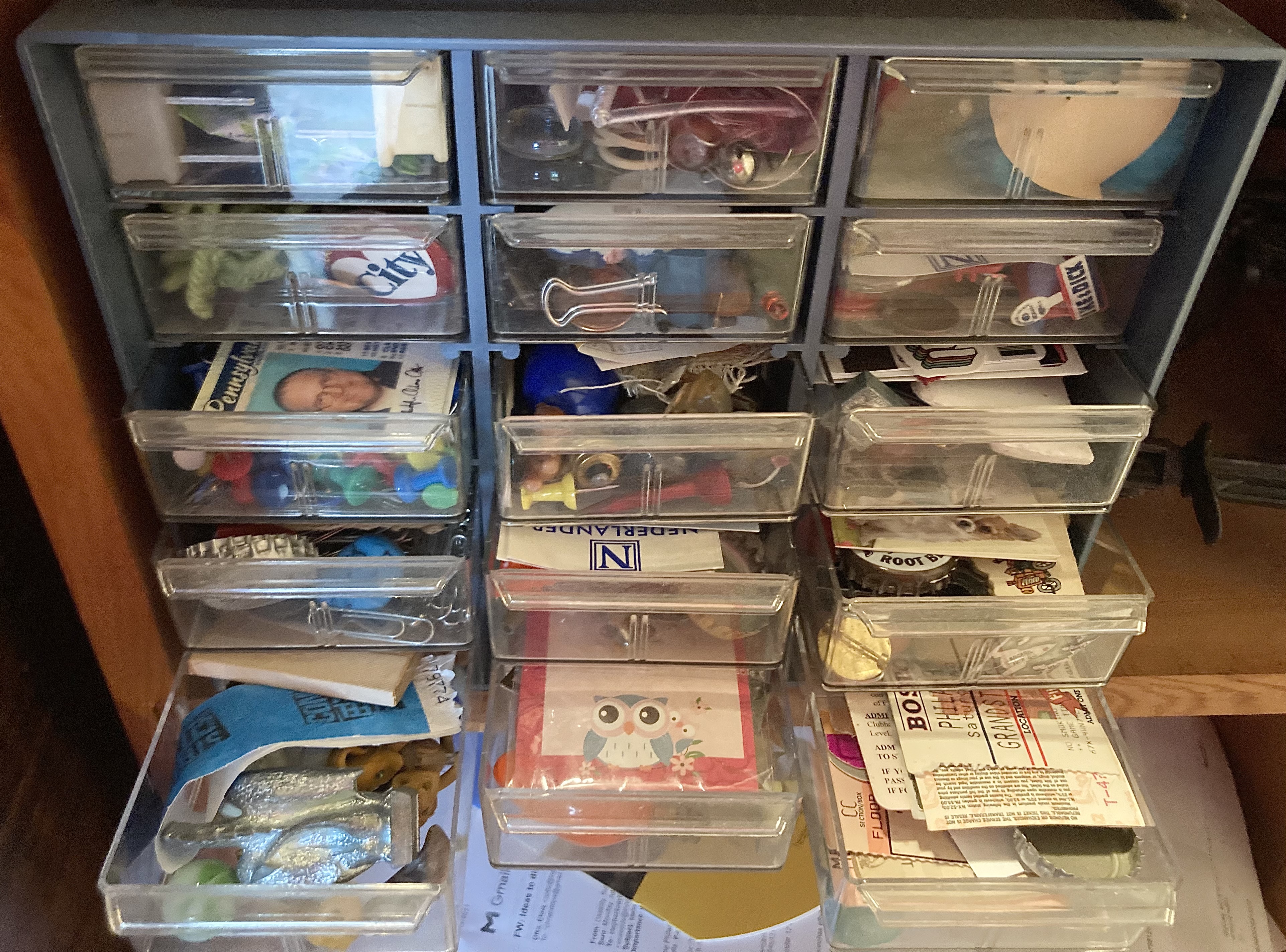
Note: The photo at the top of this post is my little plastic chest of drawers. It started, years ago, as the home of my office supplies at my work desk at the York Daily Record. Over the years, I've filled it with all sorts of little treasures, baubles and bits of ephemera. And I've forgotten half of what I've put in there. At 9 inches wide by 7 inches tall, with 15 drawers, it doesn't take up much space. And there's still a little bit of room inside, amazingly, for some small things to be tucked inside in future years.

Saturday, August 6, 2022

Saturday's postcard: Dinosaurs and a doggy overlooking South Dakota

This undated (but probably 1950s or earlier) postcard shows a pair of dinosaurs and a dog (for scale) overlooking Rapid City, South Dakota. It's a "Natural Color Post Card" made by E.C. Kropp Co. of Milwaukee, and it was published by Johnston & Bordewyk of Rapid City.

I've featured a bunch of E.C. Kropp postcards on Papergreat over the years; you can use the search bar to track down the other ones. In 2015, I quoted some historical information about Kropp from metropostcard.com page that is no longer on the internet. So much for the knowledge being housed in perpetuity here. Here's that history again:
The company "began producing chromolithographic souvenir cards and private mailing cards in 1898 under the name Kropp. These cards were of much higher quality than those that would printed under the E.C. Kropp name. They became the E.C. Kropp Company in 1907 and produced large numbers of national view-cards and other subjects."
Dinosaur Park, which was dedicated in 1936, is one of the oldest dinosaur-themed attractions in the United States, and it's still around. According to Wikipedia, it was "created to capitalize on the tourists coming to the Black Hills to see Mount Rushmore" and constructed jointly by Rapid City and the Works Progress Administration (project #960). 

In a paper titled, "Works Progress Administration Projects in Rapid City, South Dakota," Kathy Bunkowske writes that "R.L. Bronson, secretary of the Rapid City Chamber of Commerce, first propositioned the idea of a Dinosaur Park to federal agencies after visiting the Chicago Century of Progress Exposition and viewed a mechanically operated reproduction of a brontosaurus. The government approved the five prehistoric sculptures, Triceratops, Triconodon, Brontosaurus, Stegosaurus, and Tyrannosaurus Rex, allowing WPA Project 960 to begin excavation work in March, 1936."

Emmet Sullivan was the designer and superintendent of construction, and Bunkowske notes that "the project suffered a serious setback when Sullivan resigned as project foreman and left with the teeth belonging to the Tyrannosaurs Rex."

Two more dinosaurs were later added to the original five. Wikipedia notes that the statues were originally gray, but "but by the 1950s the statues were painted bright green with white undersides."

RoadsideAmerica.com notes that Dinosaur Park is "probably the only dino park that encourages kids to climb on all its displays. This may also explain the rounded and worn edges." 

It should also be noted that the park, as you can perhaps tell from his postcard, sits atop a hill that can only be reached via a steep set of stairs, creating accessibility issues. Those have persisted for decades. But it was reported this past February that bids were being sought on a project that would bolster inclusiveness for those who wish to visit this historic attraction.

Thursday, August 4, 2022

Scholastic book: "27 Cats Next Door" (aka I feel seen)

When I was scanning my shelves looking for something to write about it, this one jumped out at me. Gee, I wonder why. When I originally placed this book on the shelf, we only had four cats. Now there are 17 cats in the house and three additional outdoor cats that we take care of. (Indeed, I had to pause while writing this to feed Big Boi.) We are frighteningly close to being the "next door people" in the title of this book.  
  • Title: 27 Cats Next Door
  • Author: Anita Feagles. Her name is misspelled as Anita Fleagles on the cover. Her full name is Anita Marie MacRae Feagles, and her other books included Casey: The Utterly Impossible Horse; The Tooth Fairy; He Who Saw Everything: The Epic of Gilgamesh; Queen Sara and the Messy Fairies; The Year the Dreams Came Back; and The Monster, Mr. Nelson.
  • Illustrator: Barron Storey. Interestingly, his name is misspelled too, being listed as Baron Storey on the title page. Storey mentions 27 Cats Next Door briefly in this 2014 interview with Aaron Silverberg about his career and artistic style.
  • Publisher: Scholastic Book Services (TW 881)
  • Year: 1966
  • Pages: 64
  • Format: Paperback
  • Chapter titles: Too Many Cats Next Door; A Cat Named Philip Rogers; And Twenty-Six Others, More or Less; The Cat That Tripped Mrs. Bolton; A Petition Against Cats; A Secret Plan; How It Feels to Be Without Friends; Still Too Many Cats; A Home for a Kitten.
  • First sentence: "Moving to a new town wasn't nearly as bad a Jim had expected."
  • Last sentence: "And he was right."

This isn't really a happy book. It's mostly sad. The teenager, Jim, discovers that his neighbor, Mrs. Ames, is essentially a cat hoarder. And that's not really a socially acceptable thing, then or now. Most people consider it weird, at best, and a public health nuisance, at worst. Mrs. Ames doesn't have any friends or help with her collection of cats and, while Jim admirably tries to assist her, he's quickly in over his head, too. They two of them can only try their best.

They don't even have the resources that might be available today to keep a stray cat colony from spiraling further out of control. Trap–neuter–return (TNR) programs weren't widespread in the United States at that point. Euthanasia at the SPCA was the only practical solution, and neither Mrs. Ames nor Jim want to see that happen.

Here's a passage from early in the book:
Jim wished he could tell Mrs. Ames that if she had fewer cats, people wouldn't say mean things about her. He said, "Maybe it would be better if you didn't have so many. If you gave them all away except for, say, three, maybe it would ... well, maybe it would be better." 

Mrs. Ames gave him a funny look. "People have been telling me that for years. But nobody will take care of them if I don't. Of course everyone thinks I'm very strange because I don't like to see animals die. I probably am."
A few pages later, Jim and his less-than-understanding father have this conversation:
"How do they kill them?" Jim asked.

"They put them in a gas chamber. They feel no pain at all. There are too many cats in the world, Jim, and some people turn them loose to starve to death. Some people drown them. Is that kinder than putting them in a gas chamber?"

"In school we're learning that pretty soon there will be too many people in the world," Jim said. "Are we going to put them in a gas chamber too?"

"Oh, come now," his father said. "People are more important than cats."

"Not to Mrs. Ames," Jim said.
In her 2008 mini-review of 27 Cats Next Door on GoodreadsKrista the Krazy Kataloguer sums up the book's big issue succinctly: "Sometimes there are no easy solutions to problems!"

That's true. But I'm fully on Team Mr. Ames. In 2022, we seem to be surrounded by overwhelming problems that no one person or family can possibly tackle: global warming, war and genocide, gun violence, gaslighting of the public to undermine any number of truths. If, to counter all this stress, we choose to put some of our finite energy and compassion toward helping cats, or any other animals, I think that's a noble use of our time here on Earth.

Tuesday, August 2, 2022

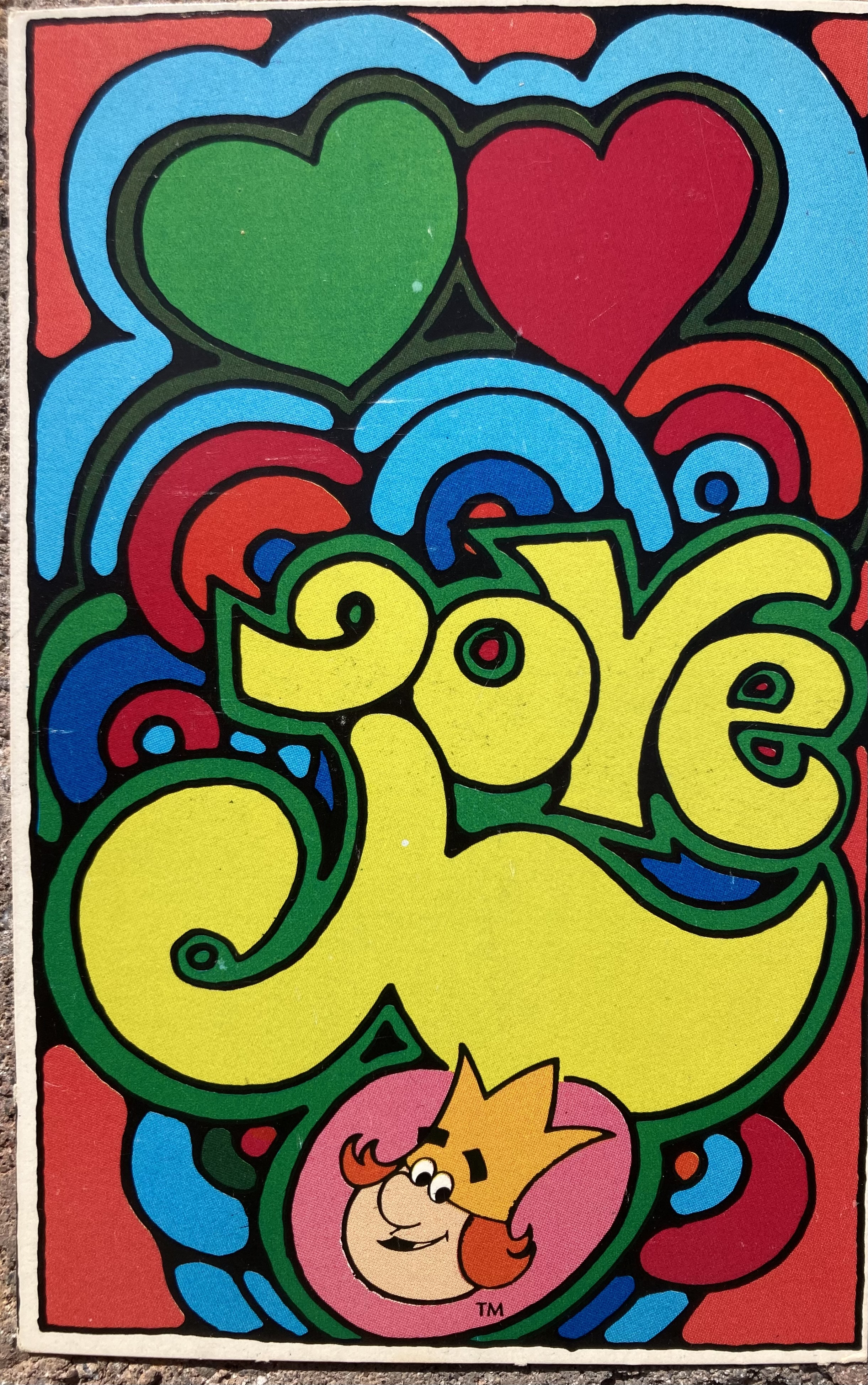
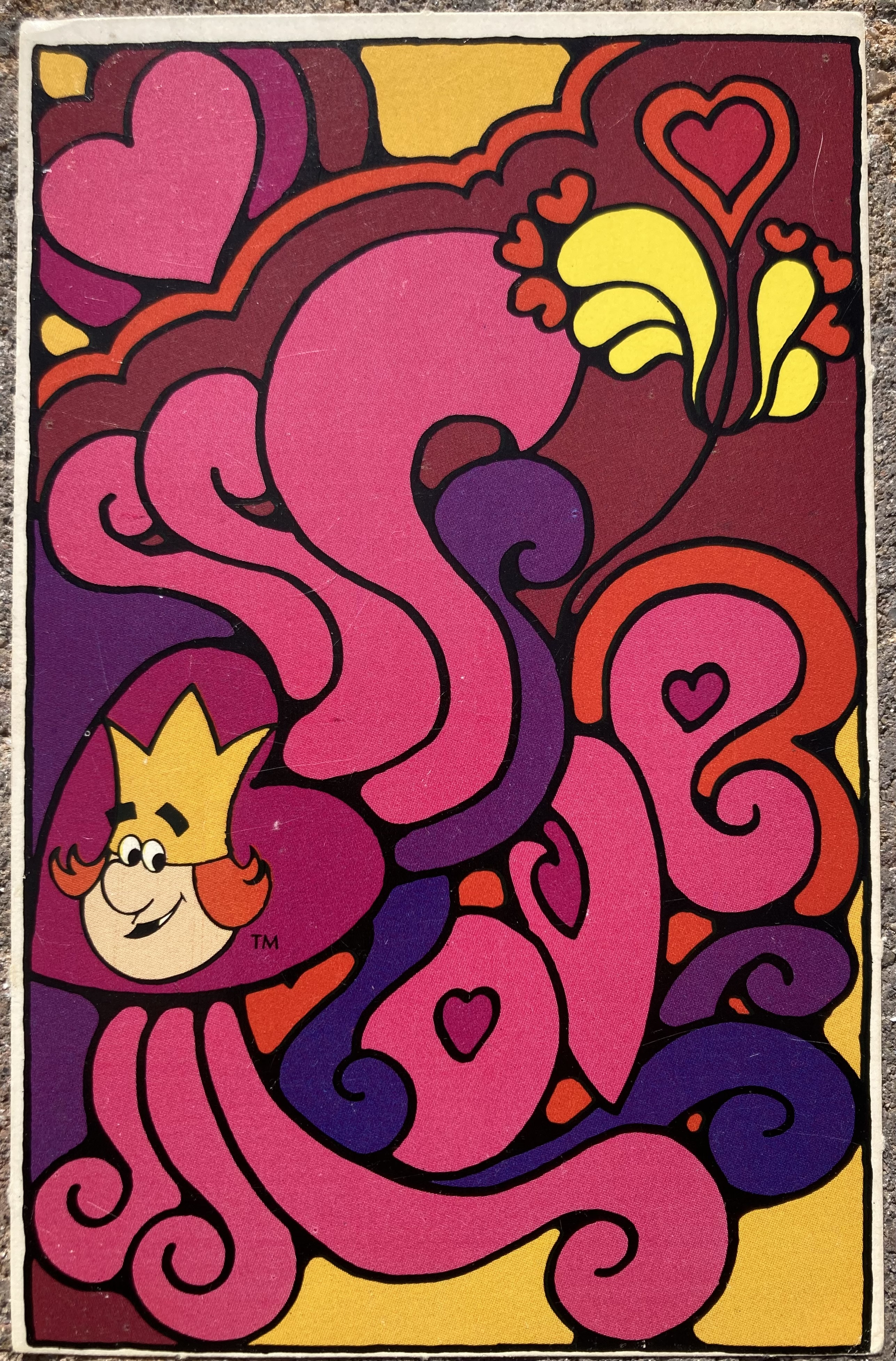
Burger King's 1972 "Love" postcards

These psychedelic "love" postcards were given away to kids at Burger King restaurants in 1972. I believe there were a total of six designs, and the cards came in perforated sets. Beyond the winning idea that the postcards touted the important concept of love to Burger King's young customers, I greatly appreciate that postcards themselves — ephemera! — were considered a good giveaway item, rather than the pointless plastic toys that became ubiquitous in the 1980s and 1990s.

It's possible that this postcard giveaway was tied to Valentine's Day, which in my mind doesn't make it any less worthy of applause. There's actually not much information available online about the history of this giveaway item. Maybe I'm overthinking this teeny-tiny corner of fast-food history, but I'd like to know more. Whose idea was this? Who designed the cards? How many were printed? How were they received by the general public? Did anyone actually mail these? (Most of the postcards that survive a half-century later are blank.)

I did come across an interesting read about McDonald's mail-advertisement postcards by Hal Ottaway on PostcardHistory.net. But the history of these colorful Burger King love postcards seems to remain sadly unwritten. If you remember getting, sending or receiving any of these, please let us know in the comments!

Let me end by saying that these postcards clearly fit thematically within our household.

Sunday, July 31, 2022

Colorful covers and endpapers of 1926's "Granny Goose"

Today's images are from my rough copy of 1926's Granny Goose, which was written and illustrated by John Rae (1882-1963) and published by P.F. Volland Company. (I previously featured Volland's trippy The Paper Dragon in 2019.)

This is Volland's statement on its "ideal" from the last page of the book:
"It is the Volland Ideal to give children only the best. Books for children should contain nothing to cause fright, suggest fear, glorify mischief, excuse malice or condone cruelty. That is why Volland books are called 'Books Good for Children.' Teachers, instructors, psychologists and parents endorse and recommend Volland Books as the most wholesome and inspiring juvenile literature — stories and verse that inspire; pictures that glow with beauty. Volland Books are graded; each contains a card telling for what age it is planned."
P.F. Volland was in business from 1909 to 1959 and was known for collaborating with dozens of outstanding artists/illustrators. Rae's work certainly falls into that category with this slim hardcover book, which measures 9¼ inches by 11¾ inches. As a minor aside, the cover calls the book Granny Goose and the title page calls it Granny Goose! with an exclamation point.

Here's a look at the endpapers, which don't scrimp on the geese.
The verses featured in the book (which is more than 50% illustrations) include mentions of King Kittery Kottle, Saint Wittery Wattle, Benjamin Bottle, Dobbeley Hobbeley Cobbeley Cory, Billy Bragg, Ned Willings, Burberry Biddle, Kirley McHugh, Tibby Tuppets, Molly Mopperty, Billings Bridge, John O'Groat, Tumbletown, Whipsy-ma-diddle, Old Johnny Bumble Buckely-Knees and Betty Battle. Some of those names/phrases are familiar, but others seem to have sprung from John Rae's wonderful imagination. There are also many good band names in the above list.

Here's a look at a couple of the interior illustrations.
The scarecrow is actually a bit on the creepy side, as is the verse that accompanies the illustration. It involves a scarecrow strolling into town, the snow turning black, bright-red hail falling from the sky and the awakening of a withery witch who comes running with a slashing switch. How, exactly, does this fit in with Volland's pledge that "books for children should contain nothing to cause fright (or) suggest fear"?

Friday, July 29, 2022

York Safe and Lock Company's April 1944 in-house magazine

For decades, York Safe and Lock Company, located in York, Pennsylvania, made perhaps the sturdiest safes in America. And they are still sought-after in the 21st century. As my former boss, Jim McClure, noted on the York Town Square blog in 2012, "York Safe & Lock safes and vaults are everywhere around the world. They simply don't wear out."

During World War II, York Safe and Lock was among the many companies that modified their production facilities to help the war effort. It even expanded to multiple plants around York County in order to provide ordnance and other necessities for the Army and Navy.

But also during the war, in April 1942, company president S. Forry Laucks died. That was perhaps the beginning of the end for the company, as Stephen H. Smith explained on the blog YorksPast in 2012: "In 1944, the Levine Brothers, of Leominster, Massachusetts, sensed an opportunity, systematically began buying out York Safe & Lock Company stockholders at large prices; by year’s end they owned the company.  While this was going on, the Navy Department in essence took over the York Safe & Lock Company because of the essential war materials being produced."1

After World War II, Harry Levine was named president and subsequently changed the name of the company to York Industries, Inc. Smith added: "In conjunction with the name change on January 3rd 1946, Levine sold the entire pre-war product line of safes, vaults and vault equipment; including trade names, patents, sales offices and franchised dealer organizations. This sale was to Diebold, Incorporated, they had been the second biggest manufacturer of safes and bank vaults in the country prior to the war."

And thus marked the end of York Safe and Lock.

During the war, it had this in-house company magazine, The Safe Combination. The first issue was in July 1943 and features Laucks, in memoriam, on the cover. I came across a handful of the magazines more than a decade ago and today I want to share just a few items from inside issue No. 10, from April 1944.

D.W. Wardrop was the editor of the magazine at that point, with Thomas Robison and S.T. Edwards serving as associate editors. Nineteen individuals from across the various York Safe and Lock plants are listed as "reporters." This issue's cover photo was taken by J.R. Miller of Dept. 458, Special Ordnance Plant.

Most of the news, of course, is related to the company's World War II efforts. There are updates on employees and their relatives who were serving in the military. There are also wartime items on gardening, gasoline conservation and the like. Finally, there's the social news you might expect to find in any company newsletter: banquets, sports leagues, etc.

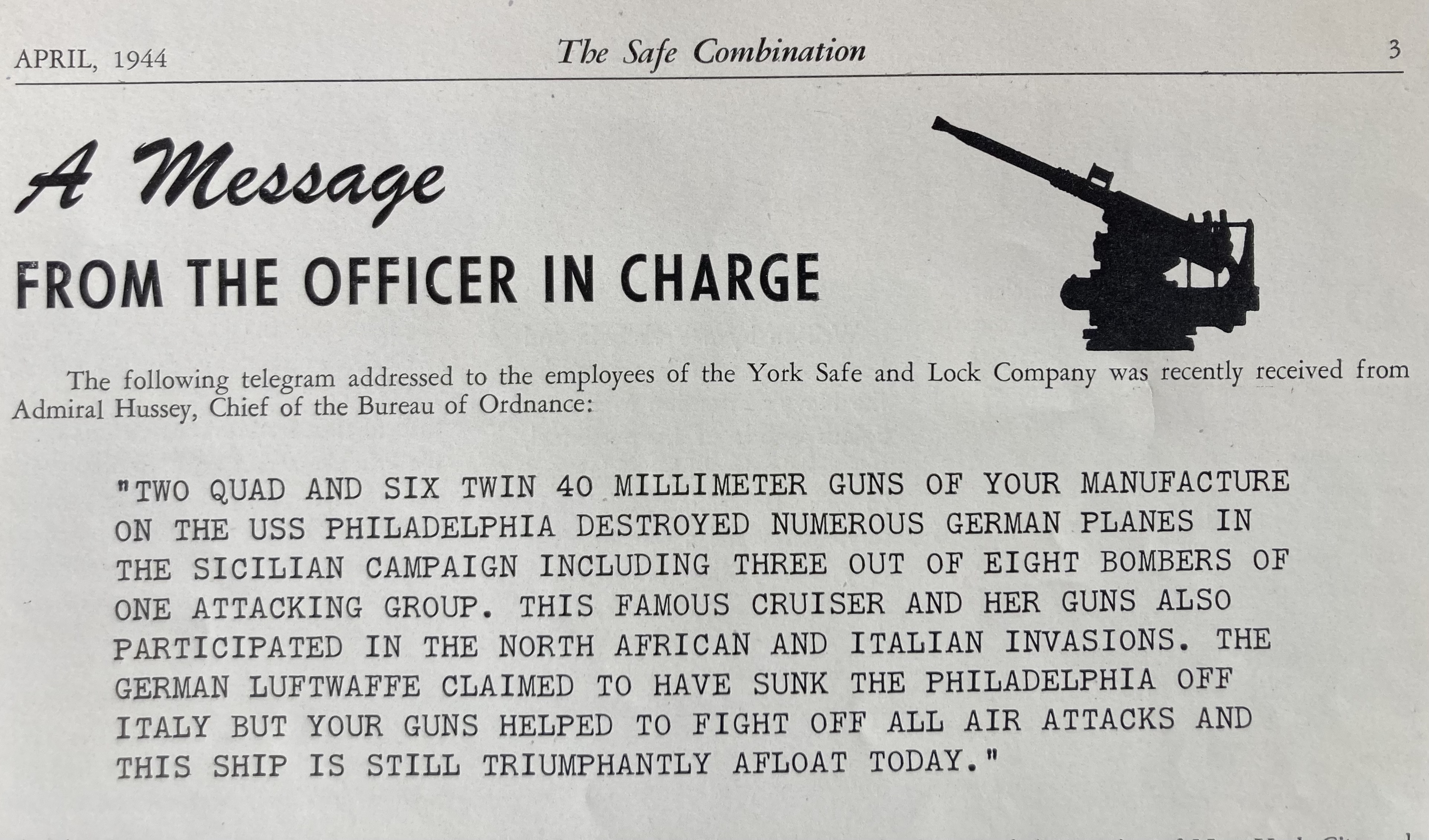
The issue leads with this telegram about the USS Philadelphia on Page 3:
The center pages of the issue are dedicated to those service members and Merchant Mariners who had been killed in action on various fronts of the war, including this notice for Martin D. Irvin.
There are also letters from service members telling their tales from the front and/or expressing their gratitude for issues of The Safe Combination received in the mail. This one is from Pvt. Vernon F. Shepp. (Shepp survived the war. He died in York at age 69 in 1988.)
Here are some additional snippets of the magazine's interior, including a profile of Fritz Ahlfeld, a member of the company's management.
Footnote
1. Smith's in-depth and fascinating post also explains the role that Capone-buster Eliot Ness played in York Safe and Lock's demise.

Wednesday, July 27, 2022

Peering inside and preserving 1962's "Dragons, Fairies and Fun"

For a book published in 1962, Dragons, Fairies and Fun by Dora Broome seems to be fairly obscure. It was published by Cultural Publications Ltd. of Nottingham, England, and it's a small-size, 152-page hardcover, measuring 5 inches by 7.5 inches. As of this writing, I can't find any other copies for sale online, and there are no reviews or websites that discuss it, to my knowledge. Perhaps documenting it here will help in a minor way to preserve it for history, lest it fade away completely. And if anyone in the United Kingdom has memories of this book, I'd love to hear them in the comments section. 
There are some signs of provenance inside the book. Pictured above is the plate that's been affixed to the inside front cover. Written in Welsh, it explains that the book is part of the Ceredigion school library and provides details on how students can check out the book, in similar fashion to the way we do so in the United States.

The message is signed by Alun R. Edwards (1920-1986), who was a longtime librarian in Wales. In fact, he's been remembered at a ceremony next month (August 2, 2022). The Ceredigion County Council website notes that Edwards "was first appointed librarian for Cardiganshire in January 1950. Over the next quarter century, he revolutionised Ceredigion's library services and indeed the book industry in Wales as a whole. Among his visions that were realised were the expansion of travelling library services, the College of Librarianship in Aberystwyth, the counties’ book purchasing scheme, the Welsh Book Council and the establishment of reading and discussion groups. Following the re-organisation of local government, he was appointed Librarian of Dyfed in 1950. He worked as the County Librarian for 30 years until he retired in 1980."
On the next page is a faded purple stamp indicating that the book has been withdrawn from circulation at Myfrgall Dyfed Library [?] and is available to buy for 10c. And on the page after that, pictured below, a child long ago indicated their clear ownership of the book. (I believe we all did this at times during our childhoods.)
Here's a rundown of the book's stories from the Contents page:
  • Hezekiah's Dragon
  • The Knight of the Dustbin
  • Hey Diddle Diddle
  • Will o' the Wisp
  • Aunt Quenelda and the Magic Mirror
  • The Magic Carpet
  • Little Bess
  • The Story of Odd
  • The Sugar Plum Fairy
  • Buffy
  • The Chimney-Sweep and the Mayor's Procession
  • The Cuckoo that went on Strike
  • The Fish Maid
  • Goodfellow
  • The Travelling Glow-worm
  • Mrs Goblin's Christmas Shopping
The illustrator is listed as B. Gerry, and I can't find any solid information on them, given that little information. For that matter, I can't find much about the life of author Dora Broome, either. She wrote 1951's Fairy Tales from the Isle of Man and 1970's More Fairy Tales from the Isle of Man, and her other titles include The Magic Journey, The Lifeboat Fish, Matilda the Radio Mouse, Lancashire Tales, Mary-Jo's Elephant, Royal Peke, Circus Pony, Ship's Monkey and Fairground Billy. With her mixture of interest in both fairy tales and the circus, she seems to have much in common with Ruth Manning-Sanders!
Gerry's cover illustration of the dragon is probably the best of the lot. There's little that's fantastical about most of the other illustrations, beyond perhaps this one.
And that's pretty much it. Again, I'm sure there are some folks out there with memories of this book. It would be great to hear from you and to share your thoughts for posterity. 

Monday, July 25, 2022

1911's "The Isle of Wight," its provenance and Joseph Sadony

Today we're taking a look at The Isle of Wight — "pictured by Ernest Haslehust" (E.W. Haslehust on the title page) and "described by Edward Thomas." It's interesting that illustrator Haslehust gets a higher credit on the cover than poet/author Thomas, who was killed in action in World War I in 1917.

There's no date of publication printed inside the book. According to WorldCat, which keeps a database of institutional library collections, it was published in 1911. Other online listings state 1915, 1915[?] and "circa 1920." There's a lot of sloppiness and misinformation on the internet, of course. I think we should go with WorldCat. Additionally, a previous bookseller has written "1911 1st ED" on one of the first pages of this copy.
 
The 64-page hardcover book was published by Blackie and Son Limited of London, Glasgow and Bombay. Wikipedia tells us that this publishing house was in business from 1809 to 1991. Some of the series it published over the decades include Beautiful England, Beautiful Ireland, Beautiful Scotland and Beautiful Switzerland. The Isle of Wight is part of the Beautiful England series, which was originally published from about 1910 through the 1925, but apparently saw reprints through the 1950s. According to Wikipedia, Haslehust was the illustrator for the approximately three dozen volumes.
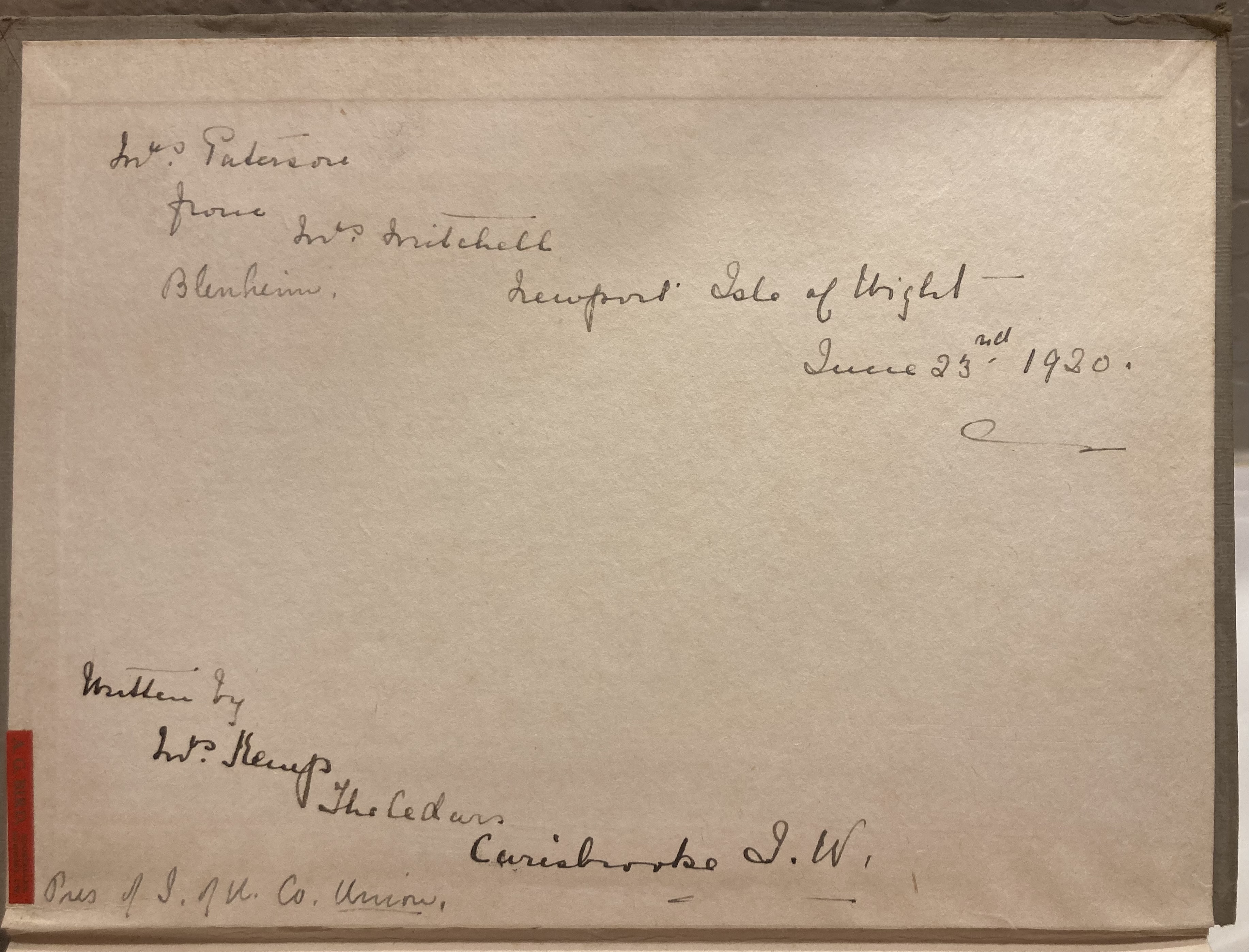
Moving to the inside front cover, there are some inscriptions of provenance:
I'm not sure what/which Blenheim is referred to in the first inscription. That's the name of at least two places in the United Kingdom. Newport and Carisbrooke are located on the Isle of Wight, a 148-square-mile island off the southern coast of England.

At first I thought The Cedars might be a neighborhood within Carisbrooke. There's no mention of it as such in Wightpedia (the wiki of Wight history) or elsewhere that I can find. But The Cedars is the name of a cozy pub on the Isle of Wight that looks like it could easily date back more than 100 years and could have also served as a residence. A 1903 church directory lists a Mr. A. Kemp at The Cedars in Carisbrooke, for what that's worth.

Then we have the bookseller's label for A.G. Bird, Bookseller, Newport, I.W. I found an obituary for Archibald Gaydon Bird that was published by Isle of Wight County Press on October 10, 1959. It states, "Mr. Bird was a native of Barnstable, where his father was a wine and spirit merchant. He spent some time in business at Croydon before coming to the Island, and in 1908 he purchased the old-established business of bookseller and stationer hitherto carried on by the Gubbins family at premises in High Street, Newport. The business has since become well known all over the Island under the style of A. G. Bird, and has now been carried on unbrokenly for well over a century."
Also in terms of provenance, there's an embossed stamp from a previous owner on the title page. It states "JOSEPH A. SADONY" and "PRIVATE." I have on my shelves another book with his stamp, Swedish Life in Town and Country (1904). Assuming I have the correct Joseph A. Sadony, he lived from 1877 to 1960 and was quite an intriguing figure. Buckle up.

First up, the Michigan estate he lived at was called The Mouth. The website SelfDefinition.org features Sadony's 1960 obituary from the Muskegon Chronicle. An excerpt:
Joseph A. Sadony, enigmatic sage of the Valley of the Pines in White River Township, died Friday evening at Hackleys Hospital, Muskegon. He was 83 years old.

"One of the best known and least understood men in Michigan," that was the opening statement of an article on Mr. Sadony in the Muskegon Chronicle on his 83rd birthday anniversary last Feb 22.

Mr. Sadony, in his cloistered life on his estate at The Mouth, devoted his years to the study and development of his theories as to the physical sciences, his theories as to the working of the human mind, and his theories as to the spiritual side of man. The insatiable curiosity of his unusual mind ran the gamut of all facets of human existence.

It was in the realm of mental phenomena that Mr. Sadony aroused the greatest curiosity and interest as to his theories. He was considered one of the world's foremost authorities on the subject of mental phenomena. It was this phase of his work which sometimes led to a misconception of the man. Mr. Sadony contended his theories of mental phenomena were based on sound psychological grounds, that there was nothing of the "clairvoyant" or "supernatural" about his mental capacities.
Sadony was the author of several books. Perhaps the most notable was his 1948 autobiography, Gates of the Mind. A review of the book at the website SearchWithin.org offers this conclusion: "What was Sadony's overall purpose for writing Gates of the Mind? He wanted to 'rescue the truth,' as he puts it, by exposing the charlatans and psychic racketeers who deceive us with tricks. He diligently demystified clairvoyance, extrasensory perception, precognition, telepathy, etc. by explaining and illustrating such phenomena in ordinary terms, and through personal examples in his life. Most of all, he wanted to show that inspiration and feeling compose the core of our heart, without which humanity would be but uninspired automatons with no purpose."

Meanwhile, there's also part of the estate called Mouth Cemetery. Jennifer Jones writes on The Dead History website that the ruins of Sadony's laboratory are visible from the cemetery. (Now this is sounding like a James Whale film.) Jones' post gets into all kinds of weirdness that goes beyond what I've already presented here, and is a fun read.

This is really only the tip of the iceberg on Sadony, who's a bit of a cult figure in certain circles. There's a website called The Valley of the Pines, The Official Joseph A. Sadony Website! (The exclamation point is theirs, not mine.) It's the official website of Sadony's estate, which is said to include "thousands upon thousands of pages of letters, books, photographs, scrap books, articles [and] journals." But it's not clear that anything new has been posted to the website in over a half-decade. There are some interesting photos, past and present, of the shops, barns, chapel, laboratory, cabins and more that are part of the estate. I'm not sure when the 30,000+ volumes from his library began trickling into the public sphere for sale as used books, but it's kind of neat that two of them have found their way to my shelves. 

Well, we've veered all the way from picturesque, century-old views of the Isle of Wight to cemeteries and psychics in Michigan, but that's what can happen when you investigate an old book's provenance. Let's finish by returning to one of Ernest Haslehust's bucolic illustrations.