Tuesday, February 14, 2023

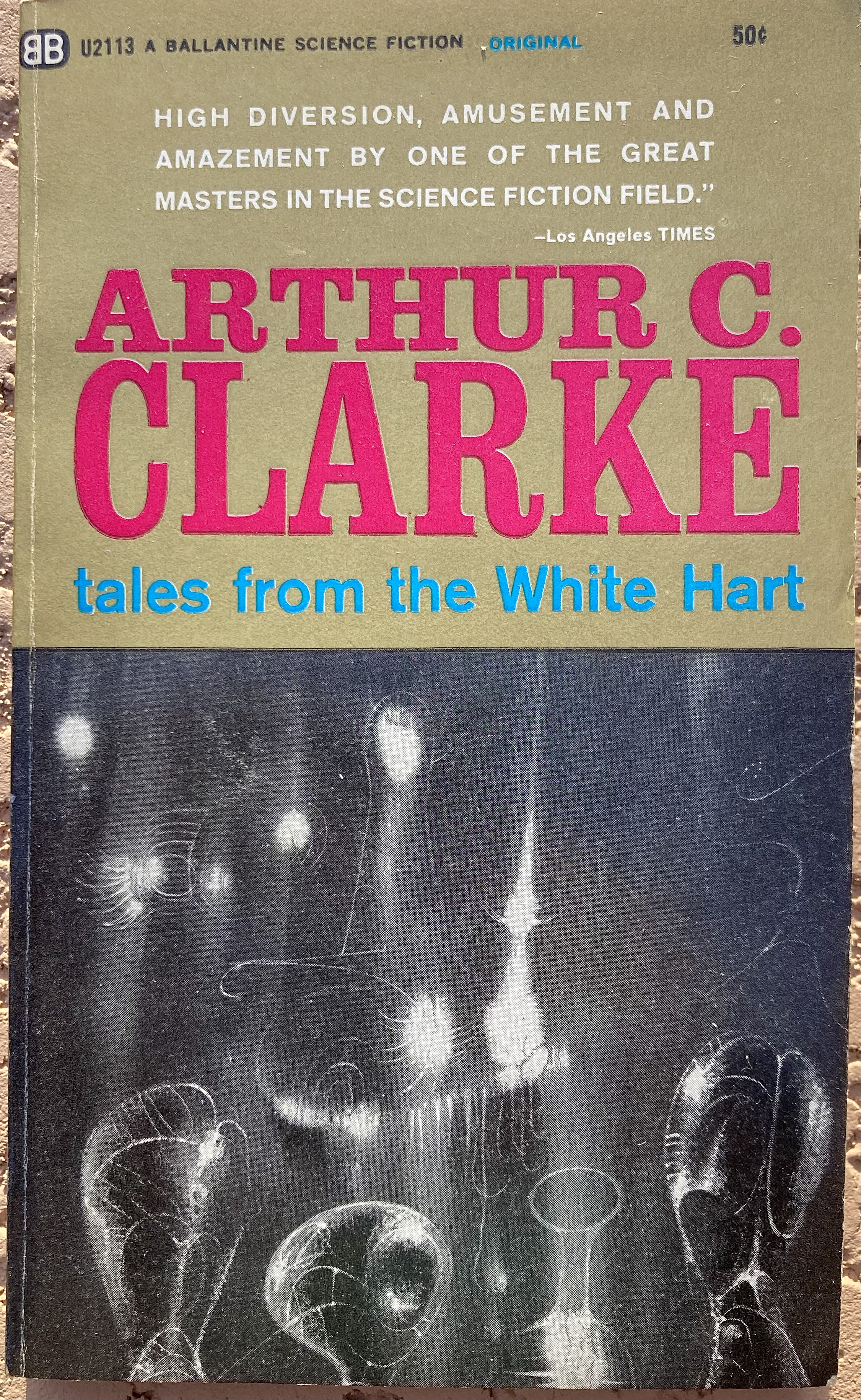
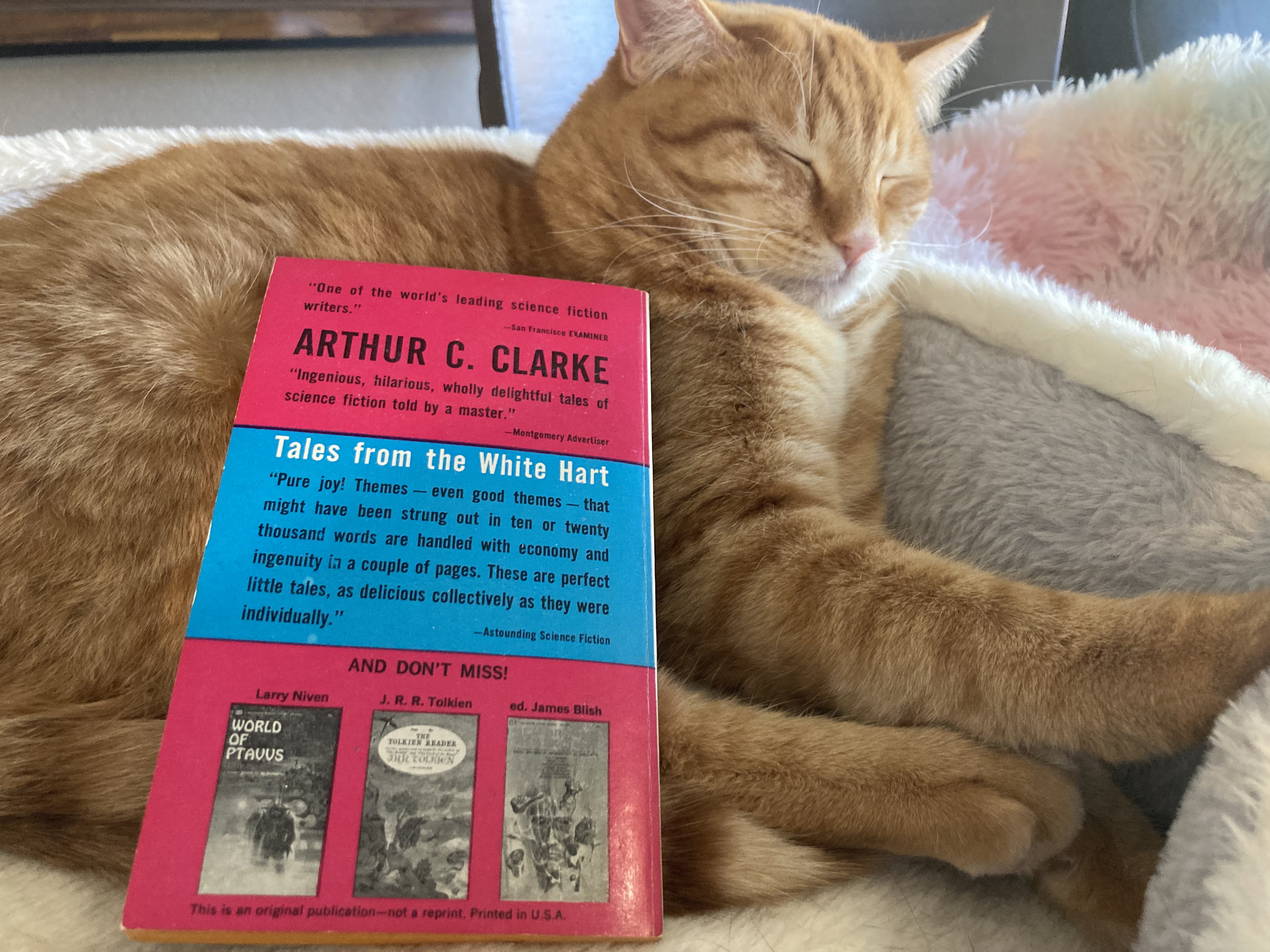
Paperback cover: "Tales from the White Hart"

  • Title: Tales from the White Hart
  • Author: Arthur C. Clarke (1917-2008)
  • Cover artist: Richard M. Powers (1921-1996), according to Internet Speculative Fiction Database
  • Original publication date: 1957
  • Publication date of this edition: Third printing, November 1966
  • Publisher: Ballantine Books (U2113)
  • Cover price: 50 cents
  • Pages: 151
  • Dedication: To Lew and his Thursday night customers
  • About: This is a collection of short stories by Clarke with the shared theme of being club tales told by a man named Harry Purvis. For more about club tales and Lord Dunsany's part in the subgenre, see the 2020 post "Stay-at-home shelfie #57."  
  • Table of contents: You can find it on Wikipedia, with hyperlinks to most of the individual tales.
  • First line of preface: "These stories were written in spurts and spasms between 1953 and 1956 at such diverse spots on the globe as New York, Miami, Colombo, London, Sydney, and various other locations whose names now escape me."
  • Colombo? He's talking about the city Sri Lanka. Clarke lived in Sri Lanka from 1956 until his death in 2008. He was an avid diver and wrote books about his underwater explorations.
  • First passage of collection: "You come upon the 'White Hart' quite unexpectedly in one of these anonymous little lanes leading down from Fleet Street to the Embankment. It's no use telling you where it is; very few people who have set out in a determined effort to get there have ever actually arrived."
  • Random sentence from the middle: "It was obvious that the orchid had a highly developed nervous system, and something very nearly approaching intelligence."
  • Goodreads rating: 3.93 stars (out of 5)
  • Goodreads review excerpt: In 2020, Erik wrote: "I read this when really young up at paternal grandmother Lajla's cottage on the southwest shore of Lake Michigan — on the great wicker couch in the living room, to be exact. It was a cool night outside. Clarke's device, setting up his stories in the context of tale tales told in a pub, the whole grownup Englishness of it, enchanted me thoroughly, made me think consciously that 'now, this is a good book!'"
  • Amazon rating: 4.5 stars (out of 5)
  • Amazon review excerpt: In 2011, Paul wrote: "Readers of some of my other reviews know that I am partial to science fictional tavern or club stories. There are basically two ways of relating fantastic events in such settings. The first is to have the events occur in the tavern itself (as in the Gavagan's Bar stories or the Callahan's Crosstime Saloon tales). The second method is to have a "tall tale" spun out by a plausible narrator (as in the Jorkens stories or the Brigadier Ffellowes tales). ... The White Hart stories are funny. I have read them over a dozen times, and I still laugh at them. But you should understand. The humor is not a slapstick American humor. It is a dry British humor. Alec Guinness rather than Jerry Lewis."

Sunday, February 12, 2023

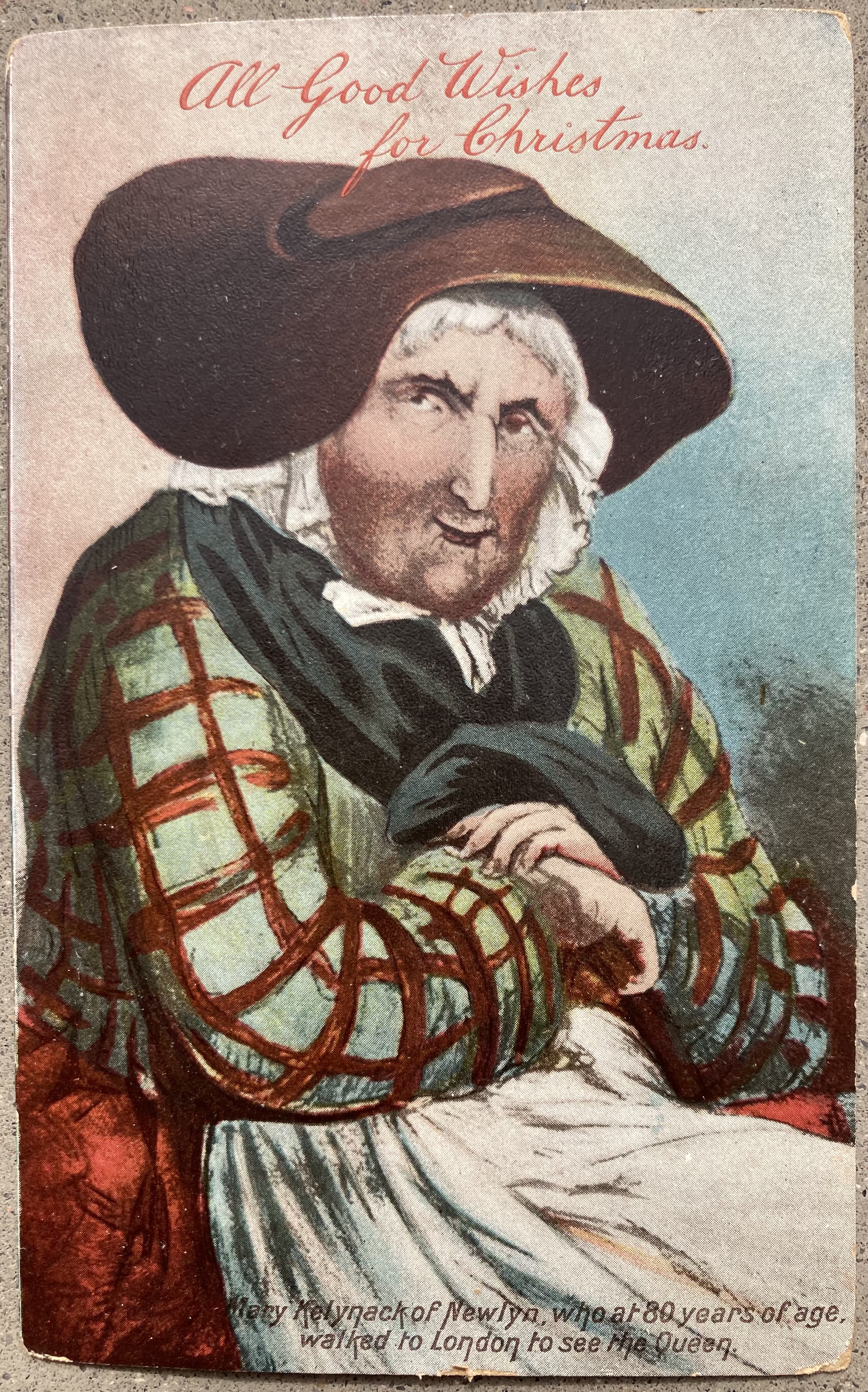
Sunday's postcard: Christmas greetings with Mary Kelynack

This undated, split-back postcard was published by F. Frith & Co. of Reigate, England.1 Across the top, it offers "All Good Wishes for Christmas." Across the bottom, the caption states: "Mary Kelynack of Newlyn, who at 80 years of age, walked to London to see the Queen."

I pulled bits and pieces of Kelynack's story, some conflicting, from several websites. It goes something like this:

Mary Kelynack lived in Newlyn, a seaside town in Cornwall, down in the southwestern tip of England. She had been having trouble receiving a pension to which she believed she was entitled (she was a widow whose husband had served in the navy). So, in the middle of 1851, she decided to walk about 300 miles (350 miles, by some accounts) to Mansion House in London and plead her case. The journey took her about five weeks. She carried a basket and "her dress would have consisted of a large shepherd’s hat of black beaver, a gaily coloured calico jacket, a coarse flannel skirt, an apron and buckled shoes," states an article on Cornwall Yesteryear. That's the traditional outfit of a Cornish fishwife. (In Cornwall, they called themselves fishjousters.)

By various accounts, Mary was either 75, 80 or 84 years old at that time.

One of Mary's other goals in making the arduous journey was to visit the much-ballyhooed Great Exhibition of 1851 held in the Crystal Palace at Hyde Park. Goods and wonders from all across the United Kingdom had been shipped to London for the exhibition, which ran from May through mid-October in 1851. Those in attendance included Charles Darwin, Karl Marx, Charlotte Brontë, Charles Dickens, Lewis Carroll and Alfred Tennyson. 

Mary wanted to see the spectacle. But, for a brief moment, she became the spectacle.

Some newspapers had documented her long journey, so, by the time she arrived in London, she was a minor celebrity. Upon being greeted by the Lord Mayor of London, she said, "I never was in such a place as this. I have come up asking for a small sum of money. I am 84. ... I had a little matter to attend to, as well as to see the Exhibition. I was there yesterday and intend to go again tomorrow."

At some point during her whirlwind time in London, Mary was granted an audience with Queen Victoria and Prince Albert. In her diary, Queen Victoria wrote: “The old Cornishwoman who walked several hundred miles to the Exhibition was at the door to see me, a most pale old woman, who was near to crying at my looking at her.”

Artists made portraits of Mary, and she received a number of gifts amid all the attention. At least one folk song was written about her.

Ultimately, Mary was able to make part of the return trip to Newlyn by train. But, despite her moment of national fame in 1851, her death in 1855 went mostly unmentioned and she was buried in a pauper's grave. She was 86. Or maybe 89. 

* * *

This postcard was never stamped or addressed, but a cursive message, written in pencil, covers the entire back of the card. It states:
My dear Lily,
Glad to hear you liked Washington. We trust you and Mr. Marshall will enjoy good health & be spurrd [?] & see old England again some day. Often think on you and pleasent [sic] hours we use to enjoy together. 

With kind love & best wishes,
Alfie [?], Aunt M. [?]
God be with us till we meet again.
Footnote
1. There's an interesting firsthand account of the final years of Frith & Co., in the late 1960s and 1970, at The Francis Firth Collection. The account concludes: "Sadly, it fell to me to print the very last Frith postcards. The final standard size postcards were cut off the last bulk roll and given an extra wash to better preserve them. They were then hand glazed, but not back printed. I still possess my copy as a memento, together with its machine negative. The other card (cards were printed two abreast) was given to the machine assistant. By the summer of 1970 my short career at F F & Co. was over and I got my P45 once the firm went into liquidation. The building was demolished and houses now cover the site."

Friday, February 10, 2023

Answering questions about my reading history and habits

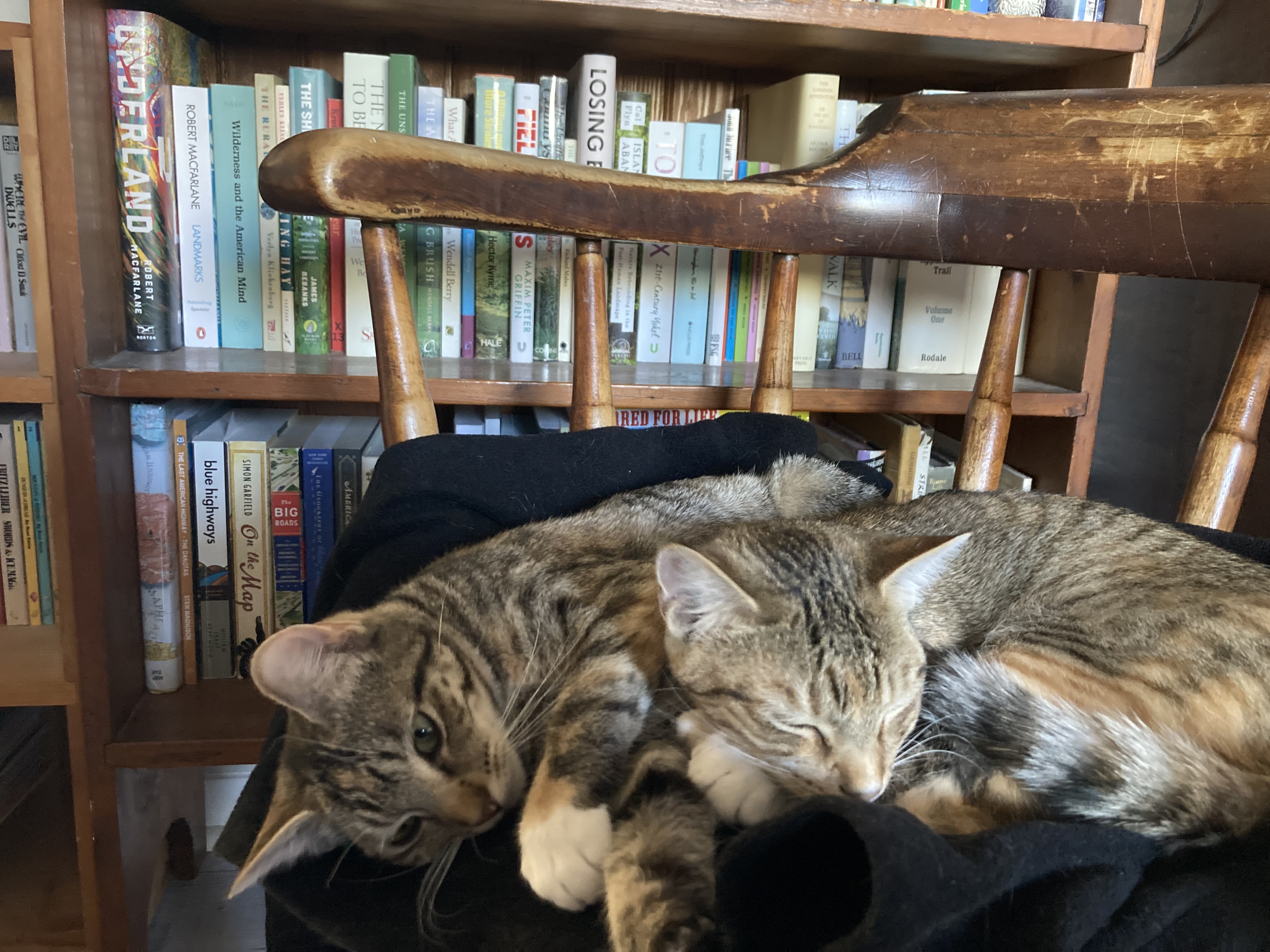
It's a quiet Friday night. Or at least as quiet as it gets in a house with 14 cats. They just had some cheese, and most of them are now resting. It sounds like one of them is trying to eat a chair in the other room, which is the biggest commotion at the moment. To my left, Nebula is a little riled up, but nothing too bad. Spice, Monkey and Titan are asleep to the right of me.

For fun, I gathered some "Questions for book lovers" from various websites and thought I'd just give it a whirl at answering some of them. 

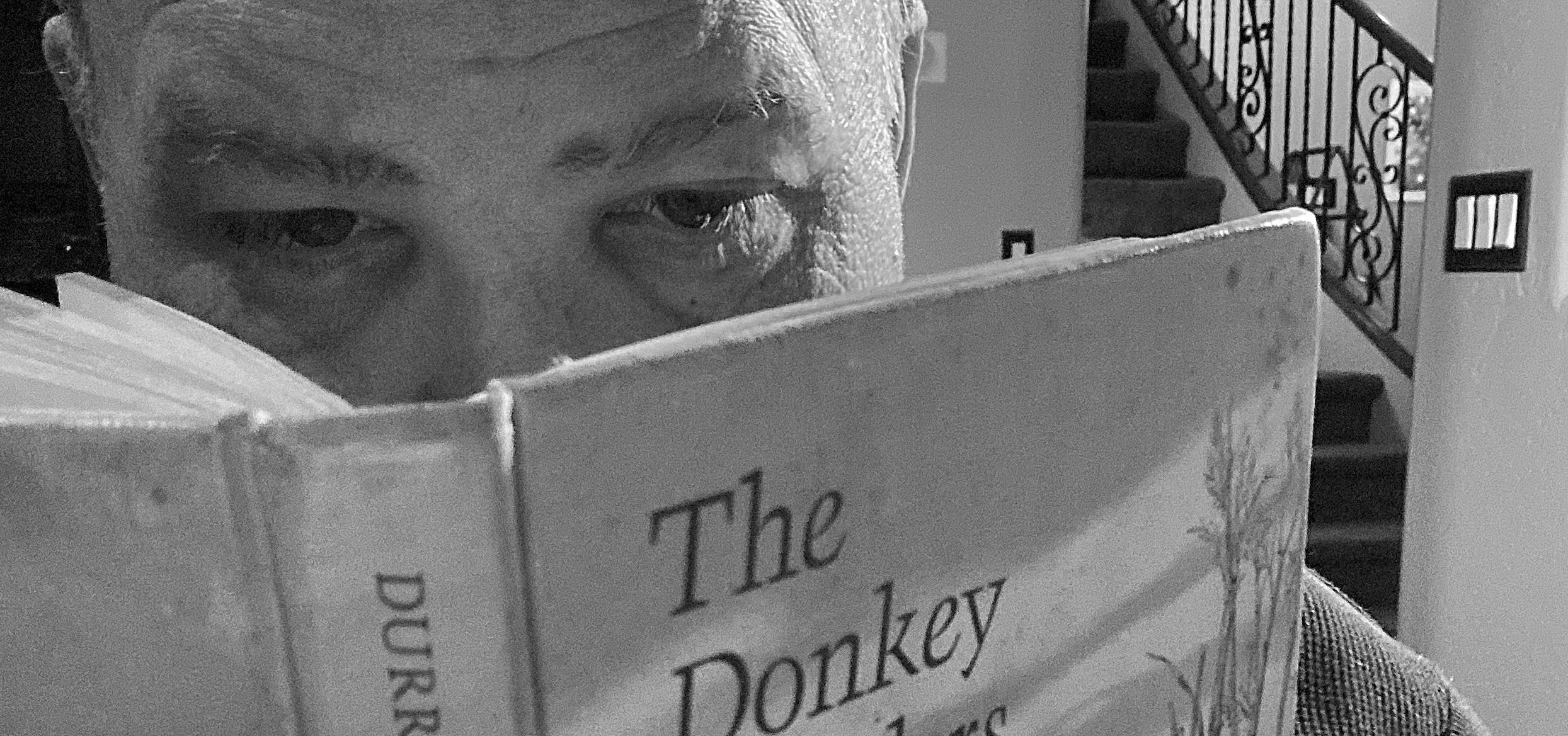
1. What book are you reading right now? The photo above is staged. The actual answer is Maude Adams: Idol of American Theater, 1872-1953, by Armond Fields. I wrote about it on January 31 and am near the end now. 

2. What’s your next read going to be? I have no idea. Choosing the next book is so hard. I often end up staring at the shelves for a long time. Usually, it comes on a whim; whatever genre I'm in the mood for at a particular moment. So we'll just have to see...

3. What’s your favorite childhood book? Longtime followers of this blog know that's an easy one. It would be a Ruth Manning-Sanders book. I'll go with A Book of Wizards, because that's the one that stuck in my memory enough from the early 1980s so that I could track down a used copy in the early 2000s. There were plenty of other favorites from throughout childhood, too, including Dr. Seuss, Beverly Cleary's books (especially the Ramona series), The Three Investigators and the Mrs. Piggle-Wiggle books by Betty MacDonald (which I've yet to really write about).

4. Can you remember what your parents used to read you before bedtime? I'm sure it happened, but I don't have any specific memories from that far back. If Mom were still alive, I'm sure she could answer this question.

5. How many different books do you manage to read at once? I typically have one primary book that I'm reading, and then three or four other books beside my bed that I might pick up depending on my mood and/or if I only have a few minutes to read. One of them is always a browsing book, while there's also usually a collection of ghost stories in the pile.

6. Can you name a book that kept you up at night? When I was a teenager, I could read late into the night, perhaps plowing through a hundred or more pages. Most often, those were Stephen King books. Now, it doesn't matter how great or compelling the book is. If I read for 15 minutes before dozing off, it's an amazing accomplishment.

7. What is the saddest book you read? Most of the literary fiction I read these days is sad and/or downbeat. Two that come to mind from recent years are Signs Preceding the End of the World by Yuri Herrera and Like a Mule Bringing Ice Cream to the Sun by Sarah Ladipo Manyika.

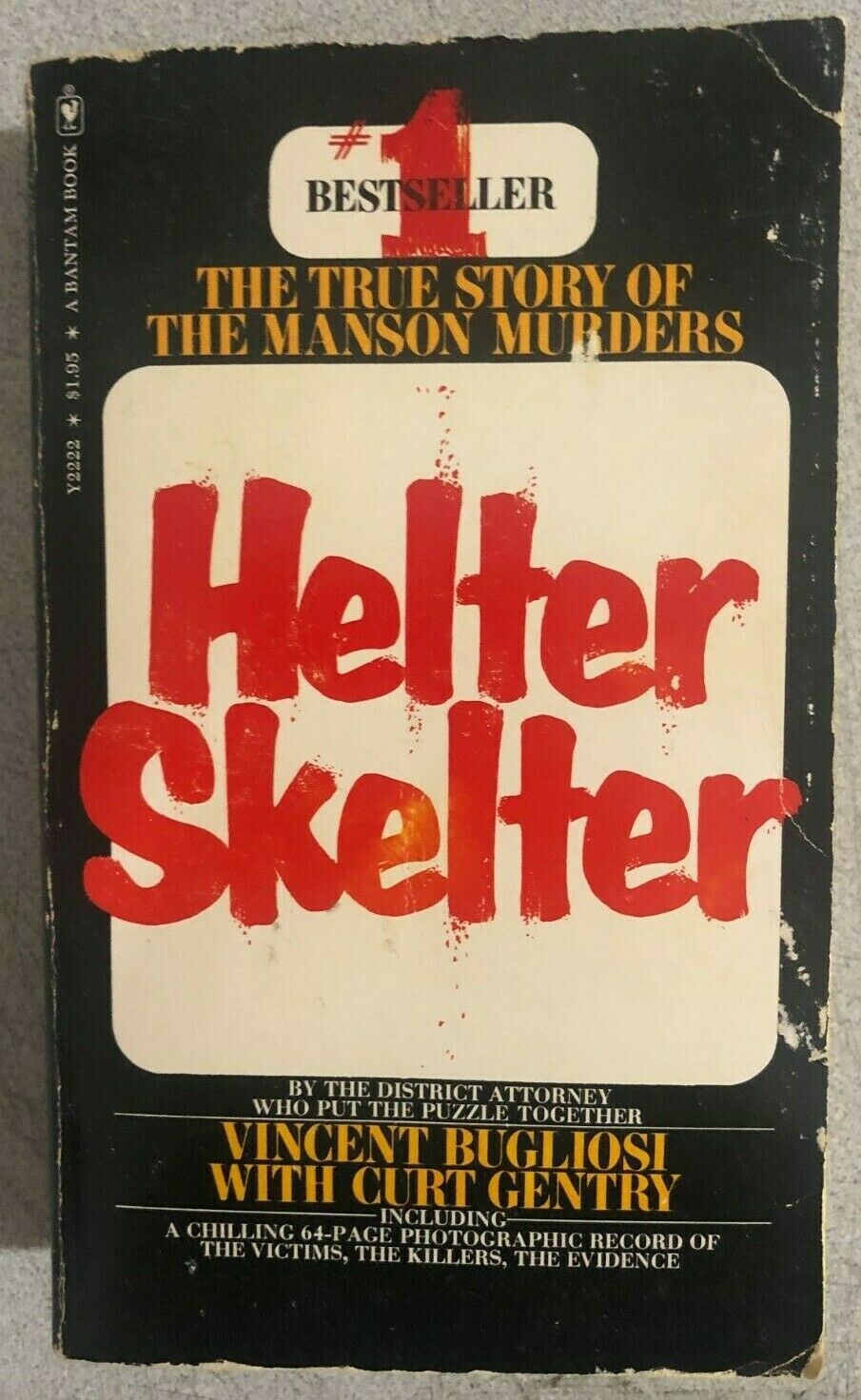
8. Which horror book did you find the scariest? I think the younger you are, the scarier the scary books are. I enjoy ghost stories and horror novels now; I find them entertaining and a nice form of escapism, because it's the real world that turned out to be scary. I'm sure I'm forgetting some that traumatized me as a kid, but a few that stick out are The Amityville Horror by Jay Anson (yes, it's a novel), the "ghost hunter" books by Hans Holzer and Susy Smith and, from Stephen King, probably It and Misery. And, when it came to Generation X getting an early education that the real world was far more terrifying than anything horror writers could muster, there was nothing scarier than the Helter Skelter paperback, with its blood-red lettering on the cover.

9. Do you prefer e-books or physical books? Physical books! I've still never read an e-book.  

10. Do you enjoy audiobooks? They're fine, but I rarely find myself in a situation where listening to them is something I want to do. I've occasionally listened to them on long drives. I know some folks who listen to audiobooks while multi-tasking or doing chores. I don't want to do that. If I'm interested enough in a book, I'll read it. And if I'm listening to an audiobook, I need to give it my full attention. If I'm going to listen to something, I'd rather listen to a podcast, as there are so many good ones out there.

11. Do you read out loud? I sometimes read out loud for my job with the newspaper. When I'm editing copy or going over something that I wrote, reading aloud can help me make sure I didn't miss anything and that it reads smoothly.

12. What are your favorite and least favorite genres? I have many favorite genres! I will read almost any topic when it comes to nonfiction, because I always want to learn something new: history, science, health, computers and technology, sociology, anthropology, architecture, civil rights, weather, film history, books about books, nature, hiking, farming, transportation, food, mythology, gaming — and the list goes on. I also enjoy most kinds of fiction, but will admit that westerns and romances aren't my cup of tea. I've never read much poetry, but I'm trying to make a concerted effort to mix a little of that in.

13. Do you ever annotate books? Occasionally. I've found myself doing this with some books that would fall under the rubric of sociology or personal essays. Two authors, of many, who give me a lot to think about are Rebecca Solnit and Ta-Nehisi Coates. I fill those with highlighting and marginalia.

14. Do you write reviews about the books you read? I generally find myself more interested in reading reviews and analysis by others. I like to seek out perspectives I might have missed, praises and criticisms after finishing a book. I am more likely to review a book if not much else has been written about it. I figure that's when I can best contribute to the vast ocean of knowledge on the internet. For example, I posted my thoughts on Ruth Manning-Sanders' 1938 children's novel Adventure May Be Anywhere on Goodreads.

15. Did you ever buy a book you had already read? Only with a select few books, if I like the design or cover of another edition. I have a few different duplicate books by J.R.R. Tolkien, because the covers are so gorgeous. And I am strangely drawn to the various covers for William Hope Hodgson's The House on the Borderland.

16. Do you want to visit a city or place just because you read about it in a book you loved? Does Hay-on-Wye count for this question? I'd love to go there. I like reading books about bookstores and their history, and I'd love to visit some of the iconic bookstores in the U.S., which is probably more feasible than hopping the Pond to get to Hay-on-Wye.

17. Have you ever met a writer in real life? I have many, many friends, colleagues and classmates who have written and published books. An incomplete list includes: Larry Alexander, Buffy Andrews, Ted Anthony, Mike Argento, Alisa Bowman, Joan Concilio, Dan Connolly, Bridget Doherty, Kimi Eisele, Megan Erickson, Andrew Ervin, Leigh Gallagher, Mike Gross, Jessica Hartshorn, Dennis Hetzel, Tom Joyce, Bill Landauer, Lauri Lebo, Jim Lewin, Caroline Luzzatto, James McClure, Rissa Miller, Isabel Molina-Guzman, Kevin Naff, Dana O'Neil, Gregory Scopino, Leslie Gray Streeter, Beth Vrabel, Michael Weinreb and Laura Wexler. Go check out their works and discover something new to read!

Sunday, February 5, 2023

Weekend things: "The London Nobody Knows" and "Marjoe"

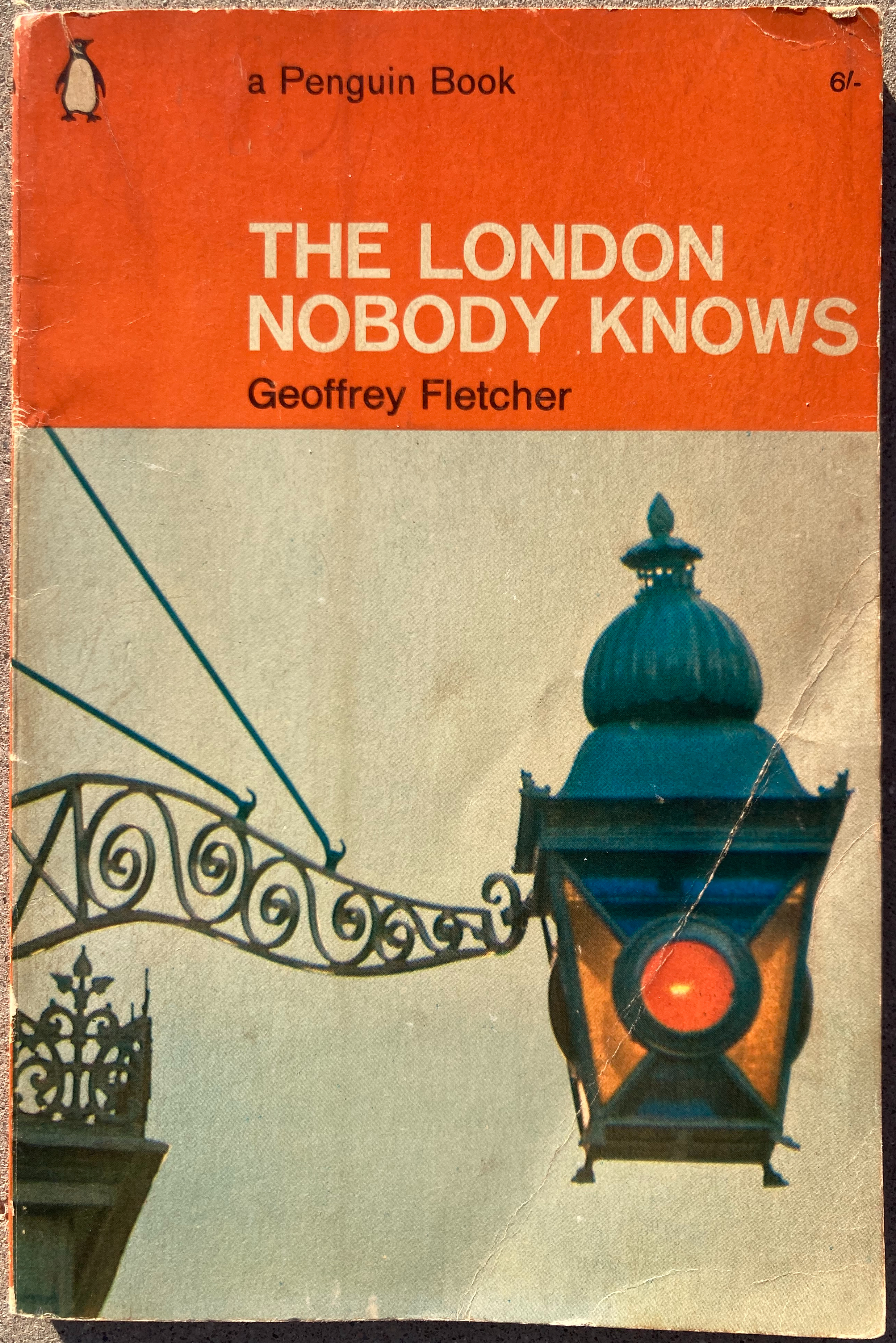
This is my worn-but-fine copy of The London Nobody Knows, which was written and illustrated by Geoffrey Fletcher (1923–2004) and first published in 1962. This is the 1965 Penguin paperback; so, it's not bad for a 58-year-old softcover that's been through multiple owners and bookshops. 

The nonfiction book's title is fairly self-explanatory, but the blurb on the back cover gives additional insight: "Geoffrey Fletcher, as the Sunday Telegraph has said, 'has an eye for what most of us miss.' His delightful scrapbook of off-beat London, with its clean drawings and entertaining text, is as enticing as Portobello Road on a Saturday afternoon." Fletcher checks out the "enamel advertisements, seedy terraces of perfect proportions, decorated cast-iron public lavatories, monumental masonry and fallen arches. Here is a rococo Victorian funeral parlour, there a splendid Hawksmoor Church, threatened by indifference and the breaker's hammer. And look! here is positively the last Yiddish theatre in London."

Of course, many things have changed in the six decades since this book's publication. Some of Fletcher's hidden gems are certainly gone forever. But there is good news, too. The "Hawksmoor Church" mentioned above is Christ Church Spitalfields, designed in the 1700s by Nicholas Hawksmoor. This book was written during its low point, but a multidecade restoration has returned much of the structure's former glory, as Wikipedia notes:
"By 1960 Christ Church was nearly derelict and services were held in the Church Hall (an ex Huguenot Chapel in Hanbury Street) as the roof of Christ Church itself was declared unsafe. The Hawksmoor Committee staved off the threat of wholesale demolition of the empty building — proposed by the then Bishop of Stepney, Trevor Huddleston — and ensured that the roof was rebuilt with funds from the sale of the bombed out shell of St John's, Smith Square, now a concert hall. ... In 1976 the Friends of Christ Church Spitalfields, an independent charity, was formed to raise money and project manage the restoration. ... the church was restored to its pre-1850 condition, working from the original building documents where possible, a process that stretched over more than 25 years."
Fletcher does most of his exploration on foot and many of his observations are of the type one can only glean via shoe leather on the sidewalk. In the chapter about Islington, he writes of the sights to be seen along Chapel Market: "The weeks before Christmas are the best time to go there, for it is then that market is most fully stocked with fruit, vegetables, poultry, and toys. Here the crowd gathers round a man selling boxes of cheap crackers, and a hawker with several days' growth of beard sells magic mice  —  white mice which run up and down his greasy sleeves. Those who buy them will find that there is nothing but a mouse of white wax inside the bag; the secret is in the manipulation; that is all."

I was surprised to learn that this 1962 book served as the basis for a 1969 documentary of the same name, which features actor James Mason as the guide/narrator. 

Much had changed — culturally if not structurally — in the seven years between 1962 and 1969. So I'm guessing the documentary has a different flavor. 

One IMDb reviewer, writing in 2011, describes the documentary as "a perfect artifact of a Britain before the almost complete Americanisation of its streets, industries and culture that was to come in the late 1980s and throughout the 1990s." Another reviewer recommends it for fans of psychogeography. And I love this comment from a 2007 review: "I never had James Mason pegged as one to go wondering around the back streets of Spitalfields (where, then, some were still alive who could remember the Ripper murders....), old theatres in Camden, and Salvation Army hostels interviewing the unfortunates there."

Speaking of documentaries... 
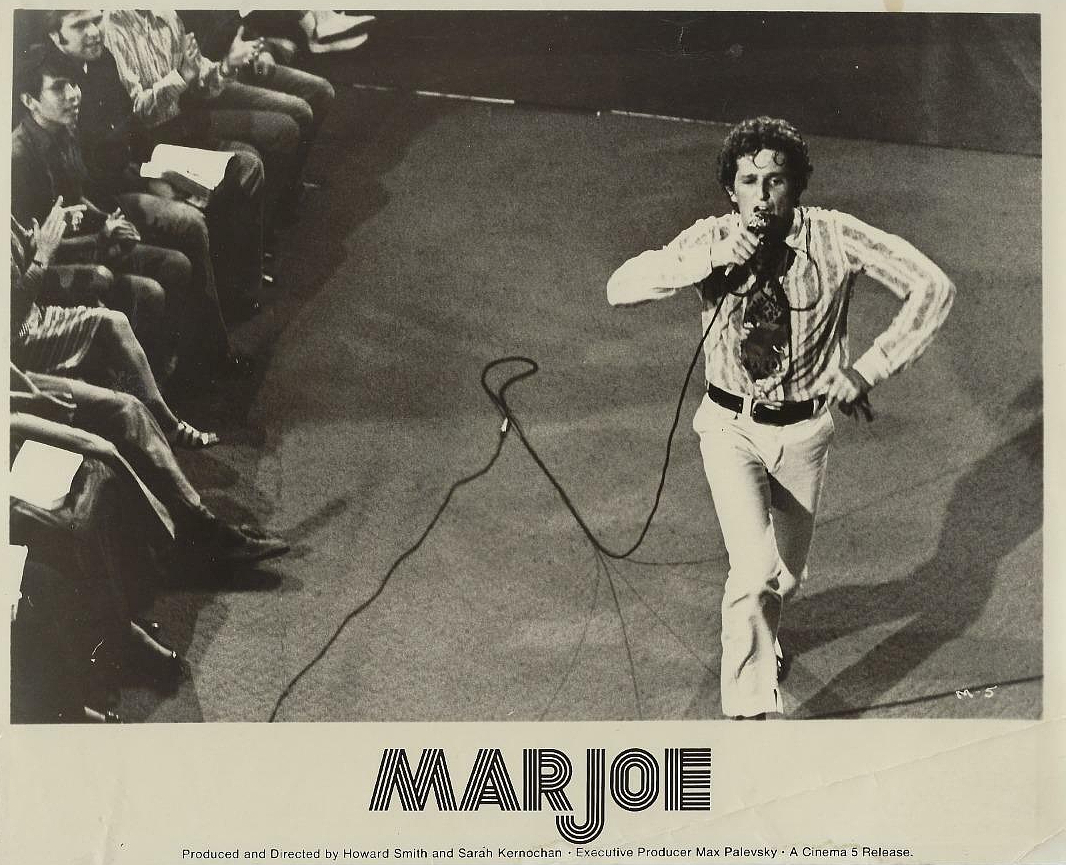
... on Friday night I finally caught up with the Oscar-winning 1972 documentary Marjoe, and I'm still trying to wrap my brain around all of it. What an incredible story and historical document it is. 

For those unfamiliar, Marjoe Gortner (who recently turned 79) was forced into preaching by his parents at age 4; perhaps not a surprise, given that his first name is a portmanteau of Mary and Joseph. For more than a decade, his parents parlayed his speaking talents and precociousness into a cash cow on the revival circuit. He never saw any of the money (he says they made millions) and set out on his own in San Francisco at age 16. Eventually, in need of money as a young adult, he returned to the only thing he'd ever been taught: deploying his charisma and persuasive speaking about God and the Bible as a traveling preacher. The money was great, but he grew tired of the deception. 

So, in 1971, he agreed to let a documentary crew "out" him as a charlatan during one final tour of the revival circuit. The documentary switches back and forth between Gortner's sermons, all of which end with his call for parishioners to "get our your wallets," and hotel interviews in which he conveys a sense of self-loathing but also anger at how that type of evangelism is a rigged to separate the faithful from their money.

Gortner knew the gig would be up for him after the documentary was released, and in fact that's what he was counting on, so that he wouldn't be tempted to live his double life any longer. He worked as an actor throughout the 1970s and 1980s. Interestingly, many of his roles cast him as a villain or deceiver, including the TV movie The Gun and the Pulpit, Bobbie Jo and the Outlaw (co-starring Lynda Carter) and the movie that critics tend to his consider his best performance, When You Comin' Back, Red Ryder?

With a running time of less than 90 minutes, Marjoe has a dizzying amount to say about bad parenting; the lifelong effects of childhood trauma; the greed, deception and hypocrisy of some religious institutions and leaders; the gullibility of the masses and the state of America in the early 1970s. And this was before that decade's rise of televangelism, which allowed people to be separated from their money without even having to leave their homes.

I think this headline on one IMDb review sums up Marjoe well: "Award-Winning Documentary that Had No Effect on Americans." 

(As an aside, it's also incredibly depressing to watch the young documentary filmmakers, who are often in the shots in which Gortner is interviewed, essentially chainsmoking through each scene. But the rise and marketing of Big Tobacco to generations of Americans is a topic for other days and other documentaries.)

Watching a documentary as compelling as Marjoe often jump-starts me down a rabbit hole of finding other documentaries about niche elements of culture and our world, especially from the 1960s and 1970s. I already mentioned 1969's The London Nobody Knows. A few others I now want to track down include 1967's Holy Ghost People, the 1967 Soviet documentary 235 000 000, and 1971's The Moon and the Sledgehammer. Other recommendations heartily welcome!

Thursday, February 2, 2023

Dust jacket of Ruth Manning-Sanders' "The Growing Trees"

I was happy to stumble across this new-to-me internet image of the dust jacket of Ruth Manning-Sanders' 1931 novel The Growing Trees. According to the UK bookseller, the very rare jacket is from the third Faber and Faber impression. 

My copy of this book is from the William & Morrow Company edition published in New York, also in 1931. It has no dust jacket. The novel, which I mentioned in passing in a 2016 post, is split into two parts: Nether Brook and Primrose Hill. This is the first paragraph:
"James Brock first experienced the joys and sorrows of a romantic attachment when he was tens years of age. It happened in the holidays, like most of events of importance in his life so far, and the object of his love was a Scotch farm girl of fourteen, called Margaret; who, with her long strands of bleached hair, and her deep-set blue eyes, reminded James of the picture of Rapunzel in the colored woodcuts in his big old edition of Grimm's Fairy Tales."
As I've noted before, Manning-Sanders was writing about fairy tales decades before she was penning her own retellings of fairy tales. In the first pages of The Growing Trees, there are also mentions of Red Riding Hood, the princess and the pea (and its feathered mattresses), Arabian Nights, and "riding to the accompaniment of silver bells like the queen of elfland."

The Faber and Faber dust jacket illustration, featuring a man and a young woman riding carousel horses, is signed Hookway Cowles. He got a lot of work with dust jackets and interior illustrations from the 1930s through 1950s; he has a listing on the Internet Speculative Fiction Database.

A 2020 post on The Folly Flaneuse provides some biographical information: Hookway Cowles lived from 1896 to 1987, and was the son of a Yorkshire clergyman. He was most famous for his work illustrating novels by H. Rider Haggard.

(The Folly Flaneuse is a wonderful and professional site that I'll have to dive into at some point. It describes itself as "rambles to, and ramblings about, follies and landscape buildings." Follies are expensive ornamental buildings with no practical purpose. They are often towers or mock ruins constructed in gardens or parks.)

Tuesday, January 31, 2023

Postcard: Maude Adams as Peter Pan

This month I've been reading Armond Fields' 2004 biography Maude Adams: Idol of American Theater, 1872-1953.

Maude Ewing Adams Kiskadden is a fascinating figure. For a time, she was the biggest star in American theater and earned vast amounts of money from her performances. She was also incredibly private about her life and became a recluse upon retirement. Her privacy was likely related, at least in part, to her sexuality; she had long-term relationships with two women during her life. (I'm at about the 75% mark of Fields' book, and so far it sticks mostly to her stage career, plus her sabbaticals to address exhaustion and her health.)1

For her stint as Peter Pan in the American debut of J.M. Barrie's Peter Pan; or, the Boy Who Wouldn't Grow Up, Adams appeared on stage about 500 times, nearly all to standing-room-only crowds. Fields describes that run's final performance at Broadway's Empire Theatre on January 4, 1908:

"Champagne was served in the lobby; autographed programs were given out to patrons; and no one wanted the play to finish. At the final curtain, instead of taking bows herself, Maude brought out the entire company to share the stage with her. Applause continued for many minutes. Although the crowd shouted for speeches, none were given. In a final gesture, Peter simply blew on his pipes and skipped merrily off the stage."

Peter Pan memorabilia and fashion were a craze in popular culture. Fields notes that Peter Pan hats and especially Peter Pan collars were all the rage. There was a limited edition souvenir book, filled with photos, that sold for $1, the equivalent of about $33 today!

And, of course, there were postcards. I wrote about a postcard of Adams' summer home in 2020. This card actually features Adams, dressed as Peter Pan. The photograph is by the Otto Sarony Company and is part of the "Rotograph" Series. 

The card was mailed in 1906 to a woman in Kidders, near Cayuga Lake in central New York state. In that year, messages could only written on the front of the card. This is the short cursive message below Peter Pan:

Sunday, Oct. 14

Going to-morrow, to spend the week in New York. Will go to see Peter Pan Wednesday afternoon. Wish you could be with us, is such a sweet play.

I'm not even going to hazard a guess on the signature. Have fun, if you wish...

Footnote

1. Last month, Kaz Rowe released an hour-long documentary on YouTube titled "Maude Adams and the LGBTQ History of Peter Pan." It's well worth your time if this topic interests you.

Sunday, January 29, 2023

From the readers: "Wild Rivers," dragons, Crasimoff's World & more

There's a bundle of great reader feedback from the past month or so, plus some emails from 2022 that I absent-mindedly forgot about when I did the last roundup. So away we go...

1941 advertisement for the Modern Talking Picture Service: I got two new comments on this 2018 post. 

First, Keith Harter writes: "My father helped in the filming of the Susquehanna River for a film called Wild Rivers, made in 1965 by Humble Oil. I wish I could find it. Any leads would be appreciated."

I didn't find any leads on discovering a copy of the film, but I did find some additional background information about it. Maybe some readers will have more success than I did regarding the film itself.

I found an old eBay listing for what's described as a "1965 Humble Oil Esso 'Wild Rivers' Map Booklet / Film Tie-In." The image is shown at right.

And the January 1966 issue of National Parks Magazine notes that "during early summer [1965] the Humble Oil and Refining Company released a particularly fine film on a subject currently much in the minds of conservationists — the projected national wild rivers system. Wild Rivers, in full color and with commentary (the photographer was Larry Madison and the narrator, Burton J. Rowles) runs 28 minutes and looks at the scenic and outdoor recreational potentials of ten of the rivers, or parts of rivers, that have been mentioned for inclusion within the wild rivers system. The film is available on loan without charge, other than return postage, from Humble Oil, P.O. Box 2180, Houston, Texas 77001; or for persons or organizations strategically located, from Modern Talking Picture Service film libraries in 22 of the nation's cities."

The other comment I received about the Modern Talking Picture Service post was from Anonymous: "My mother was office manager for Modern Talking Pictures in Charlotte, N.C., from about 1958 to 1962. My brother and I loved going in on weekends to dig through the trash in the back room where films were repaired. We’d glue together bits of this and that to make our own movies! LOL we also loved previewing the new films at home."

Bet you'd love to still have those films, too! 

Dramatic postcard featuring a dragon and a ghost [help needed]: In a September email, Jess Chua wrote, "You have a remarkable blog, and I remember a little bit of Microsoft Encarta!" 

Chua was requesting to share a postcard image from Papergreat on her own blog: "I'd like to include it in a Halloween/spooky-themed post next month. I have more Western dragon art in the draft post and wanted to include some Eastern dragons. This postcard has a spooky element to it and the anonymous comment was enlightening."

Of course! Everything on Papergreat is for sharing. And there's no need to butter me up when you ask. Here's the post Jess published last October on Dragonsinn.net: "Halloween Dragons – October 2022."

1953 envelope from the Around-The-World Shoppers Club: Way back in March 2022, M. Yang Lu wrote from France to request permission to use a Papergreat image in a magazine article. He noted, "Thanks for your very interesting sharings on your blog Papergreat. Same as you, I love to reveal a piece of history through old documents and mails. One of your articles has caught my eye. ... I have done some research on one of the competitors of the company, International Gift of the Month Club. I'm revising an article ... to be published in la Philatélie française, the official magazine of the French Federation of Philatelic Associations. I would like to ask for your permission to reproduce in my article, the image featured in your blog page. I really appreciate that you have dug further on the Internet about the Around-the-World Shoppers Club. The sources that you cited were of great help to me."

Later, he sent a PDF copy of the article, which is written in French. Here's part of the page featuring the image from Papergreat:
Try these word problems from 1900's "School Arithmetic Advanced Book": Anonymous wrote a two-part note, trying to tackle a math problem from the old textbook:

"I like these. Perhaps I'm wrong but it seems like the answer to question d) would be 48 days and not 24? If 1/3 of the workers were released it would take 3 times as many days to do the same job. If it would have taken the full crew of 60 men an additional 16 days to complete the work then it stands to reason that it would take 20 men 48 days to complete the same task."

[Later...]

"Oops I am wrong. 1/3 of the workers released. That means 2/3 remain. That would be a factor of 1.5 times the number of days to do the job. 16 days x 1.5 = 24 days."

The movie books before the internet and IMDb: Joan wrote: "I'm not 100% sure I watched 20 new films in total in 2022 (!) but three of my favorites are on this list — Chungking Express, Grand Budapest Hotel and Licorice Pizza. They actually may all be in my top 20 favorite movies of all time list! Thank you for expanding my horizons. Not just with cats."

Now let's see if I can come up with some equally good picks for 2023!

Old school library copy of "The Glass Slipper": Joan wrote: "Hey, I know E.H. Shepard well from his work on Winnie-the-Pooh!"

1984 advertisement for play-by-mail game Crasimoff's World: Iain Wilson of the podcast and Twitter account Roll to Save shared these great memories of the game: "I LOVED playing Crasimoff's World! Although memories are hazy, I do remember sitting with anticipation waiting for the packet to turn up every week. Likewise, I remember my little crew protecting a town called 'Obin'. However, by far my best memory was attending 'Crasimeet' in the mid 90s, where myself and a few others turned up in Thornton-Cleveleys in the UK for a weekend of gaming. It was a ton of fun, and I remember corresponding (by mail of course!) with a few of the guys I met there as we tried to get our parties to meet up. That was when I also learned that there were two versions of Crasimoff's World — an older 80s version and one for those like me who started later. I can't quite remember the differences other than spellcaster in the 'new' version used powders to cast their spells whereas older casters didn't."

Delving into Henry K. Wampole & Company: Sheilah Forward of Jamaica first emailed almost exactly a year ago to comment on one of Papergreat's oldest posts: "As a kid in the 1950s I loved cod liver oil. I found your 'history' about Wampole in a trip down a rabbit hole this morning investigating Mother's attempt to make me enjoy my daily dose of Wampole's. I hope you don't mind that I used some of your work to create today's Facebook entry. I've been posting everyday since we were locked down here in Jamaica on March 25, 2020. Today is Day 668. In the beginning, I presumed it would be a couple of month's commitment."

And here's an excerpt from her Facebook post, which she emailed to me separately: "Wampole’s Liquid, Tonic, Mixture or Elixir. I just called it 'Disgusting'. Mother used to dose us all with a spoonful of that wonderful, thick, golden liquid, cod liver oil, every day (probably just in the ‘almost winter’, ‘winter’ and ‘not quite winter’ seasons) to replenish winter’s vitamin deficit. I know that I looked forward to it, though my sisters may not remember it the same way. One day Mother gave us Wampole’s. What a ghastly surprise. It was red, runny and sickening sweet ‘cherry flavoured’ — supposedly children would swallow it with a smile. I did not smile. For some reason the name Wampole snuck into a dormant brain cell this morning and I sought to know more about this dreadful potion."

Scholastic book: "Arrow Book of Spooky Stories": There are two comments on this 2023 post. Tom from Garage Sale Finds wrote: "I've always said, my favorite day in school every month was the arrival of the Scholastic order form along with the books you ordered the previous month. I loved these spooky story books along with the 'mysterious monsters' books and was sure to order whenever offered. And I'll have you know, I do get these spooky story books out and read from then when my family has a campfire outside."

And Shawn Marie Mann from Cookbook Chat wrote: "My family was poor growing up but I was always given $1 to order from Scholastic. Back in the 1970s that dollar would go a long way, sometimes 4 books! And those books were well written, professionally illustrated and amazing. Today's kids have the magic of the internet but they will never have what we had back then. Thanks for this great post!"

Join the Wartime Reducing Party: Linda Whitney writes: "I love your site! Check out my Etsy store Hoozestuff. I have lots of ephemera there and booklets and such. I also have an older Lindlahr diet booklet from 1936."

Very obscure Manning-Sanders novel: "Mermaid's Mirror": The Brown Brontë writes: "I would also love to track down a copy of this! I found out that she wrote a letter on 6th June 1935 to her friend, the journalist Thomas Moult in which she mentions that 'Mermaid's Mirror' is out. She says she has asked Cassell to send him a copy, and that she hopes he will be able to write something nice about it. The letters are in Leeds University's Special Collections."

Indeed, it's a rarity. It appears that neither Selina Pennaluna (1927) nor Mermaid's Mirror (1935) is part of the Ruth Manning-Sanders estate auction that I mentioned in a recent post.

Thursday, January 26, 2023

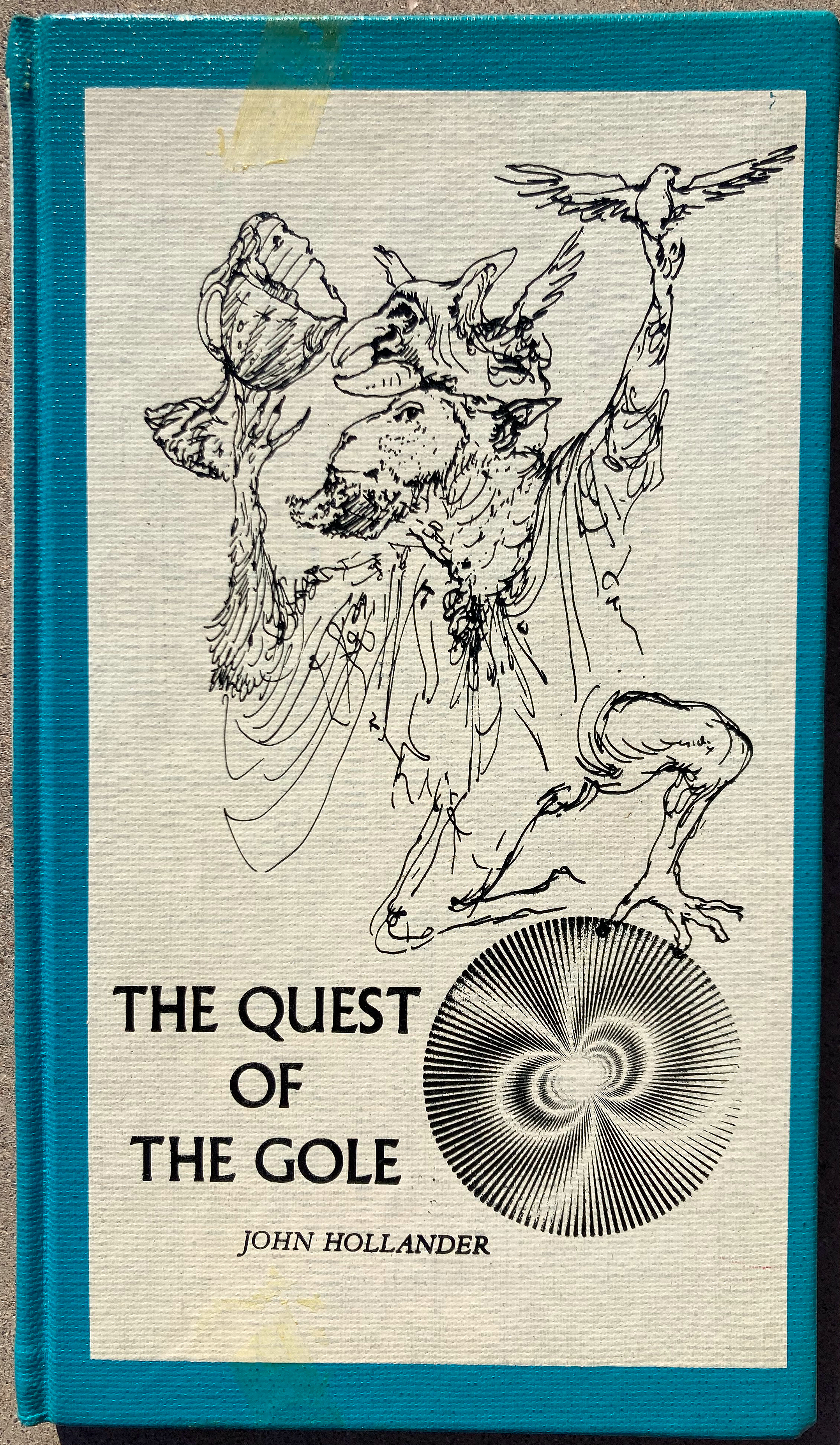
Book cover: "The Quest of the Gole"

  • Title: The Quest of the Gole
  • Author: John Hollander (1929-2013)
  • Illustrator: Reginald Pollack (1924-2001)
  • Publisher: Atheneum, New York
  • Year: 1966
  • Pages: 117
  • Format: Library-bound hardcover
  • Dimensions: 5⅜ inches by 9¼ inches
  • Provenance: Given to me as a Christmas present by Joan last month. Before that, it had been in the Spokane County Rural Library, and then a used-book store.
  • Dedication: For Jeremy, David and Raphael
  • Introduction: Hollander, who taught at Yale University and primarily wrote poetry, states in the introduction that time can erase even written tales. Paper rots. Tablets break. And fragments and memories are what remain. "The Story of the Gole is one of these old tales, and it can only be set down here at all because parts of it are still to be found in many ancient writings. ... [This book] tells as much about the Gole as is known today."
  • Format: The prologue is in verse. The following three-part tale is mostly prose, with some sections of verse intermingled. Hollander also weaves commentary smoothly into the tale, letting us know what is known, where the surviving sources conflict with each other and what details are lost forever.
  • Random sentence from the middle #1: "And he did make his home here in our city, learning our language, and living in a cave by the bay."
  • Random sentence from the middle #2: "Moad felt a strange kind of dizziness, as he realized what it was that was so remarkable about this common picture of the earth striving to meet something impossibly high above it."
  • Goodreads rating: 3.67 stars (out of 5)
  • Goodreads review: In 2009, Adam wrote: "The language in this book is rich and modeled, in parts, on medieval romances and ancient epics. Some episodes evoke Arthur, and others Beowulf or Gilgamesh. Unfortunately, the story ends up being what you might expect from a poet of the post-modern era; that is, it culminates in an insubstantial mirage, an abstracted daydream with no enduring substance."
  • Another review: Writing briefly about "Curiosities" for the magazine Fantasy & Science Fiction in 2006, Bud Webster describes the book as "tall, slim, elegant witty and eminently poetic" and further states, "The author's commentary is, for me, the most fascinating thing about this little book. Only a poet and teacher ... could have done it this well, and I'm glad he did."
Nebula (7 months old) sits alongside the spine of The Quest of the Gole.