This copy of
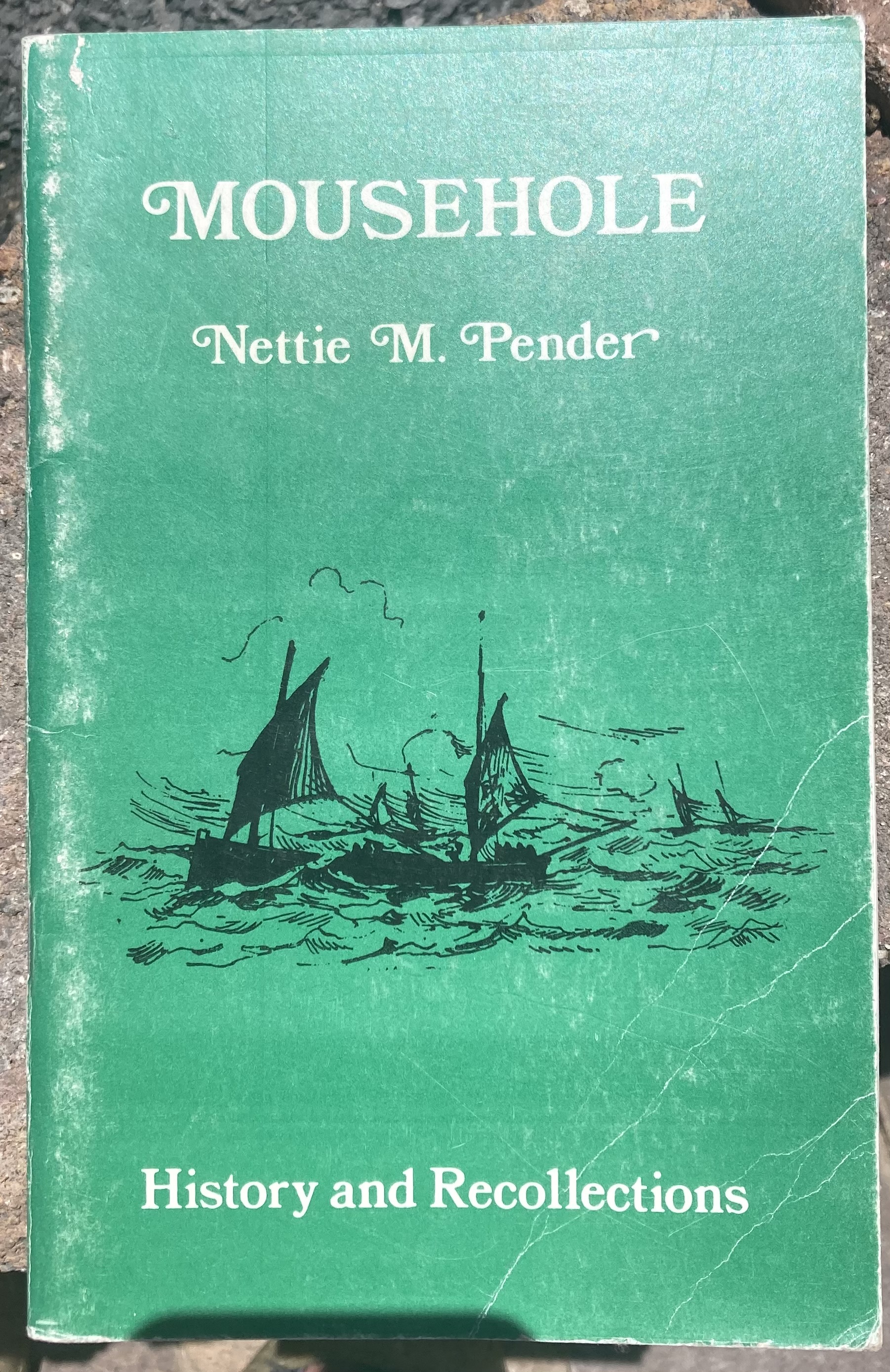
Mousehole is a staplebound book that measures 5⅜ inches by 8⅜ inches, has 78 numbered pages, and was published by Mr. J.J. Pender of 1 Keigwin Place, Mousehole, Penzance, Penwith, Cornwall, United Kingdom.
This is the September 1977 fourth edition, with the first edition having come in August 1970. It was printed by Headland Printers Limited of Penzance.
Mousehole is a village on the coast along the far southwestern tip of the United Kingdom. According to Wikipedia, its history dates to 1283 and, as you might guess, it has been associated with maritime industries for many centuries. The current population is between 600 and 700, from what I can find. A foodie note is that
stargazy pie (also called star gazey pie) has its origins in Mousehole. The dish, which is tied to
a late-December festival, is made with sardines, eggs and potatoes within a pastry crust. The sardines' heads peek out from the sides of the pie. (Eat them up, yum!) Recipes for it can be found
here and
here. I'd probably be willing to eat some (the non-bacon version), but I'd likely be the only one eating it, so I'm probably better off having a slice of someone else's creation.
But I digress.
This is a history book. On the title page, it's called
A Short History of Mousehole with Personal Recollections. Nettie Mann Pender is listed as "Bard of the Cornish Gorsedd."
Gorsedh Kernow is a Cornish organization that was founded in 1792 with the mission of,
according to its website, "preserving the history and culture of a Celtic people through poetry, song, dance, music, art, sport and spoken word," fostering good relations between Cornwall and other Celtic countries and studying the Cornish language.
Nettie was born in Mousehole and lived from 1894 to 1976, so she was certainly in a good position to convey the village's history. She mentions in the author's note, dated July 24, 1970, that writing this book was long a dream of hers.
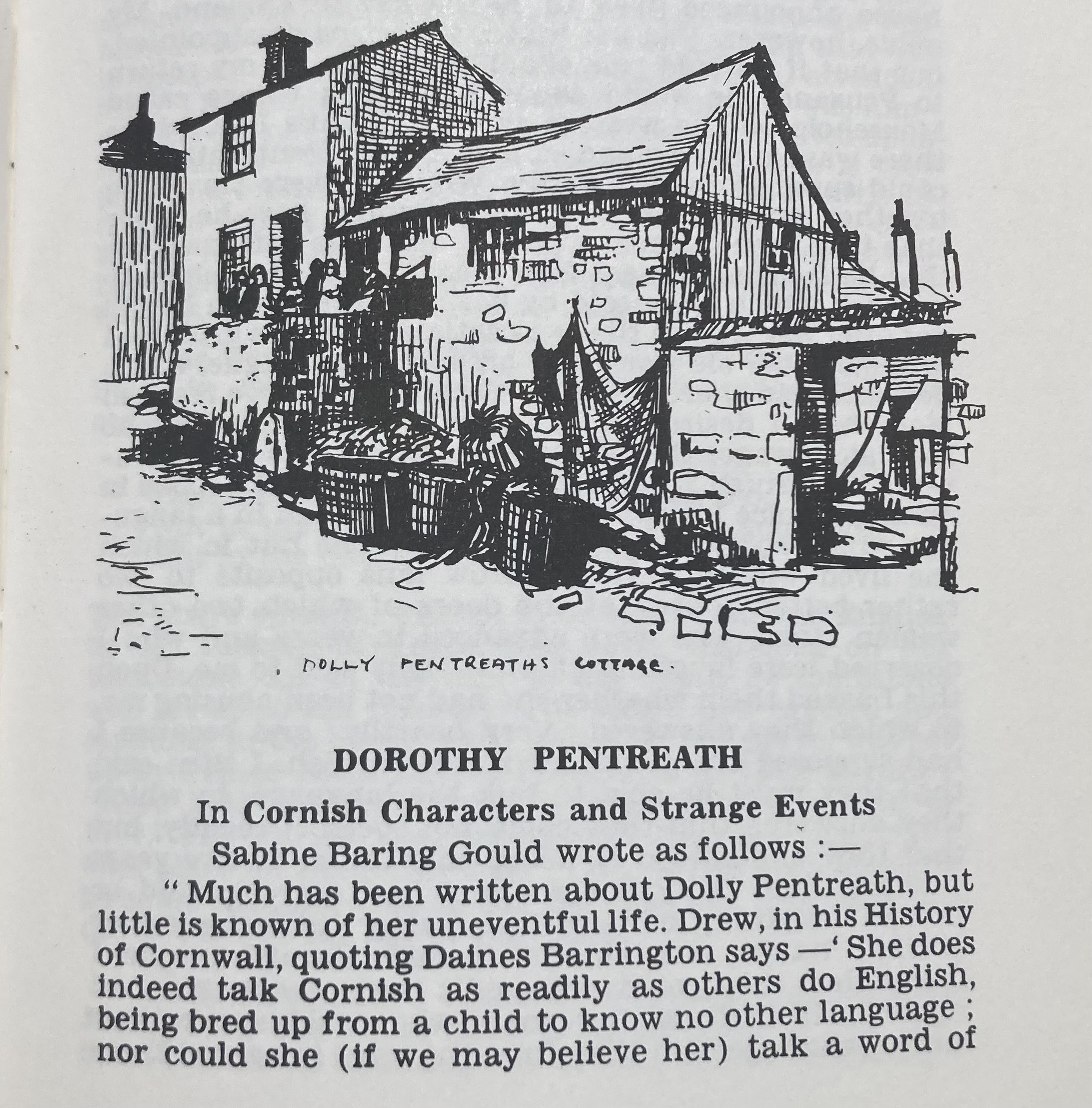
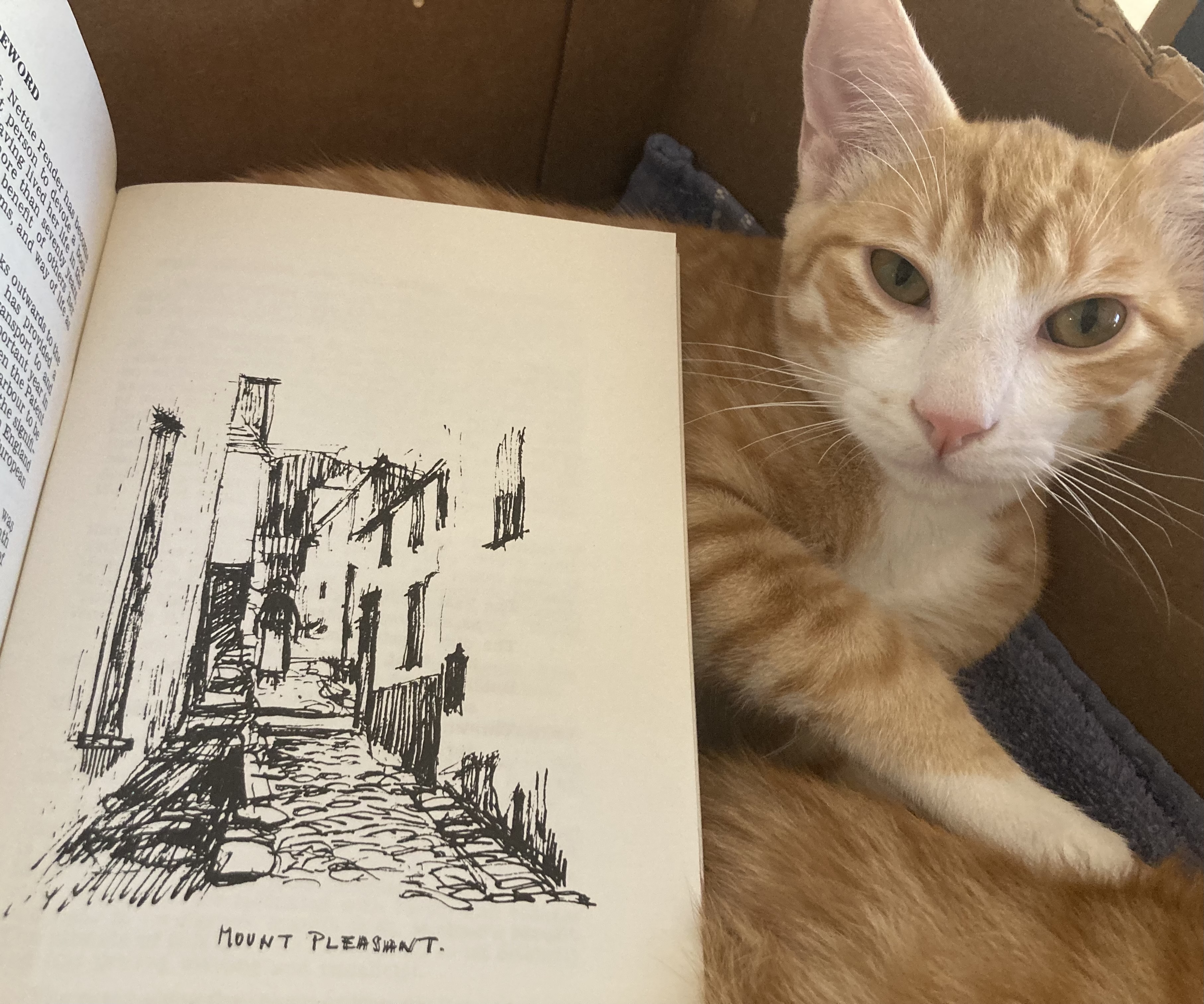
The book features a foreword by John J. Beckerlegge and drawings by Jack Pender. Aforementioned publisher John James Pender (1891-1984) was Nettie's husband, and
Jack Pender (1918-1998) was their son. Here are a few tweets featuring Jack's work:
Getting back to Nettie's book, the contents include sections on the meaning of the name Mousehole, the Cornish language, religion, fishing, education, the war years, the Mousehole Male Voice Choir and the
Wild Bird Hospital, a wonderful place that's been in operation since 1928.
There's a nice bit of verse printed on the page prior to the first chapter:
The Past is slipping from our hold
as shadowy as dreams
The dim, mysterious, lifeless past,
how faint, unreal it seems.
But here and there we come across
some waif upon the shore.
Thrown landward by the waves of time
for man to ponder o'er.
But who penned this? I find elsewhere only that it's credited to "J.B." That might be Joseph Blight, who illustrated 1880's Stories and Folk-Lore of West Cornwall, in which the verse also appears.
I read through some of Mousehole a couple of nights ago before bed (as I was simultaneously attempting to keep the cats from getting under the blanket). Much of the first half consists of town, fishing and church history. It gets more interesting when the timeline reaches the era in which Nettie was alive and can share her own memories. She speaks at length about Jacob George, her fisherman grandfather who was born in 1804.
There is some discussion of smuggling, daily chores, festivals and superstitions. It was taboo to walk over fishing nets, whistle or mention rabbits while at sea. Bread had to be cut a certain way. My favorite part, probably no surprise, was this section about Mousehole's book club:
"The Book Club was formed in Mousehole in the year 1818, organised through the influence of John Carne, Esq. Although books were quite cheap in those days, the villagers could not afford them. but there was such a thirst for knowledge that it was proposed to have a Book Club in the village. ... The books were selected with great care from the principal standard works on History, Philosophy, Biography, etc. ... I may add to that account that I can remember changing my Grandfather Mann's Club book once a month. I would take his book 'down the Gurnick' to a Mr. Praed and bring his back to Grandfather. These books were covered in black oil-cloth and were kept in what is now 'The Ladies' Parlour' at the St. Clement's Methodist Sunday School, where once a year a public tea was held and the books sold. New books would then be bought. I still have two of those books with the subscribers' names on the fly-leaf."