Tuesday, August 23, 2022

Joan Kiddell-Monroe's illustrations in "Chinese Myths and Fantasies"

Chinese Myths and Fantasies was published in 1961 by Henry Z. Walck. It contains retellings of folklore tales by Cyril Birch, an England-born author and professor who I believe is still alive at age 97, based on what I can find online. He's still listed as the Louis B. Agassiz Professor Emeritus in the Department of East Asian Languages at the University of California, Berkeley, after retiring in 1990.

Chinese Myths and Fantasies is split into three sections: The Conquerors of Chaos; Fairies, Ghosts and Others; and The Revolt of the Demons. The best story title, by far, is "The Man Who Nearly Became Fishpaste." 

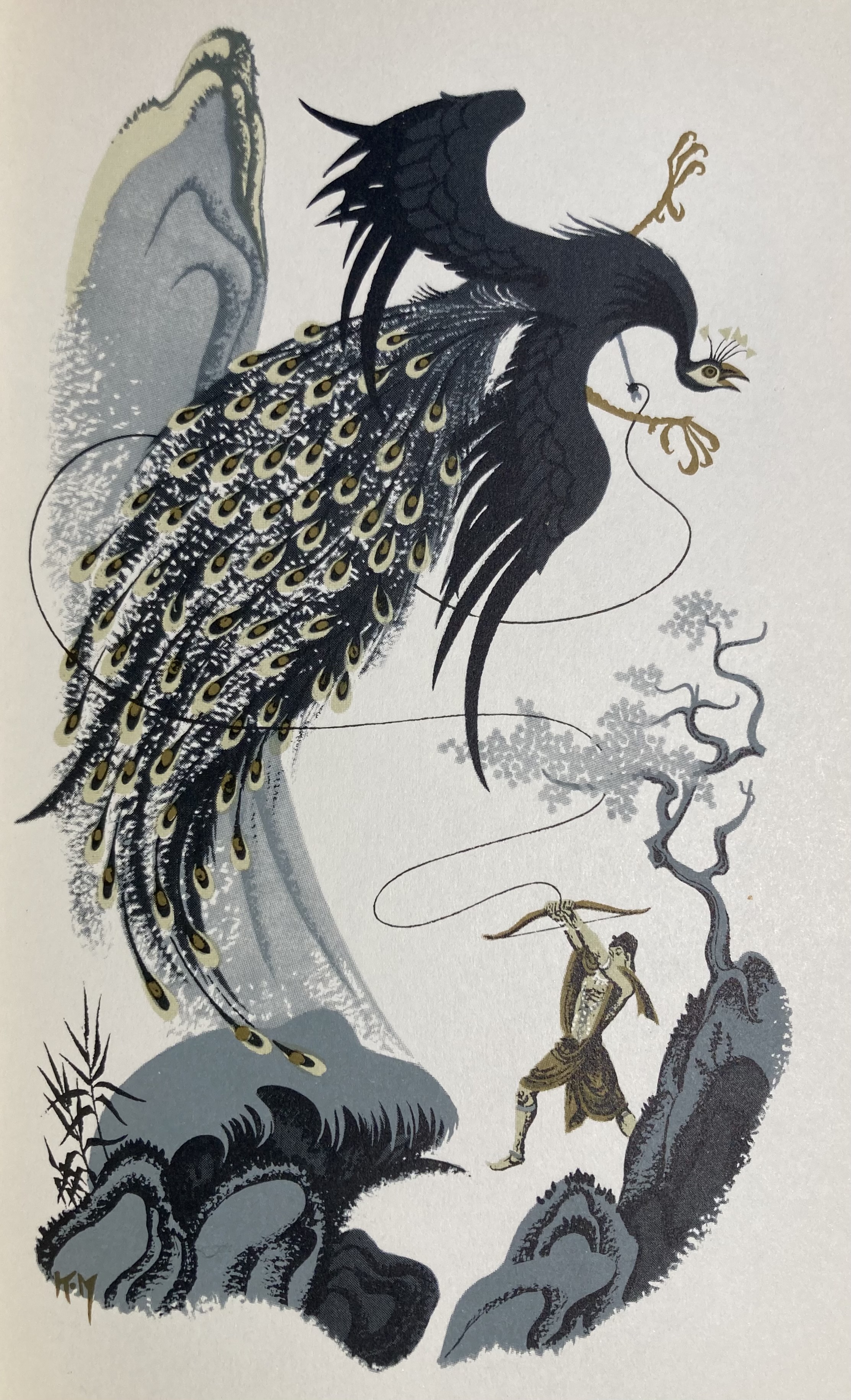
This book is a discard, probably long ago, from the public library system in Niagara Falls, New York. I understand the need to discard books and keep the finite shelves of libraries stocked with books that people want and need, but it's a shame that this book isn't still on a shelf for some young person to discover while browsing; it's really quite timeless and beautiful. Which brings us to the illustrations of Joan Kiddell-Monroe (1908-1972). The book features a combination of gorgeous color illustrations, done in shades of blue and brown, and smaller line drawings.
 
Kiddell-Monroe illustrated the initial books in the Oxford Myths and Legends series, which spanned tales from Ireland, Scotland, Wales, France, Scandinavia, Russia, Yugoslavia, Switzerland, Germany and Japan. The books have remained in print, but unfortunately not always with the original illustrations. On 50 Watts Books, Will Schofield writes, "When Oxford and other publishers sporadically reprinted these volumes after 1978, they cut the color illustrations completely (not even including black-and-white copies), which means they are forgotten and will probably remain forgotten. Some of the reprints use new illustrations. Most of the books are easy enough to find (especially as library discards), but you have to pay attention to the dates. American publishers — notably Zalck — sometimes brought out editions simultaneously with Oxford. All of the 60s and early 70s Zalck issues I have seen include the color illustrations."1

Here are some examples of Kiddell-Monroe's wonderful work in Chinese Myths and Fantasies: 
You can see some of Kiddell-Monroe's work with a different genre of books on this 2017 post at The Passing Tramp.

Getting back to Chinese Myths and Fantasies, there are a handful of great reviews/memories on Goodreads, but this one, posted by Mauve Guava almost exactly a year ago, is my favorite: "One of my favourite books during my early teens. A bottle of coke, Garibaldi biscuits, Chinese Myths and Fantasies was a taste of heaven and beyond. Simply transports you to magical faraway lands."

Footnote
1. 50watts.com is a fabulous website that received praise in a 2011 article in The Atlantic by Steven Heller, who wrote about the idea of curatorial blogs as the new museums. An excerpt: "Many blogs are indeed galleries in the cloud, extending interest with artifacts where traditional museums and libraries will not venture. ... I've admired a few of these troves, and the most engaging, for its obsession with bibliographic graphics—book covers, jackets, and illustrations—is called 50 Watts and curated by Will Schofield, a 34-year-old bibliomaniac. ... There is no organizing principle, though the posts tend to group themselves together: book covers, ephemera, weird kids' books, features on forgotten writers, artists' books, contemporary drawing."

Bonus outtake on the rigors 
of blogging with 17 cats

Sunday, August 21, 2022

Summer Sunday shelfies
(plus cats, of course)

Friday, August 19, 2022

From the readers: Bookdumping, needles and pronouncing Mousehole

The first message in today's roundup is a combination Postcrossing/Papergreat message. Through Postcrossing, I sent Cindi in the UK a postcard of the Lewis chessmen and told her about the cats and how hot it is here in Arizona. After receiving the postcard, she went to the blog and read the August 7 post Kipple 'n bytes: Thoughts on what we do and don't preserve. These are her thoughts on it all:

"Hi Chris, what a beautiful card you sent me, thank you! And you gave the temperature in C, which is helpful. The record here in England is 40.3, Alexa tells me. Poor fluffies! That can’t be fun, I’ve heard it said that paws can be burnt on hardstanding in that heat. Thanks for your blog. Re: kipple, after lessons learned after a maternal death, we decided to downsize about 8 years ago. Now we live in a small flat where we can’t accumulate. Quite often, as we only have a few bookshelves, we go ‘bookdumping’ at our local train station. It’s really fun placing books all around the place, then scuttling to the upper shopping balcony to observe who picks them up. I have also become acquainted with the concept of library books! Currently munching my way through a sandwich of Christopher Isherwood and the harder to understand (because of culturally very different references) Joan Didion."

That's definitely the kind of "bookdumping" I can get behind! So wonderful! Also, hardstanding seems like a much better and more precise word than pavement. 

From the Readers (2022 edition), plus many cats: Jarak Dekat wrote, "Oh my God, manies cats. I love it," and now I think that Oh my God, Manies Cats has taken the lead for the title of my eventual autobiography.

And Inky from the On Shoes and Ships and Sealing-Wax blog wrote: "Hooray, you're back!!! It seems you are leaning towards your own version of Millions of Cats. (I must add I've been enjoying all the pics of them on your Twitter page.)"

Regarding that: The long, long Twitter thread of daily cat pictures can be found here.

"Prinzess Victoria" and a tiny old package of sewing needles: Cat from the Cat's Wire blog wrote: "Very interesting, thank you! I just wrote a blog post about needles myself — among them Princess Victoria needles — and was amazed at all the different labels I could find for them online! My own are 'Finest silver eyed sharps' in a size 12, no country of origin and 'Princess Victoria'."

1911's "The Isle of Wight," its provenance and Joseph Sadony: Roger Allen wrote, very helpfully, "In the first inscription Blenheim could be name of a house — Mrs. Paterson's, Mrs. Mitchell's — in Newport. In local directories it may just be recorded under the street number, which would make it difficult to identify."

Cheerful Card Company can help you earn extra money for the holidays: Unknown wrote, "I sold them for years. I too am 66 and had a loyal customer base. So much so that when I stopped I had customers calling me. Only reason I stopped was when they sent out this year's kit and several weeks later sent the letter asking if you wanted them!"

The somewhat obscure "Mousehole" by Nettie Mann Pender: Roger Allen, kindly checking in again, wrote, "Mousehole — the village — is pronounced 'muzzle' or to rhyme with 'towsle'."

Thoughts on aspirational reading: Finally, Brian Busby of The Dusty Bookcase, wrote: "In the early nineties, I made a point of taking on the longest book I owned, but had not read, to bridge an old and new year. For example, I remember starting David Graham Phillips' Susan Lenox, Her Fall and Rise in December 1990, and finishing it in January 1991. Others tackled included Norman Mailer's Harlot's Ghost and The Executioner's Song. Don't know why I stopped. Dreiser's An American Tragedy beckons! Must admit, there's no form I admire more than the novella."

Wednesday, August 17, 2022

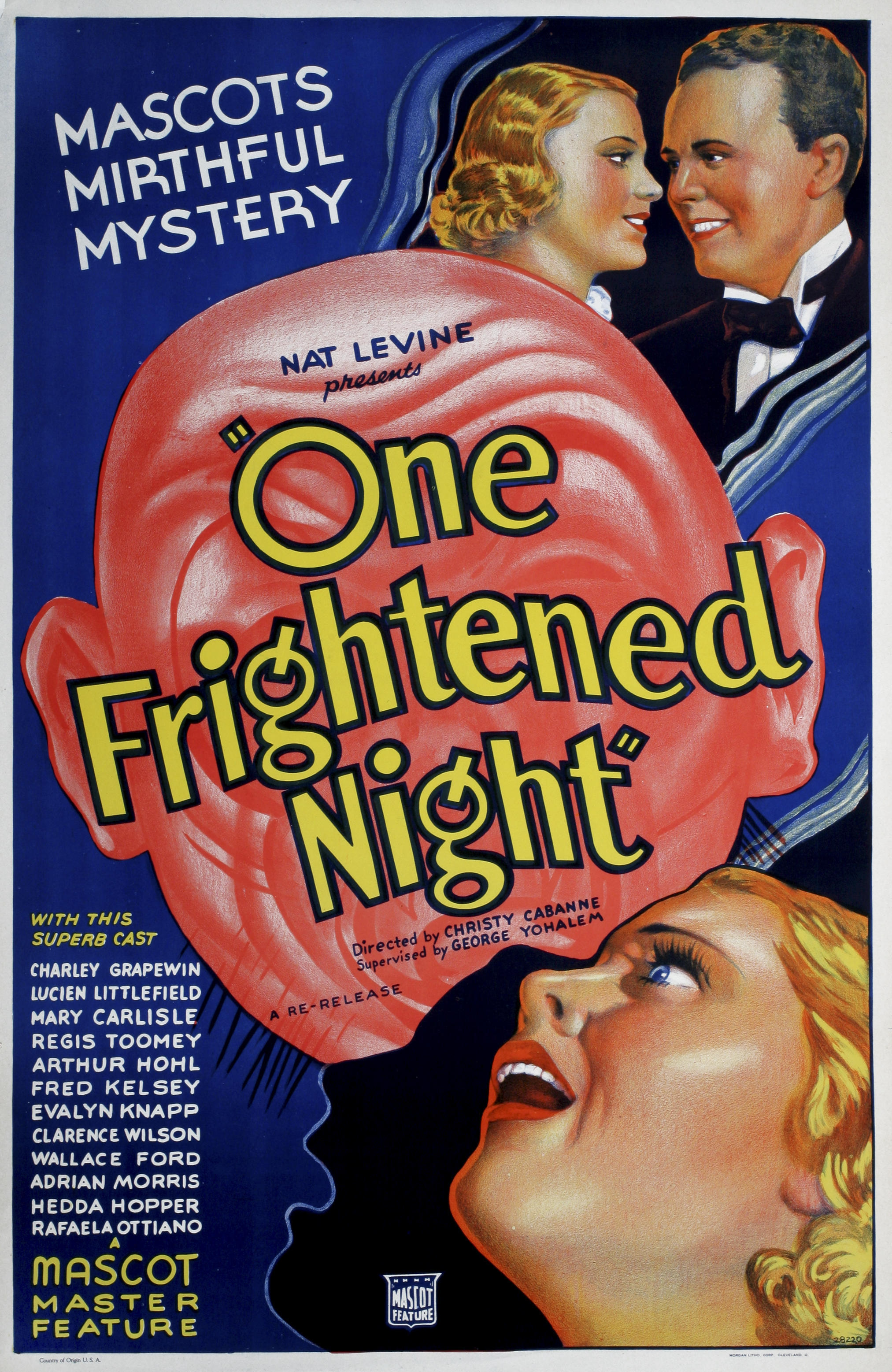
Poster for 1935's "One Frightened Night"

This is the delightful poster for the 1935 thriller/mystery/comedy One Frightened Night. The film's "monster" is shown in the middle of the poster, underneath the text. That's about right, because it's not in any way a monster movie, nor is the purported monster terribly scary. I've been on a kick of watching "old dark house" movies circa mid-1920s to mid-1940s this summer, and have some more queued up heading into the autumn. Stuff like this and 1933's The Secret of the Blue Room

Old dark house movies have, as you might assume, creaky old houses filled with suspicious characters. They take place at night and, usually and preferably, during a howling thunderbumper. There are candles, secrets to discover, hidden passages, roaring fires, banging shutters and, if it's a good one, plenty of snappy dialogue. They're great comfort-blanket films. The king of them is the one that named the subgenre, James Whale's The Old Dark House from 1932.

This poster comes from CineMaterial, a wonderful archive for movie posters and a great website to browse. Check out 1909's A Trap for Santa Claus and so many others, onward through the decades of film history. There's also a dandy subsection of Polish movie posters for international films, featuring some incredible designs.

Monday, August 15, 2022

Thoughts on aspirational reading

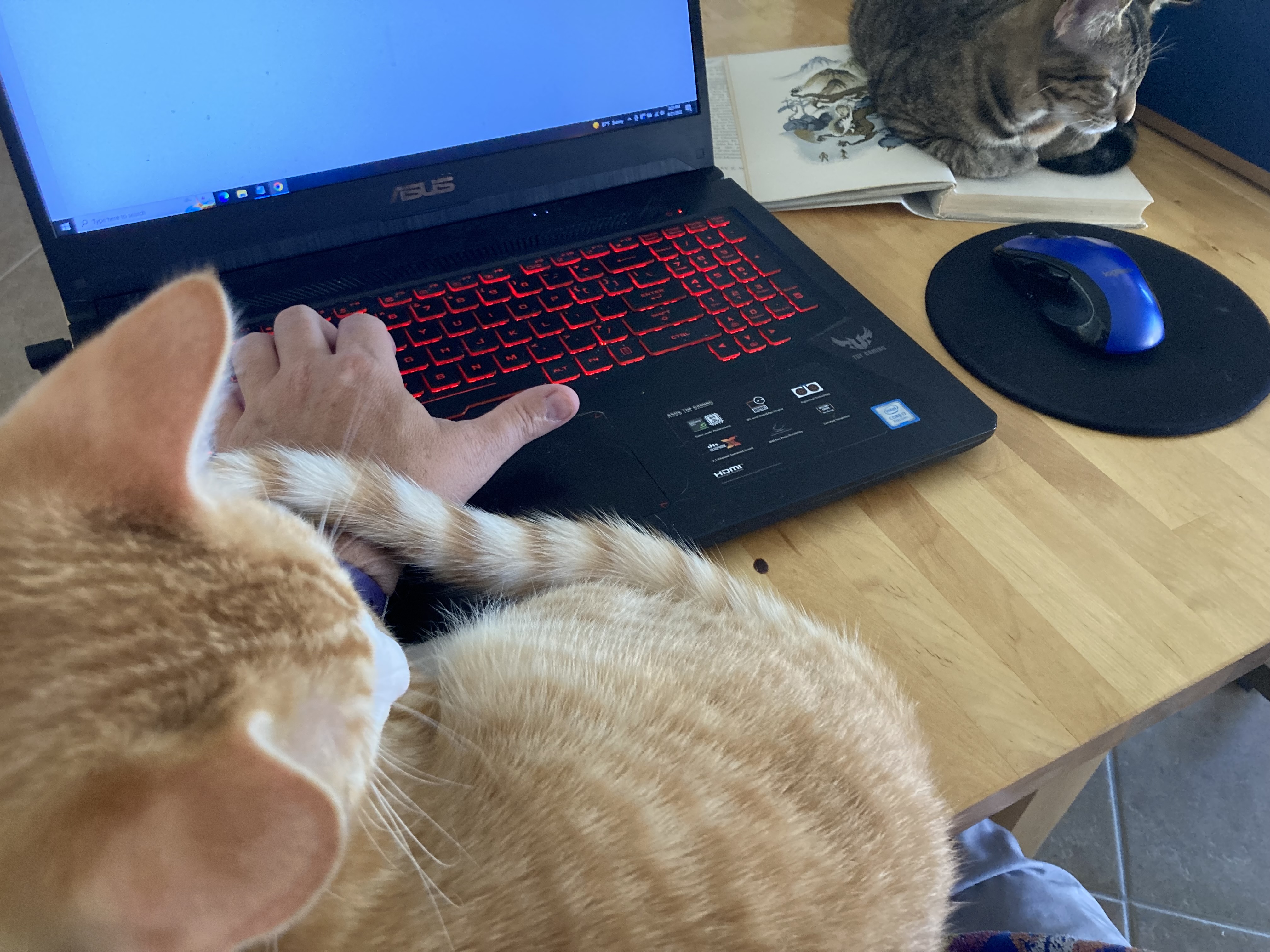
(That's Orange, who is the mother of 13 of the 17 cats currently residing in the house.)

Someday, probably when I'm retired (LOL), when I don't spend endless work hours fact-checking letters to the editor written in a post-truth world, when there isn't a household Cat Issue™ to deal with every 20 minutes, when my mental energy and focus aren't always running on empty, and hopefully when our leaders have enacted meaningful worldwide efforts to stave off the worst outcomes of man-made climate change ... on that someday, I hope to just relax in a comfy chair and do more aspirational reading.

So much aspirational reading. When that day comes, I'll read chonky books like MacKinlay Kantor's Spirit Lake, which I discovered at the York Emporium four long years ago (seems like a decade ago) and wrote about early 2019. It's 951 pages and, if I started now and attempted to read it my current rate of 3 pages per night before I fall asleep, it would take 11 months in a best-case scenario. That would be a wholly unsatisfying way to consume a great novel.

And when that day comes, I'll tackle other long reads on my shelf. Just looking at the literature shelves, there's Lost Children Archive by Valeria Luiselli, The Thousand Autumns of Jacob de Zoet by David Mitchell, Witch Hammer by Vaclav Kaplicky, The Black Prince by Iris Murdoch, The Overstory by Richard Powers, Folklorn by Angela Mi Young Hur, and so many others.

I still find ways to satisfy my need to read. Mostly, I read collections of short stories by authors who are new to me. If  I really focus, I can finish one short story on the same day I start it. Right now I'm reading Cat Pictures Please and Other Stories, a collection of sci-fi and fantasy tales by Naomi Kritzer. It's outstanding. I've also read the excellent collection Useful Phrases for Immigrants by May-lee Chai this summer. 

Short-story collections by Julio Cortázar, Jamel Brinkley, Richard Brautigan, Anjali Sachdeva and Silvia Moreno-Garcia await to tide me over to that one fine morning when I can leave my pajamas on, settle in and read some long novels.

Saturday, August 13, 2022

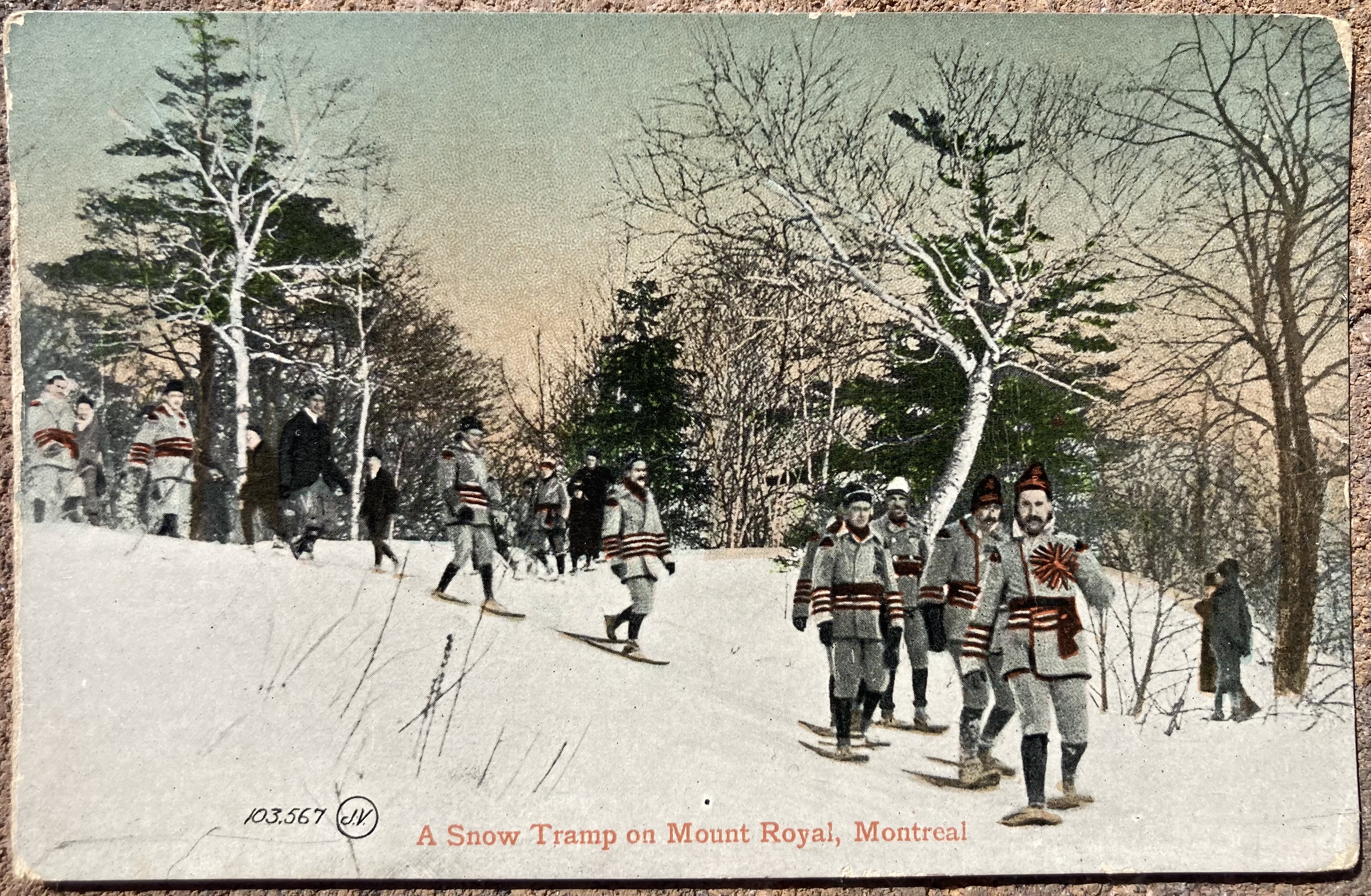
Saturday's postcard: A Snow Tramp on Mount Royal, Montreal

This postcard, titled "A Snow Tramp on Mount Royal, Montreal" was published by The Valentine & Sons' Publishing Co. of Montreal and Toronto and printed in Great Britain. 

I can't make out the year on the postmark, which is a bummer. but the green stamp is a Canadian King George V one-cent stamp that was first issued in December 1911. So, sometime during the 1910s makes the most sense.

The card was mailed to George S. Maxwell of Vernon, British Columbia. The cursive note states:
Dear Friend,
you must excuse me for not answering your card and letter [?] this but I received both O.K. Glad you are getting along so well and sorry I will not be able to see you at [??] this year. Write again and tell all the news. yours respectfully, Alexander M. Matheson.

I have no idea what that word is indicating the place they won't be meeting. It appears to have a B or G at the beginning and maybe a P and/or K. Also in this note, I was slightly thrown off by the I's that look like 9's.  

It's crazy how many postcards I've written about over the years that include apologies for failing to write back in a timely manner. Sometimes the apology takes up half the card, and then there's no interesting news on the rest of the card. What's the point? And Alexander has the temerity to write nothing and then ask that George "tell all the news."

Thursday, August 11, 2022

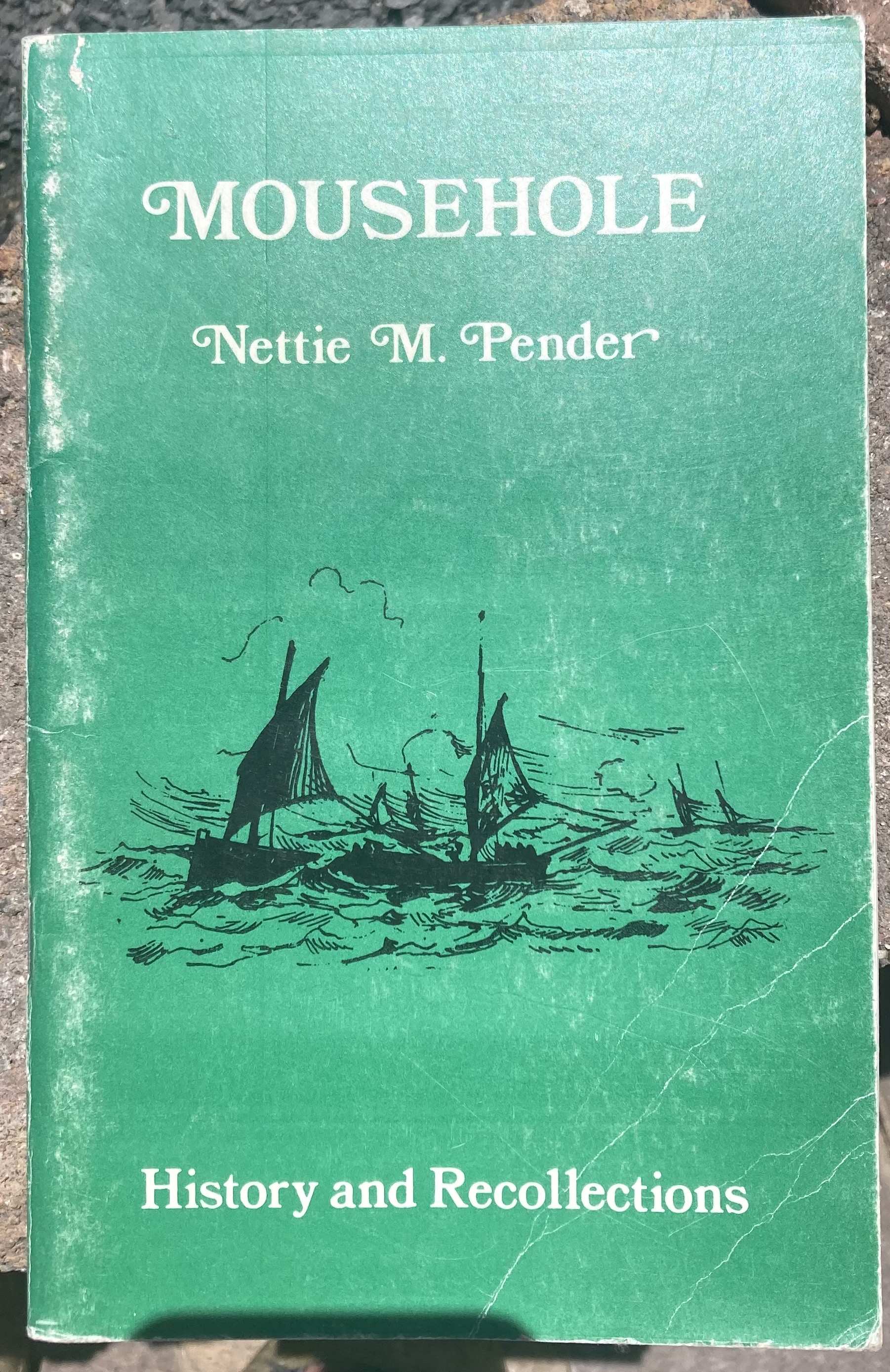
The somewhat obscure "Mousehole" by Nettie Mann Pender

This copy of Mousehole is a staplebound book that measures 5⅜ inches by 8⅜ inches, has 78 numbered pages, and was published by Mr. J.J. Pender of 1 Keigwin Place, Mousehole, Penzance, Penwith, Cornwall, United Kingdom. 

This is the September 1977 fourth edition, with the first edition having come in August 1970. It was printed by Headland Printers Limited of Penzance.

Mousehole is a village on the coast along the far southwestern tip of the United Kingdom. According to Wikipedia, its history dates to 1283 and, as you might guess, it has been associated with maritime industries for many centuries. The current population is between 600 and 700, from what I can find. A foodie note is that stargazy pie (also called star gazey pie) has its origins in Mousehole. The dish, which is tied to a late-December festival, is made with sardines, eggs and potatoes within a pastry crust. The sardines' heads peek out from the sides of the pie. (Eat them up, yum!) Recipes for it can be found here and here. I'd probably be willing to eat some (the non-bacon version), but I'd likely be the only one eating it, so I'm probably better off having a slice of someone else's creation.

But I digress.

This is a history book. On the title page, it's called A Short History of Mousehole with Personal Recollections. Nettie Mann Pender is listed as "Bard of the Cornish Gorsedd." Gorsedh Kernow is a Cornish organization that was founded in 1792 with the mission of, according to its website, "preserving the history and culture of a Celtic people through poetry, song, dance, music, art, sport and spoken word," fostering good relations between Cornwall and other Celtic countries and studying the Cornish language.

Nettie was born in Mousehole and lived from 1894 to 1976, so she was certainly in a good position to convey the village's history. She mentions in the author's note, dated July 24, 1970, that writing this book was long a dream of hers.

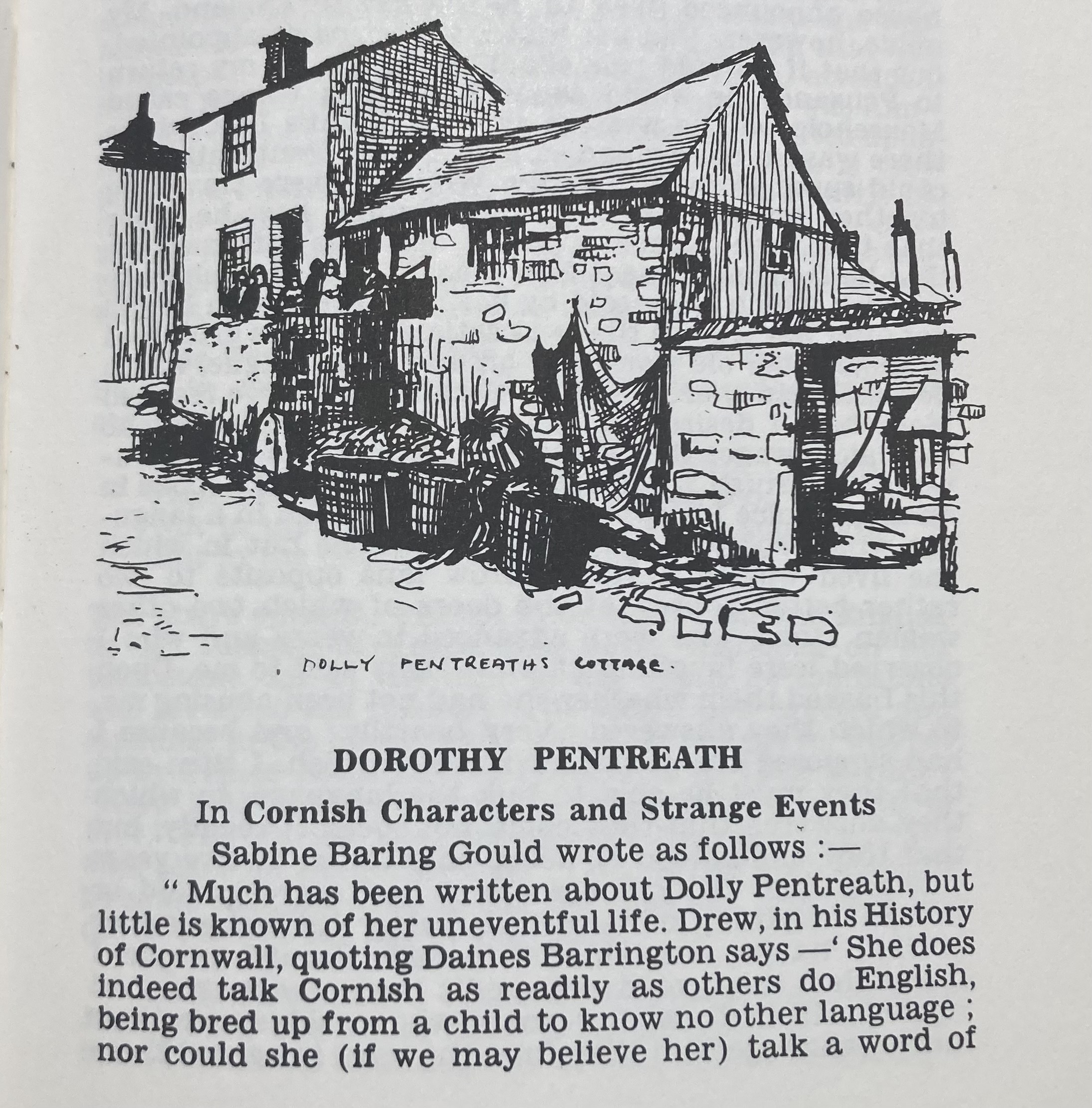
The book features a foreword by John J. Beckerlegge and drawings by Jack Pender. Aforementioned publisher John James Pender (1891-1984) was Nettie's husband, and Jack Pender (1918-1998) was their son. Here are a few tweets featuring Jack's work:
Getting back to Nettie's book, the contents include sections on the meaning of the name Mousehole, the Cornish language, religion, fishing, education, the war years, the Mousehole Male Voice Choir and the Wild Bird Hospital, a wonderful place that's been in operation since 1928.

There's a nice bit of verse printed on the page prior to the first chapter:

The Past is slipping from our hold
as shadowy as dreams
The dim, mysterious, lifeless past,
how faint, unreal it seems.
But here and there we come across
some waif upon the shore.
Thrown landward by the waves of time
for man to ponder o'er.

But who penned this? I find elsewhere only that it's credited to "J.B." That might be Joseph Blight, who illustrated 1880's Stories and Folk-Lore of West Cornwall, in which the verse also appears.

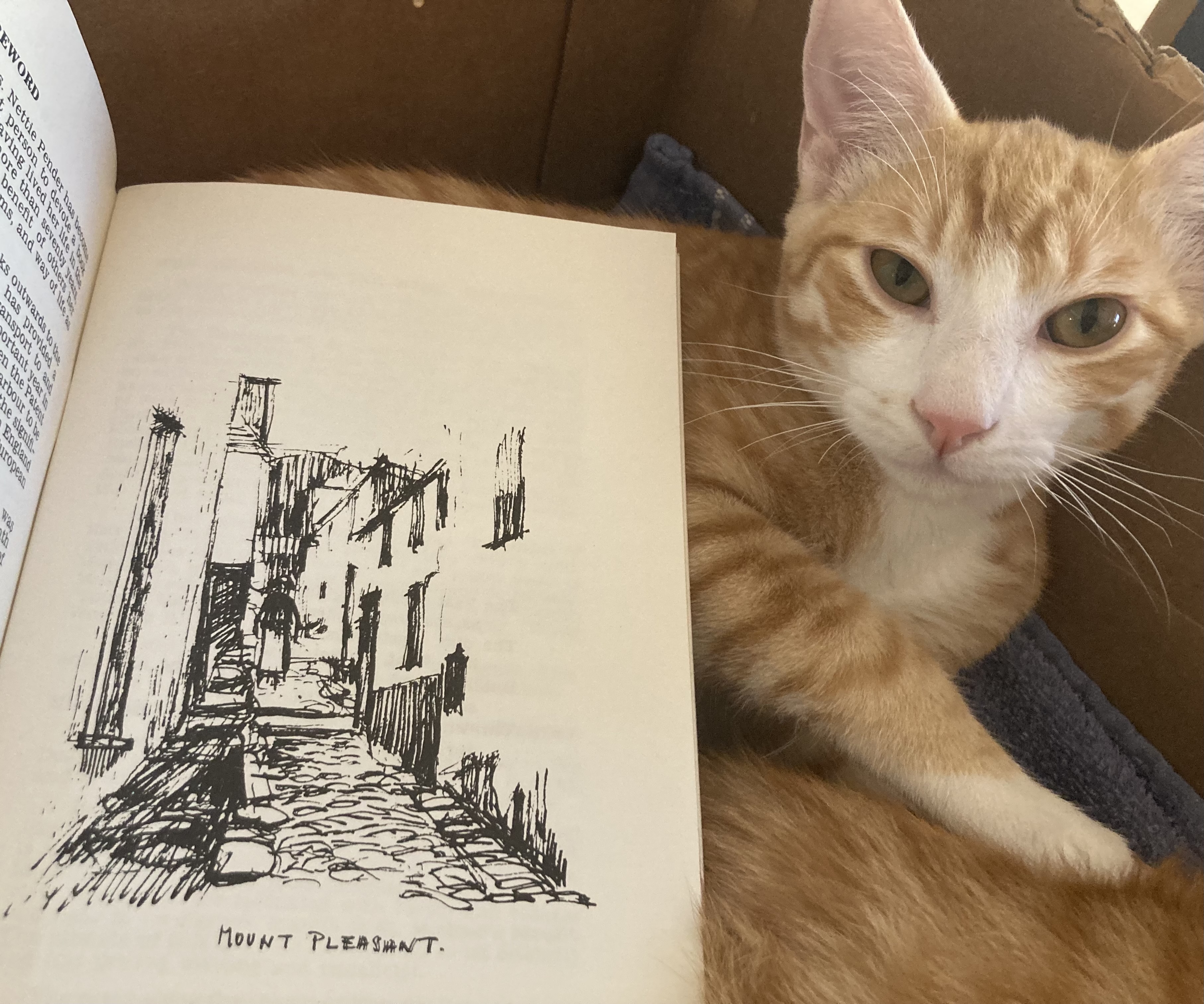
I read through some of Mousehole a couple of nights ago before bed (as I was simultaneously attempting to keep the cats from getting under the blanket). Much of the first half consists of town, fishing and church history. It gets more interesting when the timeline reaches the era in which Nettie was alive and can share her own memories. She speaks at length about Jacob George, her fisherman grandfather who was born in 1804.

There is some discussion of smuggling, daily chores, festivals and superstitions. It was taboo to walk over fishing nets, whistle or mention rabbits while at sea. Bread had to be cut a certain way. My favorite part, probably no surprise, was this section about Mousehole's book club:
"The Book Club was formed in Mousehole in the year 1818, organised through the influence of John Carne, Esq. Although books were quite cheap in those days, the villagers could not afford them. but there was such a thirst for knowledge that it was proposed to have a Book Club in the village. ... The books were selected with great care from the principal standard works on History, Philosophy, Biography, etc. ... I may add to that account that I can remember changing my Grandfather Mann's Club book once a month. I would take his book 'down the Gurnick' to a Mr. Praed and bring his back to Grandfather. These books were covered in black oil-cloth and were kept in what is now 'The Ladies' Parlour' at the St. Clement's Methodist Sunday School, where once a year a public tea was held and the books sold. New books would then be bought. I still have two of those books with the subscribers' names on the fly-leaf."

Tuesday, August 9, 2022

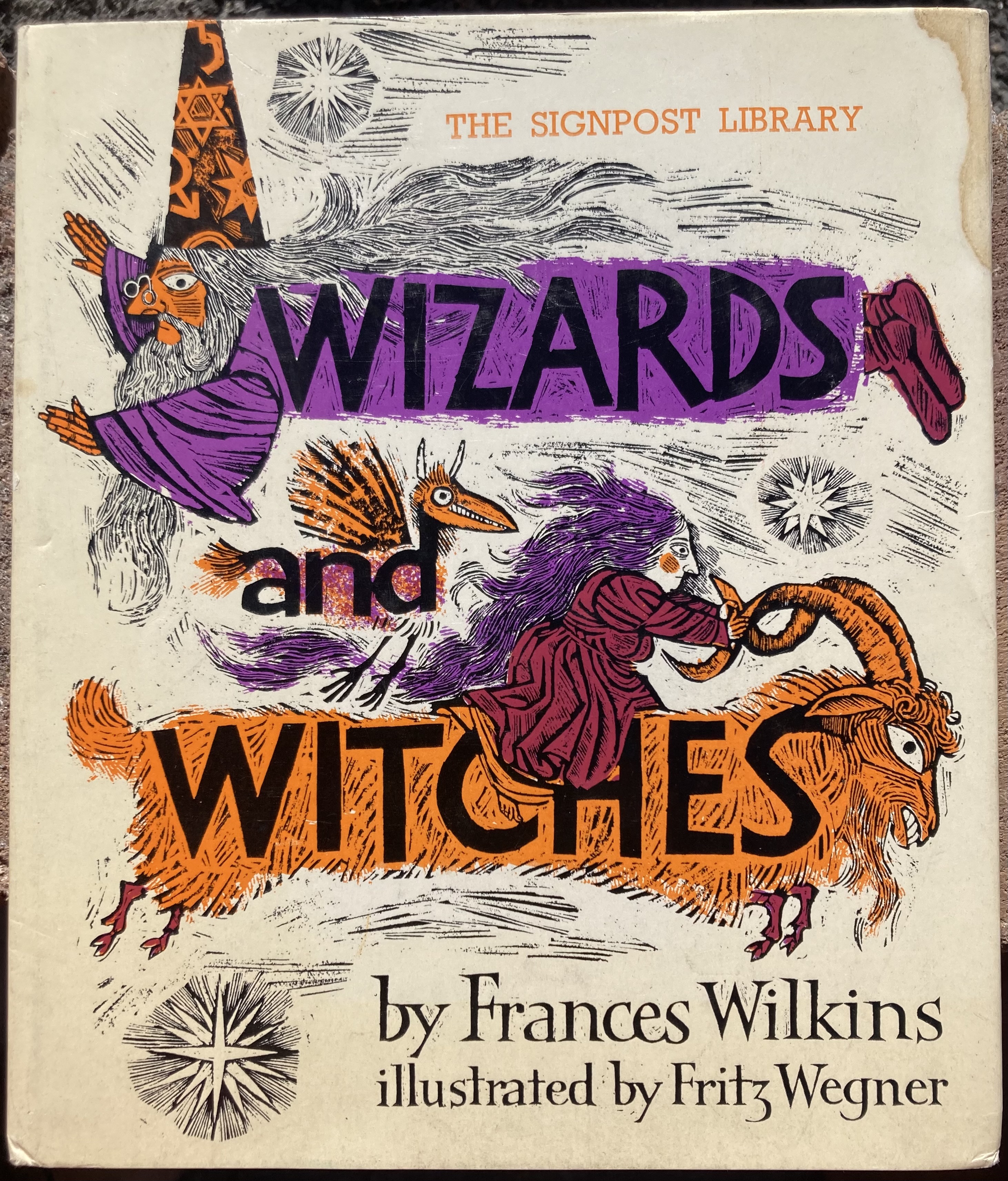
"Wizards and Witches" by Frances Wilkins and Fritz Wegner

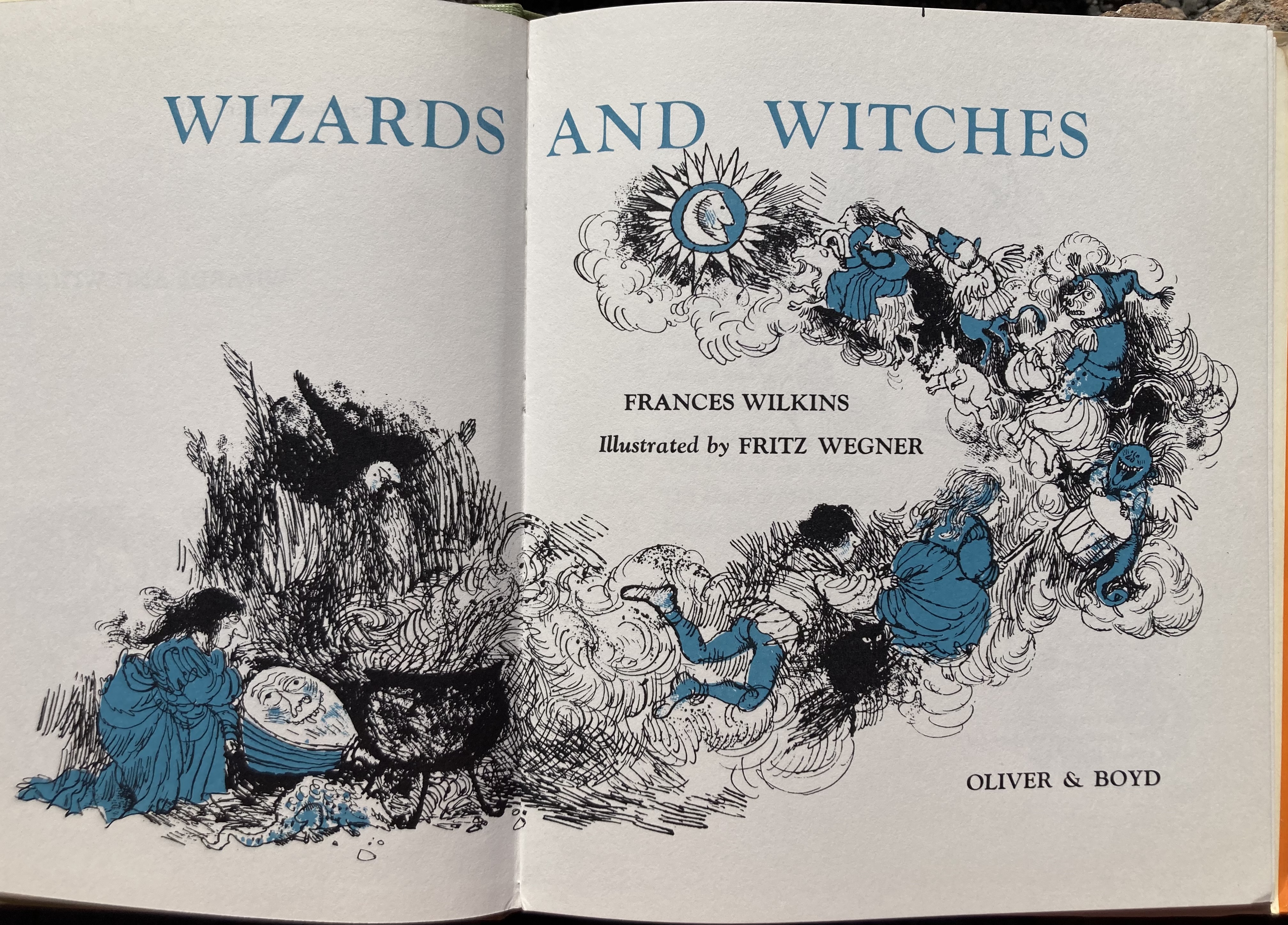
Wizards and Witches, published in the United Kingdom in 1965, was part of The Signpost Library (also known as The Byways Library). This was an educational series from publisher Oliver & Boyd of 64-page hardcovers aimed at younger readers. The back cover of the dust jacket lists the first 13 titles, which included Pirates and Highwaymen, Tools and Machines, Costume Through the Ages, Bridges, Cathedrals and Churches and, most disturbingly, Clowns Through the AgesAn internet search shows that later titles includes Folk Costume of Western Europe, Folk Costume of Southern Europe and Ballet and The Dance.

This is not a book about folklore, necessarily, but more of a clear-eyed look at the purported practice of magic throughout the age; and the sad, and very real, consequences for many of those accused of "witchcraft." Chapters cover the cunning folk; Roger Bacon and other alchemists; Joan of Arc; witchcraft in the time of Henry VIII; the book Daemonologie by King James VI of Scotland (later the King James I of England who brought us the most famous translation of the Bible); and the Salem witch trials. There's an unfortunate chapter toward the end, written from a colonialist perspective and embedded with racism, that briefly discusses witch doctors and is titled "Jungle Magic."

Author Wilkins covered many topics during her writing career, which appears to have continued until at least 2003. She wrote about Morocco, smuggling (in multiple books), Uzbekistan, the Tudor era, caves, Thailand and the slavery trade.

Illustrator Fritz Wegner (1924-2015) had a long and successful career after, according to his obituary in The Guardian, a harrowing episode as a young teenager: "Born in Vienna to secular Jewish parents, Michael and Eti, he had a secure childhood, but it was abruptly ended by the Anschluss of 1938. After drawing a cartoon of Hitler and enraging his pro-Nazi teacher, he understood the danger he was in, and his parents organised his departure, alone, by train to London."