Saturday, September 3, 2022

Carlos Mérida's delightful illustrations for "The Magic Forest"

So far as I can tell, famed Guatemalan artist Carlos Mérida (1891-1985) didn't illustrate many books during his long career of focusing primarily on canvas, ceramics and murals. A Treasury of Mexican Folkways, from 1947, is perhaps the most notable example of Mérida doing book illustrations; he provided about 100 drawings.1

Mérida also collaborated with author Patricia Fent Ross on at least three books. Two of them are Made in Mexico: The Story of a Country's Arts and Crafts and The Hungry Moon: Mexican Nursery Tales. The third is today's featured book: The Magic Forest, which was published in 1948 by Alfred A. Knopf under the Borzoi Books for Young People label.

Here's a little about Mérida's career from, purely coincidentally, the website of the nearby Phoenix Art Museum:
"Guatemalan artist Carlos Mérida is best known for creating Modernist abstract art that integrated Latin American culture with 20th-century European painting. ... In 1910, at the age of 19, Mérida presented work in his first art exhibition. That same year, he moved to Paris, where he lived for four years and met and worked with Pablo Picasso, Piet Mondrian, and Amedeo Modigliani, as well as several prominent Latin American artists residing in Europe at that time. ... He was known for integrating figurative elements into his abstract art, such as colorful organic and geometric representations of clusters of people, and employed a variety of media, including watercolor, oil, gouache and pencil, and parchment and plastic."
Mérida's illustrations, including the cover and endpapers, for The Magic Forest are pure delight. As for the story itself, its characters include Concha and Coco Perez, who are twins; Peddy, the Chief of the Elves; Queen Peachblossom; Raul the Fox; Rosita Rabbit; Dido the Dog; Mario Monkey; Chippy Chipmunk; Mr. Bear; Bully Badger and Derry Deer. In 1948, a short review from Kirkus called it "a disturbing fairy tale for the five and six year olds [but] older children will find it enjoyable in somewhat the manner of the Wilde tales." That's the only review I could find online. The book isn't even listed on Goodreads, which is curious for something from a major publisher as relatively recent as 1948. I might go ahead and rectify that.

Here is a sampling of Merida's illustrations, starting with the front endpapers.
Footnote
1. A Treasury of Mexican Folkways is subtitled "The Customs, Myths, Folklore, Tradition, Beliefs, Fiestas, Dances and Songs of the Mexican People." Reviewing it on Amazon in 2007, someone noted: "This fascinating book is a magnificent, all-inclusive account of the Mexican people, their colorful, dramatic, and ancient traditions and ways of life, worship, work, and play. It is filled with rare and wonderful stories of saints, heroes, cowboys, bandits; descriptions of exotic dances and fiestas; accounts of strange customs and ceremonies. All the folk arts -- pottery making, gold and silver work, carving, weaving, hand-drawn work -- are thoroughly described and lavishly illustrated with line drawings and photographs. ... [It] is nothing less than an encyclopedia, a virtual one-volume course in Mexican lore and culture." 

Thursday, September 1, 2022

"A beautiful woman, and a most horrid demon"

It's September 1, and the coolest kids declare that's the official start of Halloween Season. That's perfectly fine with me. We need all the horror escapism we can get these days, when the real world is scarier than Boris Karloff and Michael Myers. I've already been doing some posts that could qualify as Mild Fear 2022 since the blog reboot (1, 2), but I'll make this the first official post for that category of the year. 

It's also time for our family to finalize our 2022 Halloween Movie Festival, which will likely begin in September and bleed (ha!) into November. I'll share the lineup when it's done, but it's likely to include some lighter fare, like Mad Monster Party, Carry on Screaming!, My Name Is Bruce and the hard-to-find 1985 TV movie The Midnight Hour. We've also been working our way through the Hammer Dracula film series this summer. Because we can never get enough of Peter Cushing and Christopher Lee.

Anyway, for tonight's fun little post, this is a newspaper clipping I found on Page 2 of the May 11, 1865, version of the Lancaster Intelligencer.  I don't know what was in the water 157 years ago, but this is quite the wild ghost tale. I think if I had been the editor in the newsroom, I probably would have asked for another source to verify this before sending it to the press. But that's just me. I'm no fun anymore.

Tuesday, August 30, 2022

1973's "Garage Sale Shopper"

Today we have a book that's a Goodwill find about shopping at garage sales a half-century ago. Garage Sale Shopper was written by Sunny Wicka and published in 1973 by Dafran House Publishers of New York. The subtitle is "A Complete Illustrated Guide for Buyers and Seller."

The book itself is an interesting find, but hardly a hidden-treasure rare book (which I'm always on the lookout for at thrift shops). There are a few copies for sale on eBay and AbeBooks for under $10. 

No, this book is most intriguing as a cultural artifact and a peek into the exciting world of scoping out yard and garage sales in the early 1970s. And that's cooler than you might initially imagine. In the 2020s, I still occasionally find items from the 1960s and 1970s at yard sales. So it's not hard to imagine that 1973 yard sales had items dating to the 1920s. Or earlier!

As Wicka notes, yard sales were still a relatively new phenomenon in the early 1970s. During the 1950s and 1960s, there was a transition from holding such secondhand sales at churches and other community centers to holding them in individual driveways in the new American suburbs, the perfect spot for walk-by and drive-by customers. Wicka writes: "It has mushroomed in the last few years to a national hobby of incredible proportions." Her reasons for the "mushrooming" include the economic savings of buying furniture and clothing new instead of used; the perhaps dubious idea that rich people with mountain cabins and lake cottages want to furnish those second homes at a discount; and Americans choosing recycling over continued wastefulness.

The book contains section that explains garage sales to newcomers, one that provides strategies for shoppers, and one provides tips for sellers, including pricing and advertising.

There's a big section titled "Garage Sale Finds" (not to be confused with the wonderful blog of the same name). And another section provides ideas on what to do with those finds when you bring them back home.

Some excerpts:
  • "At one of my sales, an elderly man confided to me that he lived on a large acreage with a big garden, and he intended to use the 15¢ ragged golf bag he had just bought for carrying his hoe and rake and cultivator to and from the gardening area. I say, right on, sir."
  • "Milk bottles, medicine bottles, decorative bottles and unusually shaped jars seem to go well if marked low. An antique shop owner told me that the present day ceramic and quality glass wine bottles will become scarce as more and more distillers are switching to less expensive type containers for their products -- making their old containers fair game for collectors."
  • "Another one of my clever friends and her equally clever husband mounted a collection of five door knobs on a gracefully shaped piece of wood. The final result was then installed in the entryway where visitors could hang their jackets and hats on brass, porcelain and copper."
If author Wicka is still alive, she'll be 88 this October. Maybe she still keeps an eye out for good yard sales in Minnesota. Here's a picture of her from the book, modeling one of her second-hand finds...

Friday, August 26, 2022

RPPC: 1913 Coquille High School girls basketball team

This real photo postcard from more than a century ago features the five members of the 1912-1913 girls basketball team at Coquille High School in Oregon. The basketball on the front has 1912 written on it, and two notations on the back state that it's the 1913 team. 

The AZO stamp box on the back of the card has three triangles pointing upward and one triangle (in the lower right) pointing downward, which means, according to playle.com, that the blank card was printed in 1911; there must have been a window during which they could be used.

The card was never mailed, but this is the note written in cursive on the back:
Hello Harry,
This is our Record breaking team. They aren't such a bad looking bunch are they? Wish you would drop me a card just once. 
Stella.
Was Stella one of those five team members? Or a coach or someone at the high school? What record did the team break? 

To try to find out more, I found the 1913 Coquille High School yearbook, The Laurel, on E-Yearbook.com. The yearbook's editor-in-chief is listed as "Urqurart Adams," which is an unfortunate typo. As in, it's unfortunate when you're in charge and your own name is spelled wrong on the first page. His name is Urquhart Adams.

The bad news is that there's no mention in the yearbook of a girls basketball team. The boys basketball team, however, gets a three-page spread for its undefeated 6-0 season. Interestingly, the coach was Harry Oerding. Is that the same Harry that the card is written to? 

The school had a very small student population. Looking at some of the photos, I think I can spot some members of the girls basketball team. What do you think? I have some thoughts/guesses, but I don't want to influence anyone's analysis.

First up are seniors Ruth Woodford and Mae Lund, followed by the junior, sophomore and freshman class photos and captions.

Tuesday, August 23, 2022

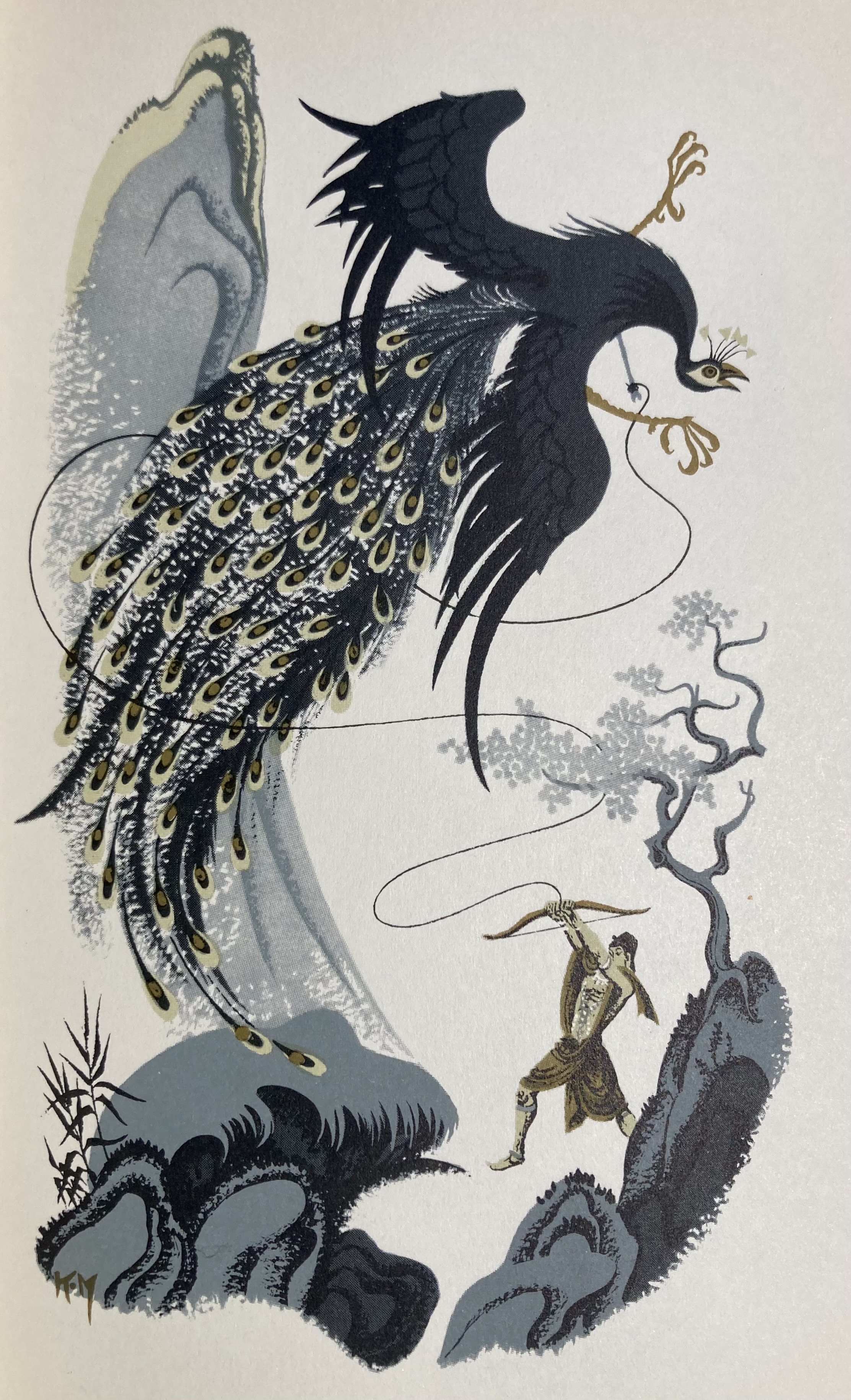
Joan Kiddell-Monroe's illustrations in "Chinese Myths and Fantasies"

Chinese Myths and Fantasies was published in 1961 by Henry Z. Walck. It contains retellings of folklore tales by Cyril Birch, an England-born author and professor who I believe is still alive at age 97, based on what I can find online. He's still listed as the Louis B. Agassiz Professor Emeritus in the Department of East Asian Languages at the University of California, Berkeley, after retiring in 1990.

Chinese Myths and Fantasies is split into three sections: The Conquerors of Chaos; Fairies, Ghosts and Others; and The Revolt of the Demons. The best story title, by far, is "The Man Who Nearly Became Fishpaste." 

This book is a discard, probably long ago, from the public library system in Niagara Falls, New York. I understand the need to discard books and keep the finite shelves of libraries stocked with books that people want and need, but it's a shame that this book isn't still on a shelf for some young person to discover while browsing; it's really quite timeless and beautiful. Which brings us to the illustrations of Joan Kiddell-Monroe (1908-1972). The book features a combination of gorgeous color illustrations, done in shades of blue and brown, and smaller line drawings.
 
Kiddell-Monroe illustrated the initial books in the Oxford Myths and Legends series, which spanned tales from Ireland, Scotland, Wales, France, Scandinavia, Russia, Yugoslavia, Switzerland, Germany and Japan. The books have remained in print, but unfortunately not always with the original illustrations. On 50 Watts Books, Will Schofield writes, "When Oxford and other publishers sporadically reprinted these volumes after 1978, they cut the color illustrations completely (not even including black-and-white copies), which means they are forgotten and will probably remain forgotten. Some of the reprints use new illustrations. Most of the books are easy enough to find (especially as library discards), but you have to pay attention to the dates. American publishers — notably Zalck — sometimes brought out editions simultaneously with Oxford. All of the 60s and early 70s Zalck issues I have seen include the color illustrations."1

Here are some examples of Kiddell-Monroe's wonderful work in Chinese Myths and Fantasies: 
You can see some of Kiddell-Monroe's work with a different genre of books on this 2017 post at The Passing Tramp.

Getting back to Chinese Myths and Fantasies, there are a handful of great reviews/memories on Goodreads, but this one, posted by Mauve Guava almost exactly a year ago, is my favorite: "One of my favourite books during my early teens. A bottle of coke, Garibaldi biscuits, Chinese Myths and Fantasies was a taste of heaven and beyond. Simply transports you to magical faraway lands."

Footnote
1. 50watts.com is a fabulous website that received praise in a 2011 article in The Atlantic by Steven Heller, who wrote about the idea of curatorial blogs as the new museums. An excerpt: "Many blogs are indeed galleries in the cloud, extending interest with artifacts where traditional museums and libraries will not venture. ... I've admired a few of these troves, and the most engaging, for its obsession with bibliographic graphics—book covers, jackets, and illustrations—is called 50 Watts and curated by Will Schofield, a 34-year-old bibliomaniac. ... There is no organizing principle, though the posts tend to group themselves together: book covers, ephemera, weird kids' books, features on forgotten writers, artists' books, contemporary drawing."

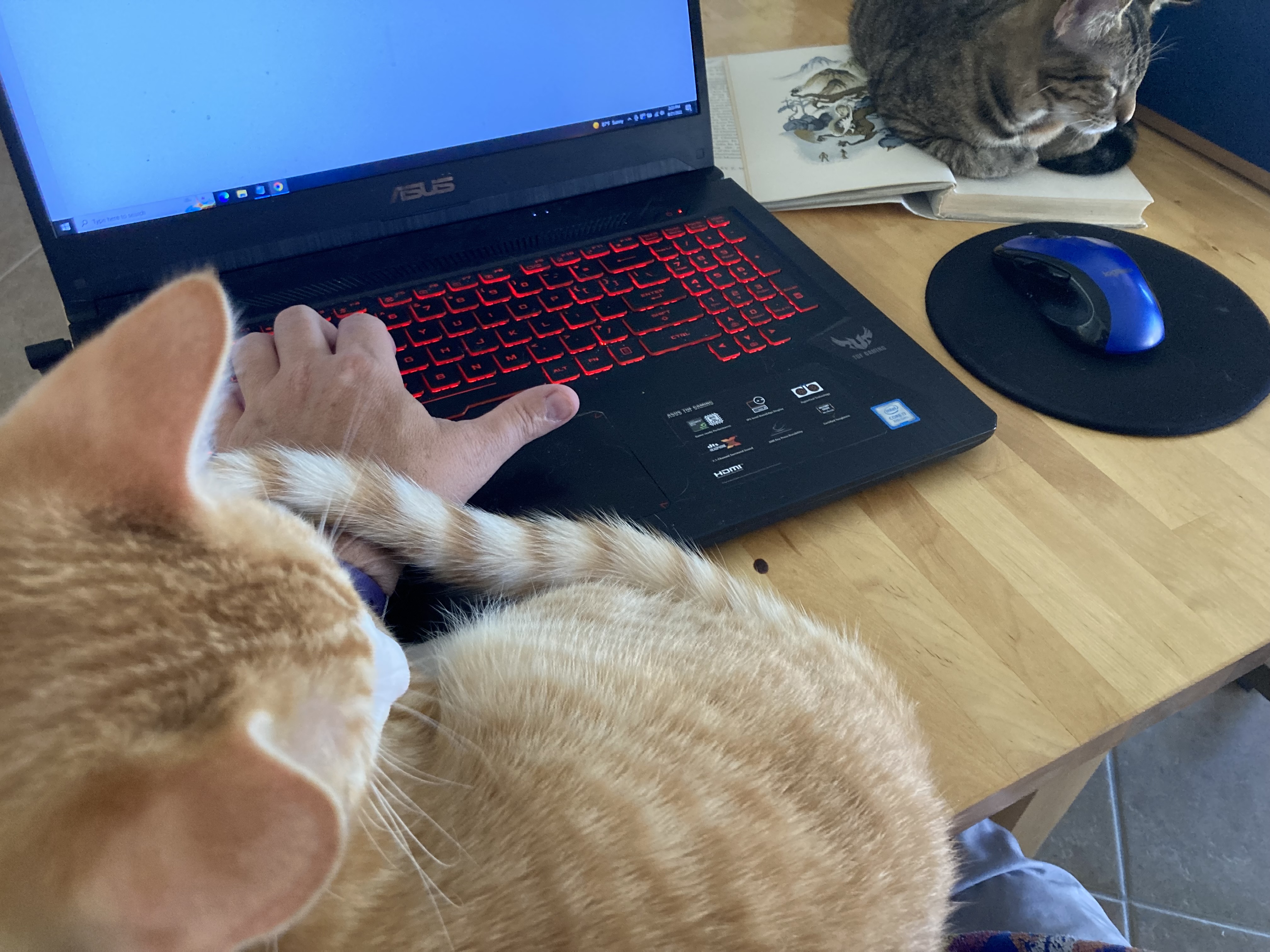
Bonus outtake on the rigors 
of blogging with 17 cats

Sunday, August 21, 2022

Summer Sunday shelfies
(plus cats, of course)

Friday, August 19, 2022

From the readers: Bookdumping, needles and pronouncing Mousehole

The first message in today's roundup is a combination Postcrossing/Papergreat message. Through Postcrossing, I sent Cindi in the UK a postcard of the Lewis chessmen and told her about the cats and how hot it is here in Arizona. After receiving the postcard, she went to the blog and read the August 7 post Kipple 'n bytes: Thoughts on what we do and don't preserve. These are her thoughts on it all:

"Hi Chris, what a beautiful card you sent me, thank you! And you gave the temperature in C, which is helpful. The record here in England is 40.3, Alexa tells me. Poor fluffies! That can’t be fun, I’ve heard it said that paws can be burnt on hardstanding in that heat. Thanks for your blog. Re: kipple, after lessons learned after a maternal death, we decided to downsize about 8 years ago. Now we live in a small flat where we can’t accumulate. Quite often, as we only have a few bookshelves, we go ‘bookdumping’ at our local train station. It’s really fun placing books all around the place, then scuttling to the upper shopping balcony to observe who picks them up. I have also become acquainted with the concept of library books! Currently munching my way through a sandwich of Christopher Isherwood and the harder to understand (because of culturally very different references) Joan Didion."

That's definitely the kind of "bookdumping" I can get behind! So wonderful! Also, hardstanding seems like a much better and more precise word than pavement. 

From the Readers (2022 edition), plus many cats: Jarak Dekat wrote, "Oh my God, manies cats. I love it," and now I think that Oh my God, Manies Cats has taken the lead for the title of my eventual autobiography.

And Inky from the On Shoes and Ships and Sealing-Wax blog wrote: "Hooray, you're back!!! It seems you are leaning towards your own version of Millions of Cats. (I must add I've been enjoying all the pics of them on your Twitter page.)"

Regarding that: The long, long Twitter thread of daily cat pictures can be found here.

"Prinzess Victoria" and a tiny old package of sewing needles: Cat from the Cat's Wire blog wrote: "Very interesting, thank you! I just wrote a blog post about needles myself — among them Princess Victoria needles — and was amazed at all the different labels I could find for them online! My own are 'Finest silver eyed sharps' in a size 12, no country of origin and 'Princess Victoria'."

1911's "The Isle of Wight," its provenance and Joseph Sadony: Roger Allen wrote, very helpfully, "In the first inscription Blenheim could be name of a house — Mrs. Paterson's, Mrs. Mitchell's — in Newport. In local directories it may just be recorded under the street number, which would make it difficult to identify."

Cheerful Card Company can help you earn extra money for the holidays: Unknown wrote, "I sold them for years. I too am 66 and had a loyal customer base. So much so that when I stopped I had customers calling me. Only reason I stopped was when they sent out this year's kit and several weeks later sent the letter asking if you wanted them!"

The somewhat obscure "Mousehole" by Nettie Mann Pender: Roger Allen, kindly checking in again, wrote, "Mousehole — the village — is pronounced 'muzzle' or to rhyme with 'towsle'."

Thoughts on aspirational reading: Finally, Brian Busby of The Dusty Bookcase, wrote: "In the early nineties, I made a point of taking on the longest book I owned, but had not read, to bridge an old and new year. For example, I remember starting David Graham Phillips' Susan Lenox, Her Fall and Rise in December 1990, and finishing it in January 1991. Others tackled included Norman Mailer's Harlot's Ghost and The Executioner's Song. Don't know why I stopped. Dreiser's An American Tragedy beckons! Must admit, there's no form I admire more than the novella."

Wednesday, August 17, 2022

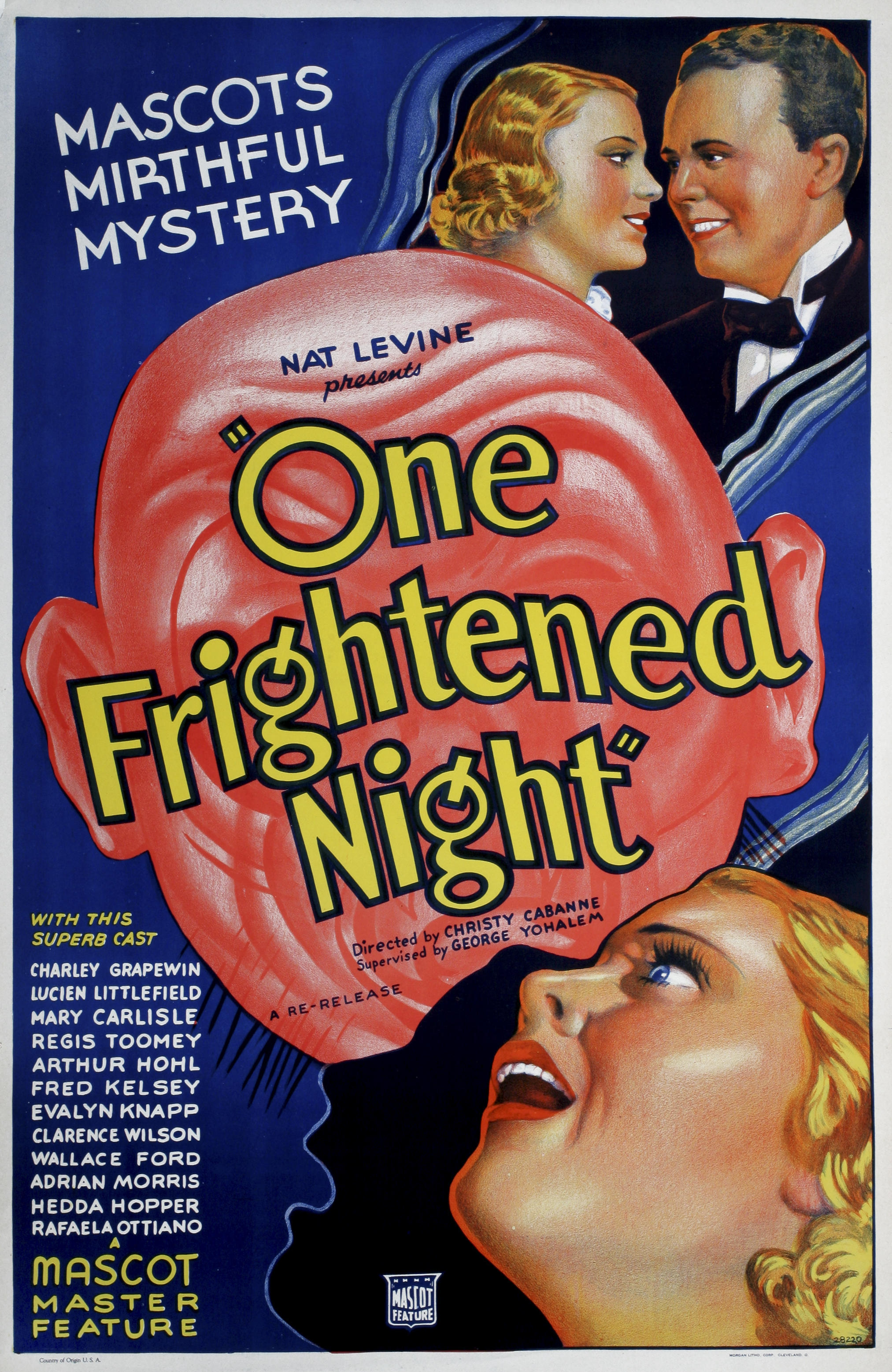
Poster for 1935's "One Frightened Night"

This is the delightful poster for the 1935 thriller/mystery/comedy One Frightened Night. The film's "monster" is shown in the middle of the poster, underneath the text. That's about right, because it's not in any way a monster movie, nor is the purported monster terribly scary. I've been on a kick of watching "old dark house" movies circa mid-1920s to mid-1940s this summer, and have some more queued up heading into the autumn. Stuff like this and 1933's The Secret of the Blue Room. 

Old dark house movies have, as you might assume, creaky old houses filled with suspicious characters. They take place at night and, usually and preferably, during a howling thunderbumper. There are candles, secrets to discover, hidden passages, roaring fires, banging shutters and, if it's a good one, plenty of snappy dialogue. They're great comfort-blanket films. The king of them is the one that named the subgenre, James Whale's The Old Dark House from 1932.

This poster comes from CineMaterial, a wonderful archive for movie posters and a great website to browse. Check out 1909's A Trap for Santa Claus and so many others, onward through the decades of film history. There's also a dandy subsection of Polish movie posters for international films, featuring some incredible designs.