Tuesday, January 31, 2023

Postcard: Maude Adams as Peter Pan

This month I've been reading Armond Fields' 2004 biography Maude Adams: Idol of American Theater, 1872-1953.

Maude Ewing Adams Kiskadden is a fascinating figure. For a time, she was the biggest star in American theater and earned vast amounts of money from her performances. She was also incredibly private about her life and became a recluse upon retirement. Her privacy was likely related, at least in part, to her sexuality; she had long-term relationships with two women during her life. (I'm at about the 75% mark of Fields' book, and so far it sticks mostly to her stage career, plus her sabbaticals to address exhaustion and her health.)1

For her stint as Peter Pan in the American debut of J.M. Barrie's Peter Pan; or, the Boy Who Wouldn't Grow Up, Adams appeared on stage about 500 times, nearly all to standing-room-only crowds. Fields describes that run's final performance at Broadway's Empire Theatre on January 4, 1908:

"Champagne was served in the lobby; autographed programs were given out to patrons; and no one wanted the play to finish. At the final curtain, instead of taking bows herself, Maude brought out the entire company to share the stage with her. Applause continued for many minutes. Although the crowd shouted for speeches, none were given. In a final gesture, Peter simply blew on his pipes and skipped merrily off the stage."

Peter Pan memorabilia and fashion were a craze in popular culture. Fields notes that Peter Pan hats and especially Peter Pan collars were all the rage. There was a limited edition souvenir book, filled with photos, that sold for $1, the equivalent of about $33 today!

And, of course, there were postcards. I wrote about a postcard of Adams' summer home in 2020. This card actually features Adams, dressed as Peter Pan. The photograph is by the Otto Sarony Company and is part of the "Rotograph" Series. 

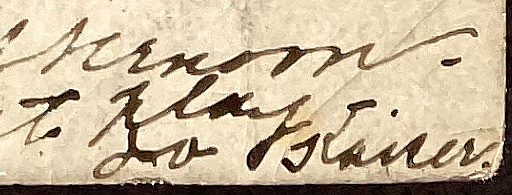
The card was mailed in 1906 to a woman in Kidders, near Cayuga Lake in central New York state. In that year, messages could only written on the front of the card. This is the short cursive message below Peter Pan:

Sunday, Oct. 14

Going to-morrow, to spend the week in New York. Will go to see Peter Pan Wednesday afternoon. Wish you could be with us, is such a sweet play.

I'm not even going to hazard a guess on the signature. Have fun, if you wish...

Footnote

1. Last month, Kaz Rowe released an hour-long documentary on YouTube titled "Maude Adams and the LGBTQ History of Peter Pan." It's well worth your time if this topic interests you.

Sunday, January 29, 2023

From the readers: "Wild Rivers," dragons, Crasimoff's World & more

There's a bundle of great reader feedback from the past month or so, plus some emails from 2022 that I absent-mindedly forgot about when I did the last roundup. So away we go...

1941 advertisement for the Modern Talking Picture Service: I got two new comments on this 2018 post. 

First, Keith Harter writes: "My father helped in the filming of the Susquehanna River for a film called Wild Rivers, made in 1965 by Humble Oil. I wish I could find it. Any leads would be appreciated."

I didn't find any leads on discovering a copy of the film, but I did find some additional background information about it. Maybe some readers will have more success than I did regarding the film itself.

I found an old eBay listing for what's described as a "1965 Humble Oil Esso 'Wild Rivers' Map Booklet / Film Tie-In." The image is shown at right.

And the January 1966 issue of National Parks Magazine notes that "during early summer [1965] the Humble Oil and Refining Company released a particularly fine film on a subject currently much in the minds of conservationists — the projected national wild rivers system. Wild Rivers, in full color and with commentary (the photographer was Larry Madison and the narrator, Burton J. Rowles) runs 28 minutes and looks at the scenic and outdoor recreational potentials of ten of the rivers, or parts of rivers, that have been mentioned for inclusion within the wild rivers system. The film is available on loan without charge, other than return postage, from Humble Oil, P.O. Box 2180, Houston, Texas 77001; or for persons or organizations strategically located, from Modern Talking Picture Service film libraries in 22 of the nation's cities."

The other comment I received about the Modern Talking Picture Service post was from Anonymous: "My mother was office manager for Modern Talking Pictures in Charlotte, N.C., from about 1958 to 1962. My brother and I loved going in on weekends to dig through the trash in the back room where films were repaired. We’d glue together bits of this and that to make our own movies! LOL we also loved previewing the new films at home."

Bet you'd love to still have those films, too! 

Dramatic postcard featuring a dragon and a ghost [help needed]: In a September email, Jess Chua wrote, "You have a remarkable blog, and I remember a little bit of Microsoft Encarta!" 

Chua was requesting to share a postcard image from Papergreat on her own blog: "I'd like to include it in a Halloween/spooky-themed post next month. I have more Western dragon art in the draft post and wanted to include some Eastern dragons. This postcard has a spooky element to it and the anonymous comment was enlightening."

Of course! Everything on Papergreat is for sharing. And there's no need to butter me up when you ask. Here's the post Jess published last October on Dragonsinn.net: "Halloween Dragons – October 2022."

1953 envelope from the Around-The-World Shoppers Club: Way back in March 2022, M. Yang Lu wrote from France to request permission to use a Papergreat image in a magazine article. He noted, "Thanks for your very interesting sharings on your blog Papergreat. Same as you, I love to reveal a piece of history through old documents and mails. One of your articles has caught my eye. ... I have done some research on one of the competitors of the company, International Gift of the Month Club. I'm revising an article ... to be published in la Philatélie française, the official magazine of the French Federation of Philatelic Associations. I would like to ask for your permission to reproduce in my article, the image featured in your blog page. I really appreciate that you have dug further on the Internet about the Around-the-World Shoppers Club. The sources that you cited were of great help to me."

Later, he sent a PDF copy of the article, which is written in French. Here's part of the page featuring the image from Papergreat:
Try these word problems from 1900's "School Arithmetic Advanced Book": Anonymous wrote a two-part note, trying to tackle a math problem from the old textbook:

"I like these. Perhaps I'm wrong but it seems like the answer to question d) would be 48 days and not 24? If 1/3 of the workers were released it would take 3 times as many days to do the same job. If it would have taken the full crew of 60 men an additional 16 days to complete the work then it stands to reason that it would take 20 men 48 days to complete the same task."

[Later...]

"Oops I am wrong. 1/3 of the workers released. That means 2/3 remain. That would be a factor of 1.5 times the number of days to do the job. 16 days x 1.5 = 24 days."

The movie books before the internet and IMDb: Joan wrote: "I'm not 100% sure I watched 20 new films in total in 2022 (!) but three of my favorites are on this list — Chungking Express, Grand Budapest Hotel and Licorice Pizza. They actually may all be in my top 20 favorite movies of all time list! Thank you for expanding my horizons. Not just with cats."

Now let's see if I can come up with some equally good picks for 2023!

Old school library copy of "The Glass Slipper": Joan wrote: "Hey, I know E.H. Shepard well from his work on Winnie-the-Pooh!"

1984 advertisement for play-by-mail game Crasimoff's World: Iain Wilson of the podcast and Twitter account Roll to Save shared these great memories of the game: "I LOVED playing Crasimoff's World! Although memories are hazy, I do remember sitting with anticipation waiting for the packet to turn up every week. Likewise, I remember my little crew protecting a town called 'Obin'. However, by far my best memory was attending 'Crasimeet' in the mid 90s, where myself and a few others turned up in Thornton-Cleveleys in the UK for a weekend of gaming. It was a ton of fun, and I remember corresponding (by mail of course!) with a few of the guys I met there as we tried to get our parties to meet up. That was when I also learned that there were two versions of Crasimoff's World — an older 80s version and one for those like me who started later. I can't quite remember the differences other than spellcaster in the 'new' version used powders to cast their spells whereas older casters didn't."

Delving into Henry K. Wampole & Company: Sheilah Forward of Jamaica first emailed almost exactly a year ago to comment on one of Papergreat's oldest posts: "As a kid in the 1950s I loved cod liver oil. I found your 'history' about Wampole in a trip down a rabbit hole this morning investigating Mother's attempt to make me enjoy my daily dose of Wampole's. I hope you don't mind that I used some of your work to create today's Facebook entry. I've been posting everyday since we were locked down here in Jamaica on March 25, 2020. Today is Day 668. In the beginning, I presumed it would be a couple of month's commitment."

And here's an excerpt from her Facebook post, which she emailed to me separately: "Wampole’s Liquid, Tonic, Mixture or Elixir. I just called it 'Disgusting'. Mother used to dose us all with a spoonful of that wonderful, thick, golden liquid, cod liver oil, every day (probably just in the ‘almost winter’, ‘winter’ and ‘not quite winter’ seasons) to replenish winter’s vitamin deficit. I know that I looked forward to it, though my sisters may not remember it the same way. One day Mother gave us Wampole’s. What a ghastly surprise. It was red, runny and sickening sweet ‘cherry flavoured’ — supposedly children would swallow it with a smile. I did not smile. For some reason the name Wampole snuck into a dormant brain cell this morning and I sought to know more about this dreadful potion."

Scholastic book: "Arrow Book of Spooky Stories": There are two comments on this 2023 post. Tom from Garage Sale Finds wrote: "I've always said, my favorite day in school every month was the arrival of the Scholastic order form along with the books you ordered the previous month. I loved these spooky story books along with the 'mysterious monsters' books and was sure to order whenever offered. And I'll have you know, I do get these spooky story books out and read from then when my family has a campfire outside."

And Shawn Marie Mann from Cookbook Chat wrote: "My family was poor growing up but I was always given $1 to order from Scholastic. Back in the 1970s that dollar would go a long way, sometimes 4 books! And those books were well written, professionally illustrated and amazing. Today's kids have the magic of the internet but they will never have what we had back then. Thanks for this great post!"

Join the Wartime Reducing Party: Linda Whitney writes: "I love your site! Check out my Etsy store Hoozestuff. I have lots of ephemera there and booklets and such. I also have an older Lindlahr diet booklet from 1936."

Very obscure Manning-Sanders novel: "Mermaid's Mirror": The Brown Brontë writes: "I would also love to track down a copy of this! I found out that she wrote a letter on 6th June 1935 to her friend, the journalist Thomas Moult in which she mentions that 'Mermaid's Mirror' is out. She says she has asked Cassell to send him a copy, and that she hopes he will be able to write something nice about it. The letters are in Leeds University's Special Collections."

Indeed, it's a rarity. It appears that neither Selina Pennaluna (1927) nor Mermaid's Mirror (1935) is part of the Ruth Manning-Sanders estate auction that I mentioned in a recent post.

Thursday, January 26, 2023

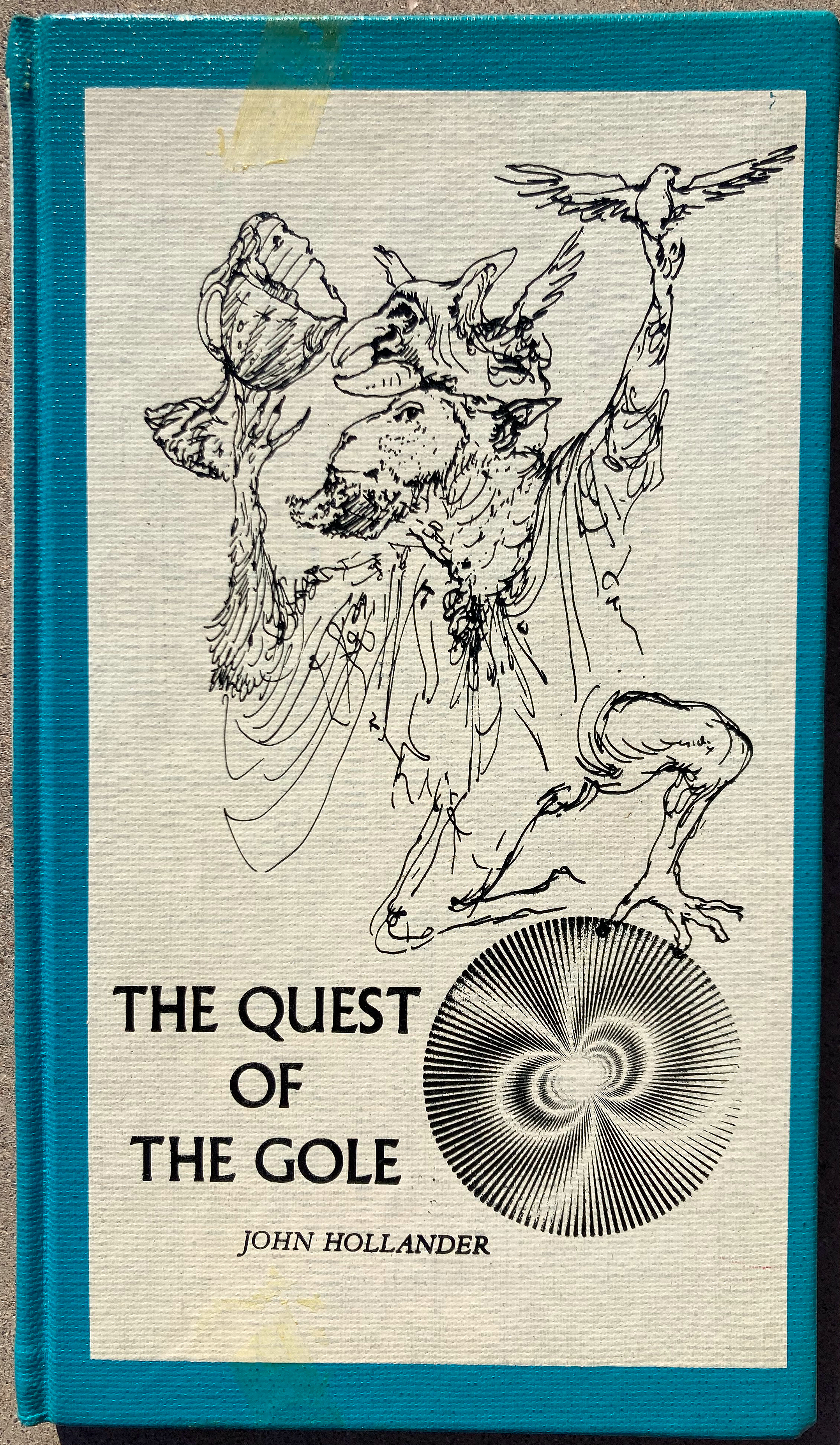
Book cover: "The Quest of the Gole"

  • Title: The Quest of the Gole
  • Author: John Hollander (1929-2013)
  • Illustrator: Reginald Pollack (1924-2001)
  • Publisher: Atheneum, New York
  • Year: 1966
  • Pages: 117
  • Format: Library-bound hardcover
  • Dimensions: 5⅜ inches by 9¼ inches
  • Provenance: Given to me as a Christmas present by Joan last month. Before that, it had been in the Spokane County Rural Library, and then a used-book store.
  • Dedication: For Jeremy, David and Raphael
  • Introduction: Hollander, who taught at Yale University and primarily wrote poetry, states in the introduction that time can erase even written tales. Paper rots. Tablets break. And fragments and memories are what remain. "The Story of the Gole is one of these old tales, and it can only be set down here at all because parts of it are still to be found in many ancient writings. ... [This book] tells as much about the Gole as is known today."
  • Format: The prologue is in verse. The following three-part tale is mostly prose, with some sections of verse intermingled. Hollander also weaves commentary smoothly into the tale, letting us know what is known, where the surviving sources conflict with each other and what details are lost forever.
  • Random sentence from the middle #1: "And he did make his home here in our city, learning our language, and living in a cave by the bay."
  • Random sentence from the middle #2: "Moad felt a strange kind of dizziness, as he realized what it was that was so remarkable about this common picture of the earth striving to meet something impossibly high above it."
  • Goodreads rating: 3.67 stars (out of 5)
  • Goodreads review: In 2009, Adam wrote: "The language in this book is rich and modeled, in parts, on medieval romances and ancient epics. Some episodes evoke Arthur, and others Beowulf or Gilgamesh. Unfortunately, the story ends up being what you might expect from a poet of the post-modern era; that is, it culminates in an insubstantial mirage, an abstracted daydream with no enduring substance."
  • Another review: Writing briefly about "Curiosities" for the magazine Fantasy & Science Fiction in 2006, Bud Webster describes the book as "tall, slim, elegant witty and eminently poetic" and further states, "The author's commentary is, for me, the most fascinating thing about this little book. Only a poet and teacher ... could have done it this well, and I'm glad he did."
Nebula (7 months old) sits alongside the spine of The Quest of the Gole.

Tuesday, January 24, 2023

Some of the books that helped to inspire Ruth Manning-Sanders

There's really interesting news this week regarding Ruth Manning-Sanders (1888-1988), the English poet and author who wrote dozens of beloved books for which she collected and retold folk and fairy tales from the all over the world.

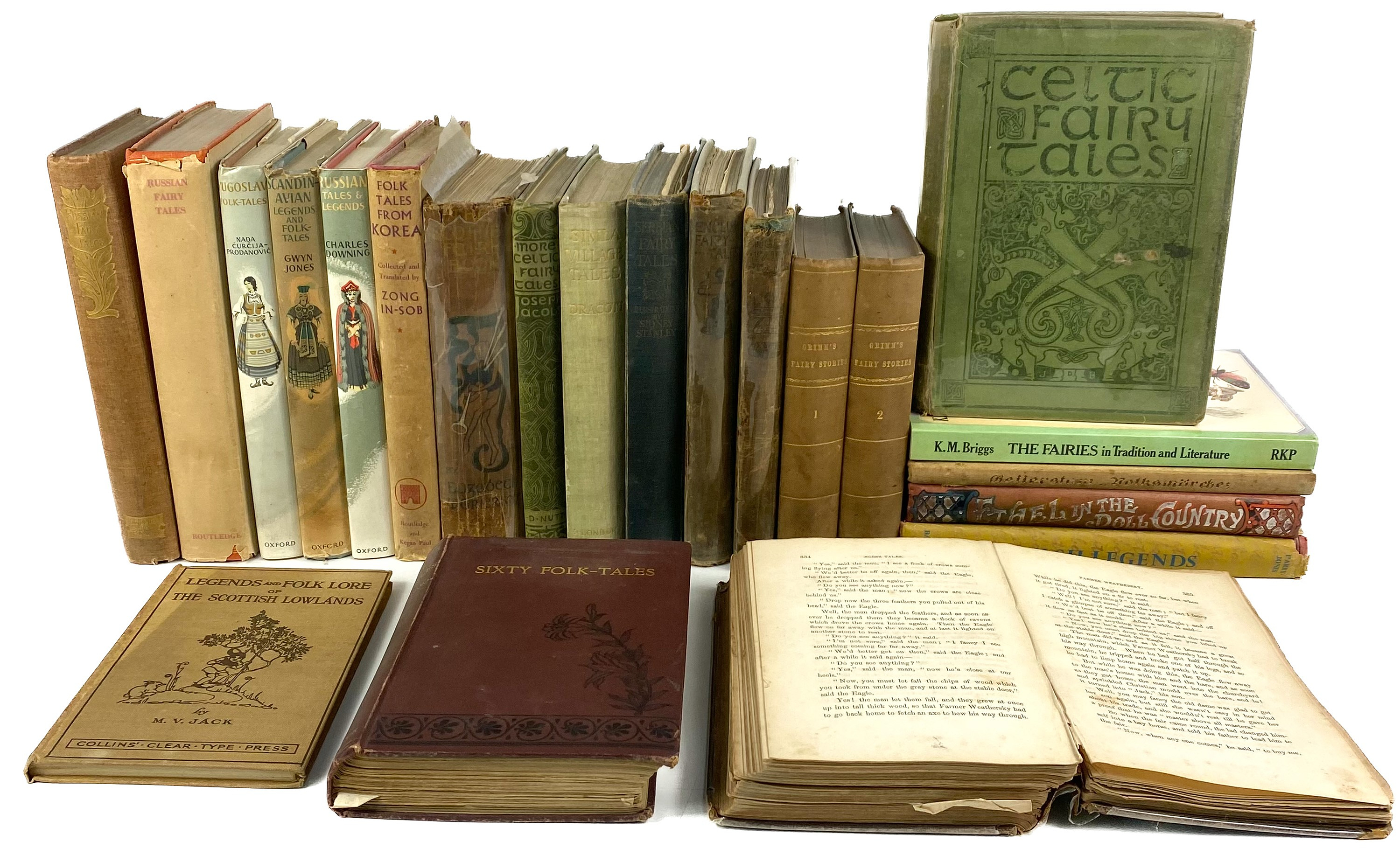
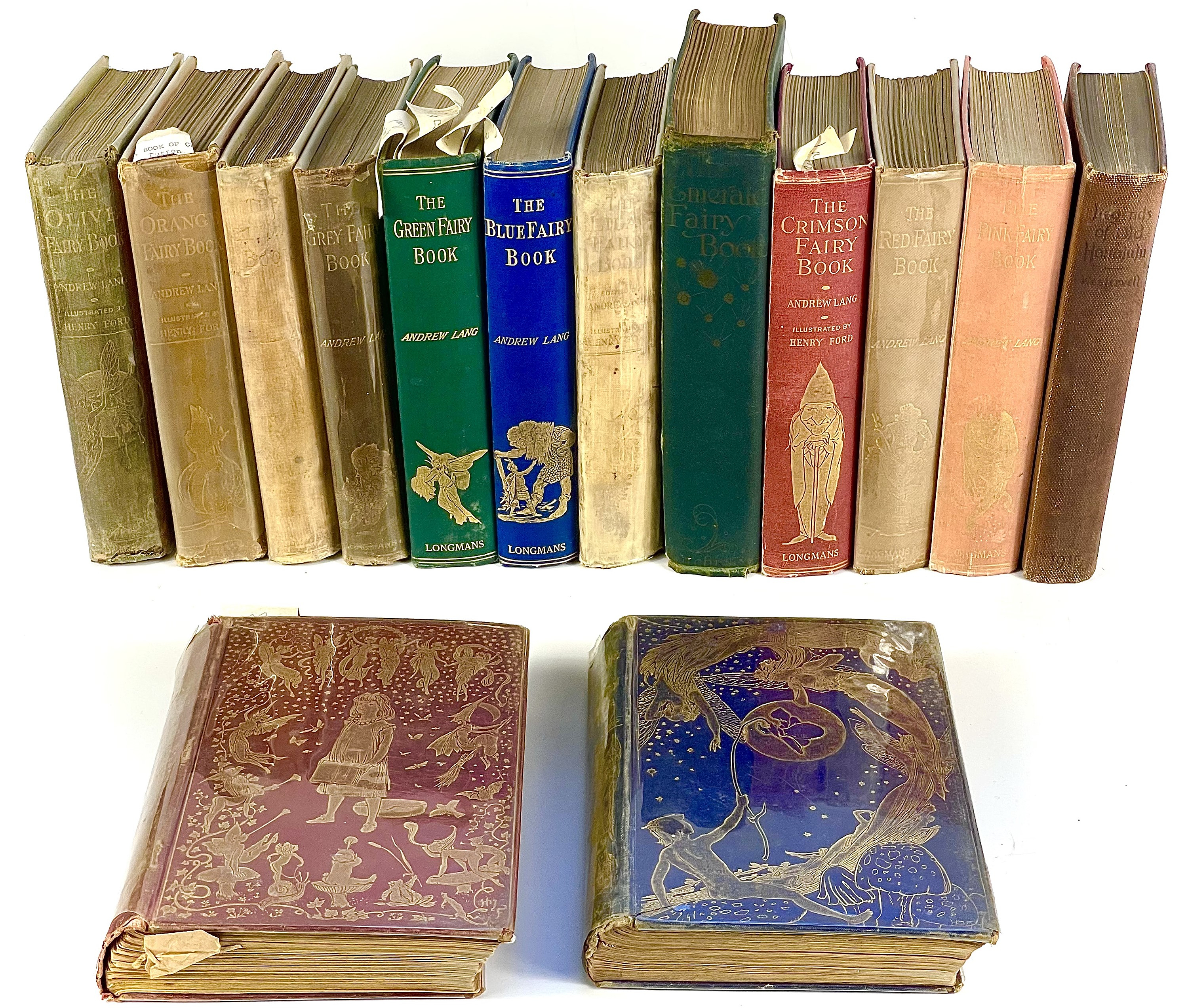
Many books from Ruth's personal library — the actual copies that inspired and informed the unique style she built as a teller of tales — are up for auction now at Lay's Auctioneers in the United Kingdom. I've included the pictures from handful of the lots in this post.

Copies of many of her own books, including her early fiction and poetry, appear in the auction listings, too. But, to me, the most fascinating lots involve the books by others that once sat on her shelves. The very books she read, possibly from childhood in some instances, and that worked their way into her fiber. For example, there an many volumes of Lang's Fairy Books, each with a color in its title, that were published between 1889 and 1913 by Andrew Lang and his wife, Leonora Blanche Alleyne.

There are dozens of other titles, too, collected into lots. This is just a small sampling, from reading the listings and zooming in on the pictures of the spines:
  • Scandinavian Legends and Folk-Tales by Gwyn Jones
  • Russian Tales & Legends by Charles Downing
  • The Fairies in Tradition and Literature by K.M. Briggs
  • Legends and Folk Lore of the Scottish Lowlands by M.V. Jack
  • Bygone Lancashire by Ernest Axon
  • Legend of the Micmacs by Silas Tertius Rand
  • Hero-Tales & Legends of the Serbians by Woislav M. Petrovitch
  • Greek Folk Poesy by Lucy Mary Jane Garnett and John S. Stuart-Glennie 
A few lots contain fairy tale books in languages other than English. We know from biographical information that Ruth had an important collaborator regarding these volumes. Joan Manning-Sanders (1913-2002) helped to research the stories that her mother then retold. Family members say that Joan learned to read French, German, Russian and several other languages in order to discover new source material for her mother. The magic wouldn’t have happened without this mother-daughter teamwork.

I'm going to see if I can get lucky with the winning bid for something, because it would be a treasure to have some of these volumes alongside my Manning-Sanders collection. But I have no idea how these auctions will play out on the other side of the pond. 

In a dream scenario, all of these books would remain together at the Ruth Manning-Sanders Children's Library and Archives in some quaint village along the coast of Cornwall. But that's not in the cards, and no such place exists. Maybe the next best thing is for them to fan out to new homes. Ruth spent much of her life pulling fairy tales from all over the world into her orbit. Now, the process can reverse itself, and those fairy tale volumes from her library can go back out in the world in a Big Bang of imagination, inspiring future generations.
 

Sunday, January 22, 2023

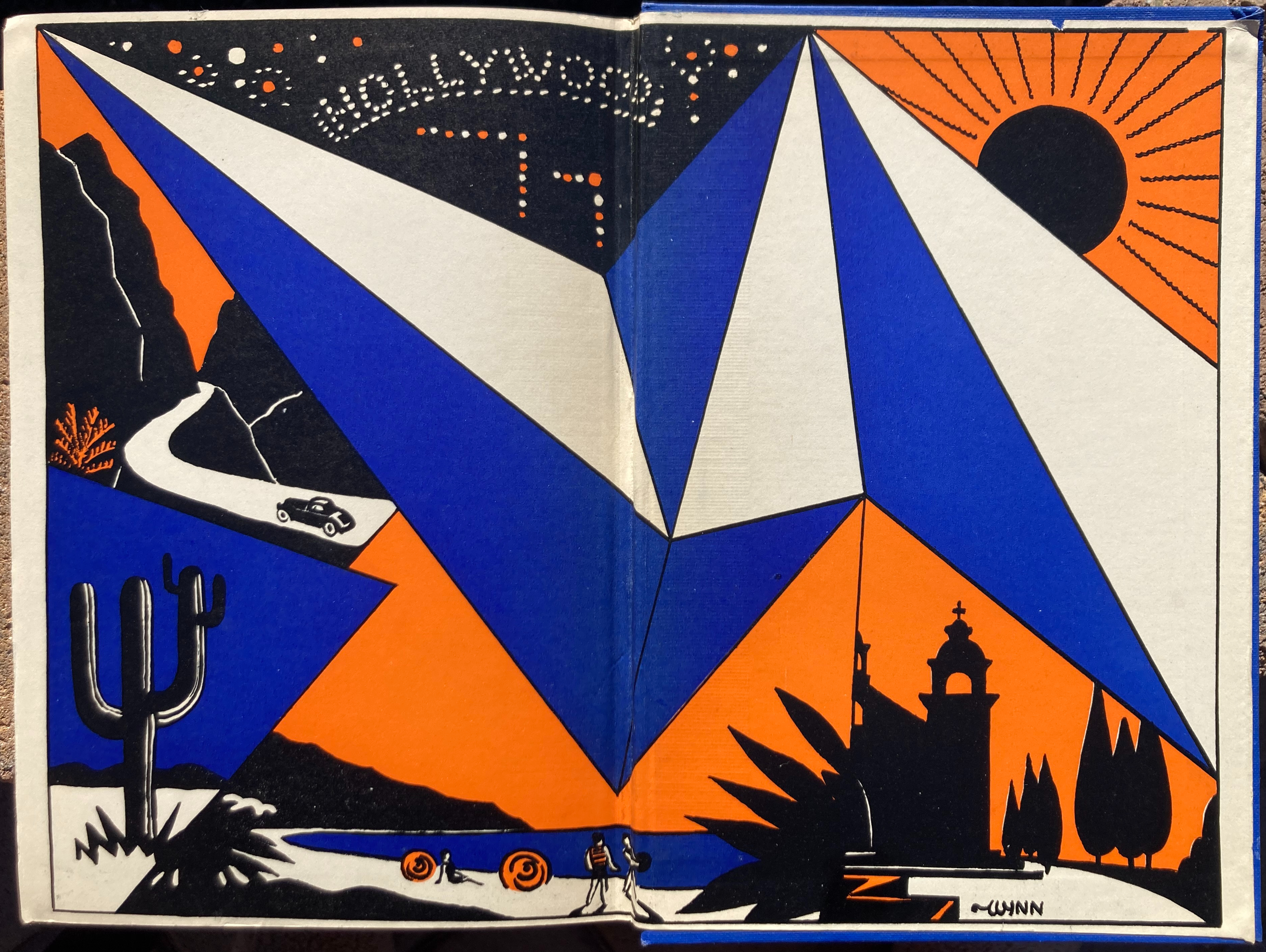
Wynn's dandy endpapers illustration for 1933's "Incredible Land"

These are the dazzling endpapers of Basil Woon's 1933 travel book Incredible Land, which is subtitled A Jaunty Baedeker to Hollywood and the Great Southwest. (Karl Baedeker published a series of guidebooks for tourists in the 1800s. They were so popular and respected that, well into the 20th century, Baedeker served as a synonym for any travel guide.)

My copy of the book doesn't have Wynn's equally dazzling dust jacket illustration, but I've included an online image of it here for posterity. I can't find much information about Wynn; having only a common four-letter moniker doesn't help much with the search engines. Any information sent via the comments would be appreciated!

This travel guide — with its hedonistic focus on finding women, food, beds and bootleggers in the West — was written during the late years of Prohibition and then essentially hit the booksellers' market just in time for Prohibition's repeal on December 5, 1933: Rotten timing for an author who had worked hard to let people know where to find illicit booze.

As The New York Times noted on December 10, 1933: "The lapse of time since this book was written has been less than a year, yet so much alcohol has flowed under the bridge during that period that many of Mr. Woon's pages have a distinctly historical flavor. This fact he himself acknowledges in a last-minute chapter of 'Addenda and Errata' in which he points out that repeal alters 'the entire entertainment map of the United States.'"

Here are a few tidbits about Arizona from Woon's book:
  • "The city of Tucson, once capital of Arizona, has of late been adopted by Eastern fashionable folk, many of whom have built fine homes there. The climate is said to be a cure for sinus trouble."
  • "During the rainy season in late summer the Arizona section of the road is sometimes impassable, due to cloudbursts transforming the desert arroyos into sudden torrents."
  • "From Roosevelt [Reservoir and Dam] one may continue southeast to Miami and Globe, copper smelting towns, and on through the Apache reservations to the Mormon colonies near Safford."

Other posts with endpapers illustrations (for your online browsing pleasure on a rainy or snowy day)

Thursday, January 12, 2023

Scholastic book: "Arrow Book of Spooky Stories"

A few days ago, author J.D. King asked on Twitter, "Do you guys remember Scholastic Book Fairs? Did you have those in your school?" It's one of the great evergreen Twitter prompts for bookish types, because it always spurs plenty of enthusiasm and nostalgia in the replies.

But responses these days also leave me feeling a bit old. They're from people happily reminiscing about times long, long after I was attending Scholastic book fairs and filling out those monthly forms to order books. Some folks talk fondly now of the "good old days" when they got Goosebumps and Animorphs books.

For me, the heyday of Scholastic fairs and in-class order forms was about 1978 to 1983. So I was getting stuff by Judy Blume, Three Investigators books, Peanuts-themed novelty books like the Peanuts Lunch Bag Cook Book that's on my list to write about, and maybe a compilation of Garfield strips.

For me, though, the keenest nostalgia is for the time even before that. I love discovering and writing about Scholastic books from the 1960s and early to mid 1970s, and have have fifty-plus post on that topic over the years.

In 2015 I wrote about 1960's Arrow Book of Ghost Stories. Today, it's the paperback volume that was a followup to that title: 1962's Arrow Book of Spooky Stories, also edited by Nora Kramer1, and this time illustrated by Erwin Hoffman. It's Scholastic book TX 331 and initially had a cover price of 35 cents.

Here's the table of contents:
  • Horace the Happy Ghost, by Elizabeth Ireland
  • Never Mind Them Watermelons, by Maria Leach
  • The Tinker and the Ghost, by Ralph S. Boggs & Mary Gould Davis
  • The Lucky Man, by Maria Leach
  • The Stubbornest Man in Maine, by Moritz Jagendorf
  • Here We Go, by Maria Leach
  • The Friendly Ghost, by Elizabeth Yates
  • The Dancing Jug, by Lupe De Osma
  • The Strange Visitor, by Joseph Jacobs
  • A Shiver of Ghosts, by Cyril Birch
  • The Ghostly Fisherman, by Natalie Savage Carlson

Some of these authors show up in other Scholastic anthologies. Leach, a folklorist who wrote The Soup Stone: The Magic of Familiar Things, and Jagendorf have stories in Nine Witch Tales. Cyril Birch was also a folklorist who wrote a book about Chinese myths that I discussed last summer. (When you've blogged this long, you can almost always find ways to connect to past entries.)

There are, of course, a lot of fond memories of this book. Some folks specifically remember that it was through Scholastic that they discovered the book. Writing an Amazon review in 2011, The Grey Piper stated, "Great spooky stories! Aimed for kids of course, I had this when I was a kid and just wanted to revisit. Some of these might even make good stories for adults, told in a more mature style around a fireplace on a winter's night! Very nice introduction to the ghost story for young readers."

And in a short review for Goodreads in 2014, Pamela wrote: "I read this when I was in third grade. It is best read with a flash light in a tent with your girl friends or with your Girl Scout troop. Lots of fun."

Footnote
1. Nora Kramer lived from 1896 to 1984. Her obituary in the July 6, 1984, edition of The New York Times described her as an author, editor, and expert on children's book, adding, "She was founder and director of the Book Plan, a personalized book selection service for young people, which she began under the name of Eleanor Brent." She also went by Edna Mitchell Preston for some works.

Tuesday, January 10, 2023

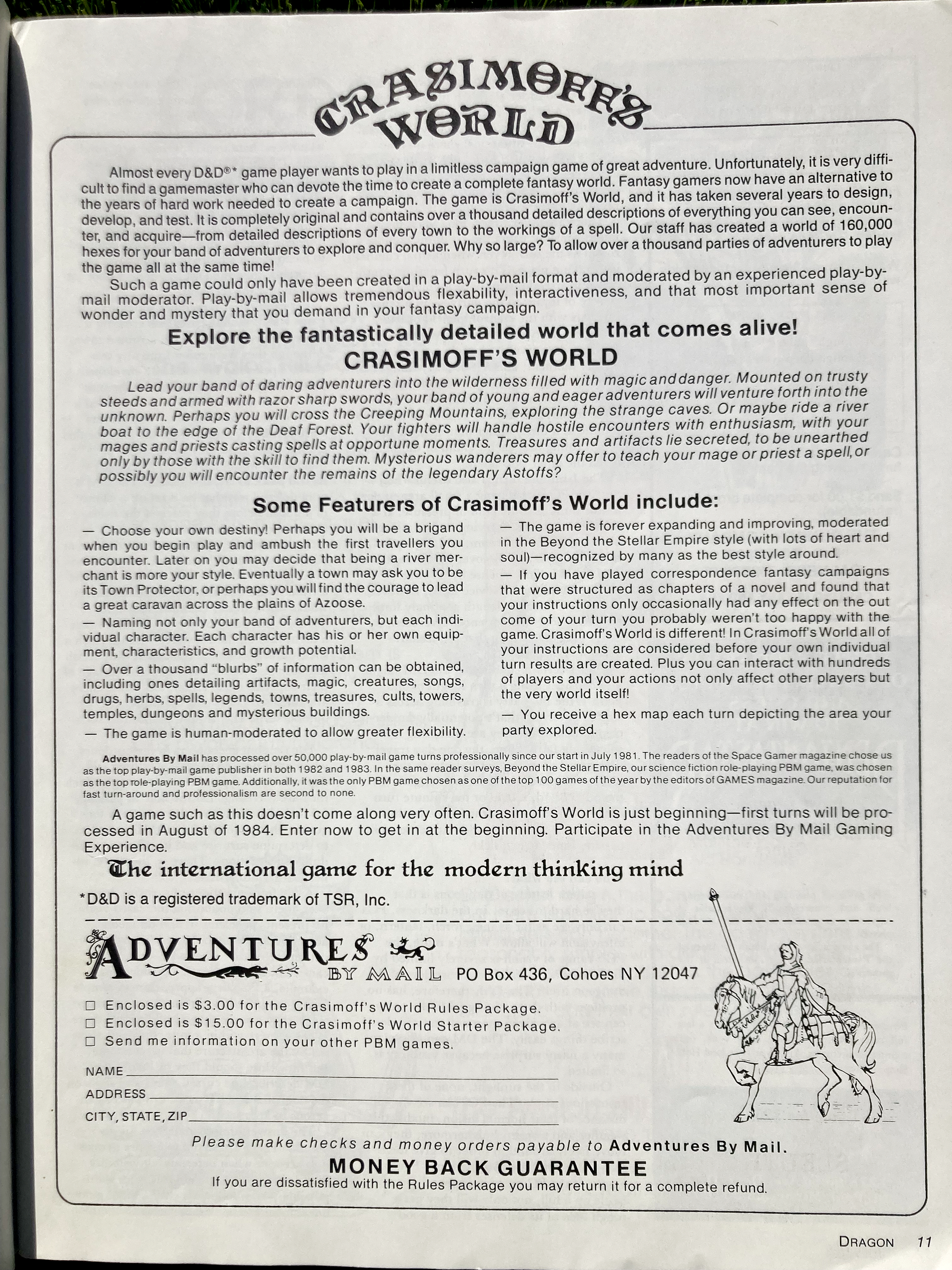
1984 advertisement for play-by-mail game Crasimoff's World

This full-page advertisement from Dragon magazine #87 (July 1984) touts the play-by-mail roleplaying game Crasimoff's World.

In that era, if you didn't have a group of gaming friends on your block, in your dormitory or in your city, play-by-mail RPGs offered an opportunity to participate in some dungeoning and dragoning with folks from around the country in the years before participation in MUDs (playing by modem) became more feasible and served as the bridge to the dawn of the online multiplayer gaming that dominates today.

For Crasimoff's World, you needed a few dollars, stamps and envelopes. And plenty of patience. Wikipedia states that the game was the brainchild of Kevin Cropper and launched in 1980 in the United Kingdom, where it was very popular. This advertisement was part of the 1984 launch of the game in the United States, through a licensee. It states that "first turns will be processed in August of 1984."

Here's how the Wikipedia article describes the UK gameplay in the early years:
"Players paid £2.50 for the rulebook, selected a cast of nine characters who were either priests, fighters or mages, and gave the group a name. Cropper would then place the new band of adventurers somewhere in his campaign world, and send the new player a letter that described their starting location, as well as campaign news, recent events in the new group's locality, and some rumours. The player would then respond with what they wanted their party to do, including which direction the party was travelling, trades or purchases, possible actions if encountered by hostiles, and any special instructions or requests. Cropper would then send further information and updates, and the player would respond with their next turn. Each turn cost £1.25. If one player's party wandered into an area already inhabited by another player's party, Cropper would give each player the other's contact information so the players could confer directly to share information."

The advertisement pitches the exciting possibilities of the game experience, including being a river merchant, agreeing to protect a town or leading a caravan across the plains. Discovering "the remains of the legendary Astoffs" is hinted at. It touts that the game's human moderators (as opposed to computer code) allowed for surprises and flexibility within the RPG, which was experienced by players like a good fantasy novel each time a new thick envelope showed up in the mailbox. 

There's not a whole lot out there in terms of first-person memories about Crasimoff's World. James Maliszewski of Grognardia, my go-to online historian for 1970s and 1980s fantasy roleplaying, wrote last summer that "PBM gaming is a huge black hole in my own experience of the hobby, so I must admit to having a general difficulty in comprehending how they worked in practice."

I did find a couple other things of note:
  • Mike Lay's website includes a Crasimoff's World section that by some miracle of the interwebs is still online, even though it hasn't been updated since 1999. It contains descriptions of two parties (The Thanatari & The Silent Guard) and some descriptions of the parties' moves. If PBM RPG history is your jam, I might suggest printing out some of Lay's content before it's gone forever.
  • Iain Wilson of the podcast and Twitter account Roll to Save, which are devoted to RPG history, has mentioned in passing on Twitter that he used to play Crasimoff's World.
Related posts

Sunday, January 8, 2023

Old school library copy of "The Glass Slipper"

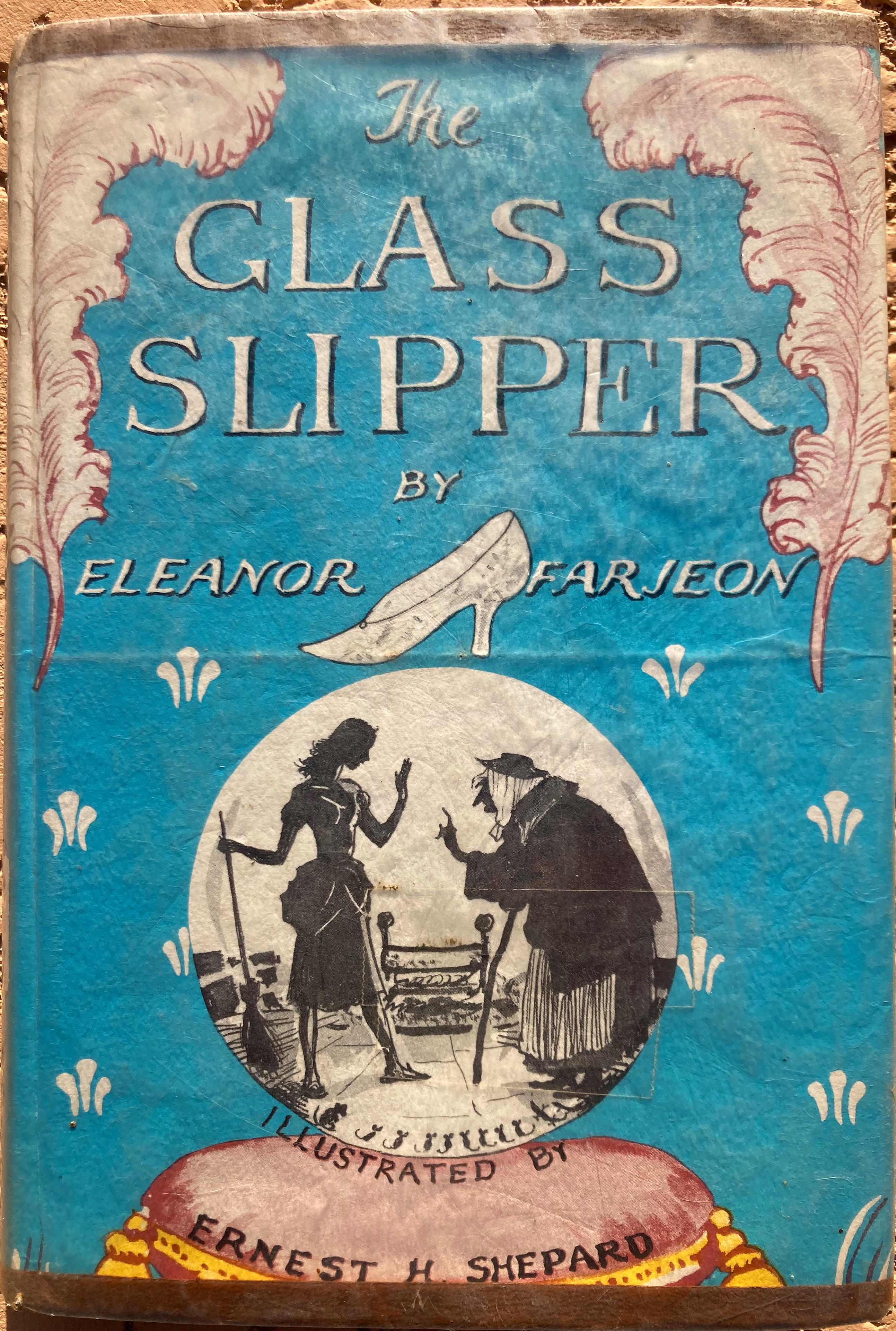
I discovered this old school library copy of The Glass Slipper, written by Eleanor Farjeon (1881-1965) and illustrated by Ernest H. Shepard (1879-1976), at the Salvation Army store in Casa Grande, Arizona. First published in 1955 (this is the 1967 printing) it's a new version of the old tale of Cinderella. "Eleanor Farjeon's magical way of re-creating an old folk-tale with fresh and original beauty has endeared her to thousands of devoted readers," states the dust jacket.

The book is actually a novelization of a play by the same name that Farjeon published in 1944 with her brother, Herbert Farjeon.

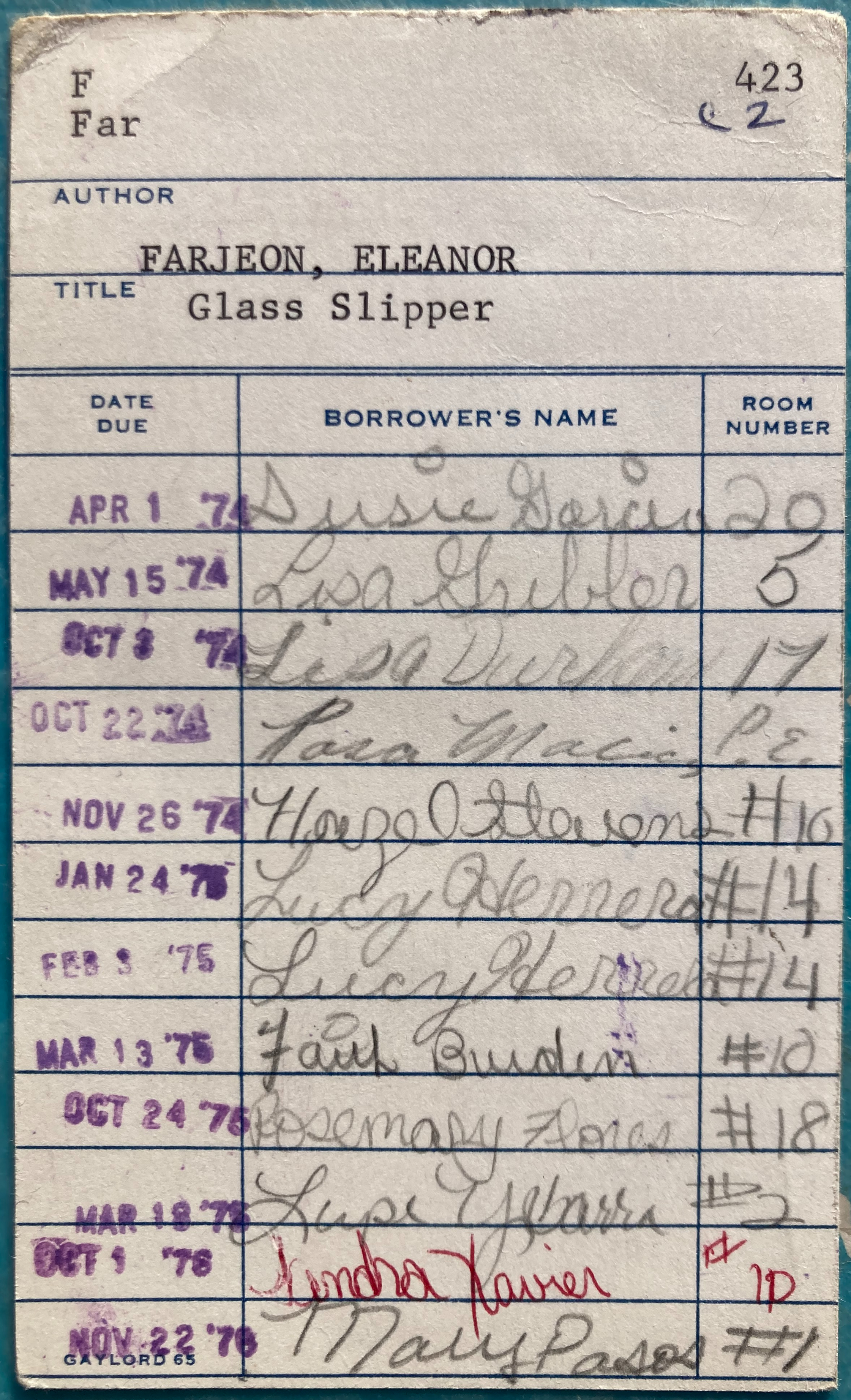
This copy spent a long time in school libraries. There are checked-out dates between 1971 and 1989. It is stamped inside with both WEST SCHOOL and ELOY JUNIOR HIGH LIBRARY, which is a Phoenix-area school. (So, the book didn't wander far.)

This cursive note appears on the title page:
November 13, 1967 — Viking — $3.30 — Alesco [?]
West School 423
1/70 Gift from West
The book is generally well-reviewed and beloved over at Goodreads. I thought this 2020 review from Julia Wise nicely summed up the pros and cons: "Delightful wordplay and rhymes, frothy, fun. My six-year-old was desperate for each next chapter even though it's not exactly a surprise how it ends. Typical early 20th-century fat shaming which I edited out on the fly, but for its age it wasn't as sexist as I thought it might be."

Here's a portion of a page that I think gives a good example of both the prose and Shepard's fun illustrations. 
It's always fun to find a used book with its circulation card and card pocket intact. It's a wonderful snapshot of all those who read it (or at least checked it out) over the years. In this instance, it appears that The Glass Slipper was read exclusively by girls here in Arizona. And they all had very good handwriting. It also spy one student who checked out the book out twice: once in the autumn and then again in the late winter. I suspect she must have really liked it.