Sunday, July 31, 2022

Colorful covers and endpapers of 1926's "Granny Goose"

Today's images are from my rough copy of 1926's Granny Goose, which was written and illustrated by John Rae (1882-1963) and published by P.F. Volland Company. (I previously featured Volland's trippy The Paper Dragon in 2019.)

This is Volland's statement on its "ideal" from the last page of the book:
"It is the Volland Ideal to give children only the best. Books for children should contain nothing to cause fright, suggest fear, glorify mischief, excuse malice or condone cruelty. That is why Volland books are called 'Books Good for Children.' Teachers, instructors, psychologists and parents endorse and recommend Volland Books as the most wholesome and inspiring juvenile literature — stories and verse that inspire; pictures that glow with beauty. Volland Books are graded; each contains a card telling for what age it is planned."
P.F. Volland was in business from 1909 to 1959 and was known for collaborating with dozens of outstanding artists/illustrators. Rae's work certainly falls into that category with this slim hardcover book, which measures 9¼ inches by 11¾ inches. As a minor aside, the cover calls the book Granny Goose and the title page calls it Granny Goose! with an exclamation point.

Here's a look at the endpapers, which don't scrimp on the geese.
The verses featured in the book (which is more than 50% illustrations) include mentions of King Kittery Kottle, Saint Wittery Wattle, Benjamin Bottle, Dobbeley Hobbeley Cobbeley Cory, Billy Bragg, Ned Willings, Burberry Biddle, Kirley McHugh, Tibby Tuppets, Molly Mopperty, Billings Bridge, John O'Groat, Tumbletown, Whipsy-ma-diddle, Old Johnny Bumble Buckely-Knees and Betty Battle. Some of those names/phrases are familiar, but others seem to have sprung from John Rae's wonderful imagination. There are also many good band names in the above list.

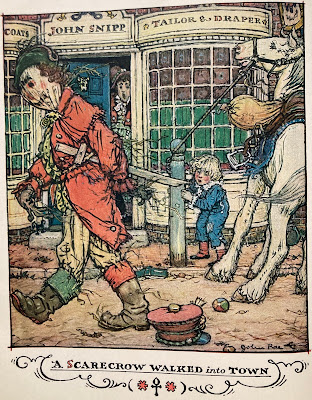
Here's a look at a couple of the interior illustrations.
The scarecrow is actually a bit on the creepy side, as is the verse that accompanies the illustration. It involves a scarecrow strolling into town, the snow turning black, bright-red hail falling from the sky and the awakening of a withery witch who comes running with a slashing switch. How, exactly, does this fit in with Volland's pledge that "books for children should contain nothing to cause fright (or) suggest fear"?

Friday, July 29, 2022

York Safe and Lock Company's April 1944 in-house magazine

For decades, York Safe and Lock Company, located in York, Pennsylvania, made perhaps the sturdiest safes in America. And they are still sought-after in the 21st century. As my former boss, Jim McClure, noted on the York Town Square blog in 2012, "York Safe & Lock safes and vaults are everywhere around the world. They simply don't wear out."

During World War II, York Safe and Lock was among the many companies that modified their production facilities to help the war effort. It even expanded to multiple plants around York County in order to provide ordnance and other necessities for the Army and Navy.

But also during the war, in April 1942, company president S. Forry Laucks died. That was perhaps the beginning of the end for the company, as Stephen H. Smith explained on the blog YorksPast in 2012: "In 1944, the Levine Brothers, of Leominster, Massachusetts, sensed an opportunity, systematically began buying out York Safe & Lock Company stockholders at large prices; by year’s end they owned the company.  While this was going on, the Navy Department in essence took over the York Safe & Lock Company because of the essential war materials being produced."1

After World War II, Harry Levine was named president and subsequently changed the name of the company to York Industries, Inc. Smith added: "In conjunction with the name change on January 3rd 1946, Levine sold the entire pre-war product line of safes, vaults and vault equipment; including trade names, patents, sales offices and franchised dealer organizations. This sale was to Diebold, Incorporated, they had been the second biggest manufacturer of safes and bank vaults in the country prior to the war."

And thus marked the end of York Safe and Lock.

During the war, it had this in-house company magazine, The Safe Combination. The first issue was in July 1943 and features Laucks, in memoriam, on the cover. I came across a handful of the magazines more than a decade ago and today I want to share just a few items from inside issue No. 10, from April 1944.

D.W. Wardrop was the editor of the magazine at that point, with Thomas Robison and S.T. Edwards serving as associate editors. Nineteen individuals from across the various York Safe and Lock plants are listed as "reporters." This issue's cover photo was taken by J.R. Miller of Dept. 458, Special Ordnance Plant.

Most of the news, of course, is related to the company's World War II efforts. There are updates on employees and their relatives who were serving in the military. There are also wartime items on gardening, gasoline conservation and the like. Finally, there's the social news you might expect to find in any company newsletter: banquets, sports leagues, etc.

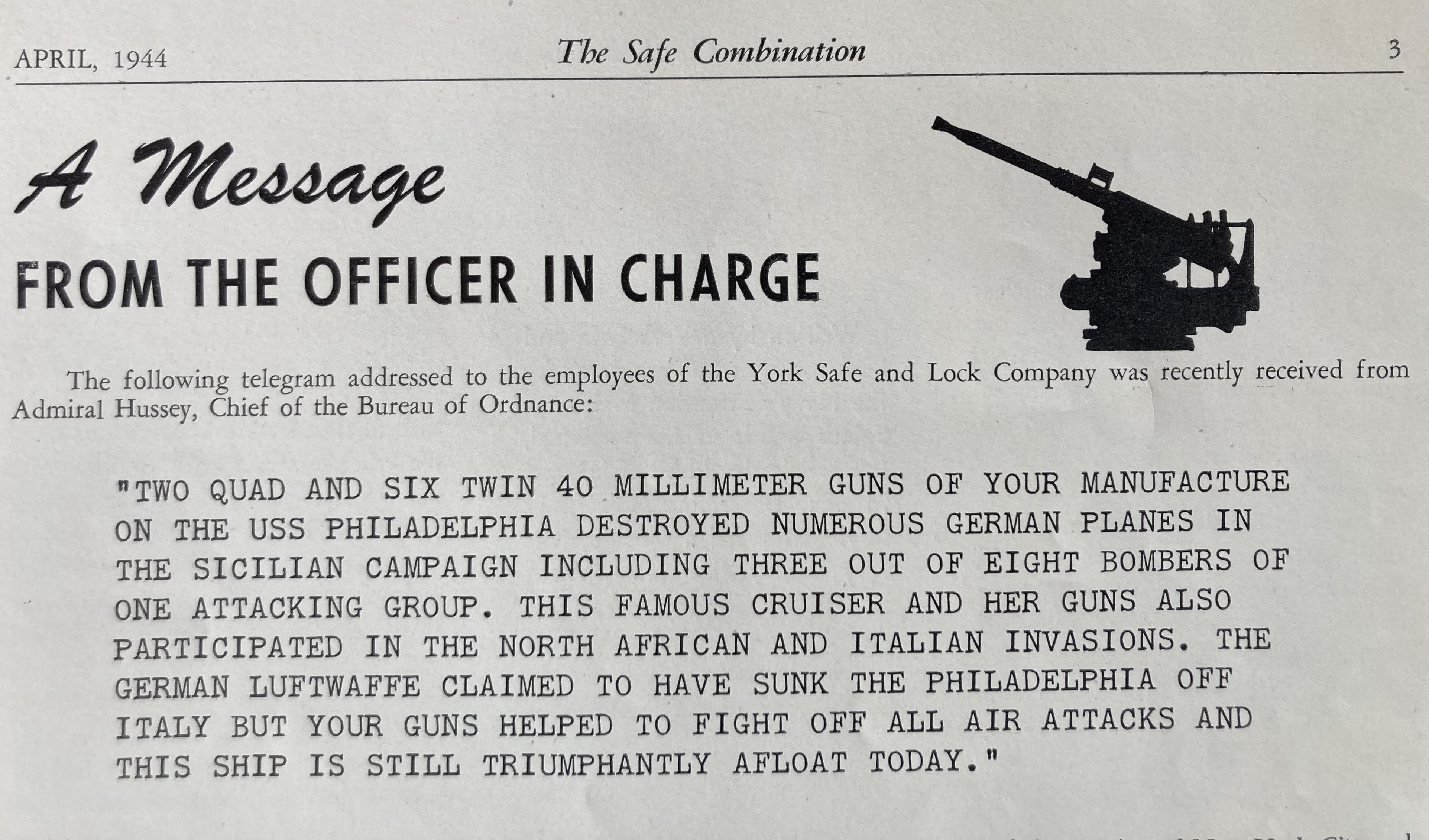
The issue leads with this telegram about the USS Philadelphia on Page 3:
The center pages of the issue are dedicated to those service members and Merchant Mariners who had been killed in action on various fronts of the war, including this notice for Martin D. Irvin.
There are also letters from service members telling their tales from the front and/or expressing their gratitude for issues of The Safe Combination received in the mail. This one is from Pvt. Vernon F. Shepp. (Shepp survived the war. He died in York at age 69 in 1988.)
Here are some additional snippets of the magazine's interior, including a profile of Fritz Ahlfeld, a member of the company's management.
Footnote
1. Smith's in-depth and fascinating post also explains the role that Capone-buster Eliot Ness played in York Safe and Lock's demise.

Wednesday, July 27, 2022

Peering inside and preserving 1962's "Dragons, Fairies and Fun"

For a book published in 1962, Dragons, Fairies and Fun by Dora Broome seems to be fairly obscure. It was published by Cultural Publications Ltd. of Nottingham, England, and it's a small-size, 152-page hardcover, measuring 5 inches by 7.5 inches. As of this writing, I can't find any other copies for sale online, and there are no reviews or websites that discuss it, to my knowledge. Perhaps documenting it here will help in a minor way to preserve it for history, lest it fade away completely. And if anyone in the United Kingdom has memories of this book, I'd love to hear them in the comments section. 
There are some signs of provenance inside the book. Pictured above is the plate that's been affixed to the inside front cover. Written in Welsh, it explains that the book is part of the Ceredigion school library and provides details on how students can check out the book, in similar fashion to the way we do so in the United States.

The message is signed by Alun R. Edwards (1920-1986), who was a longtime librarian in Wales. In fact, he's been remembered at a ceremony next month (August 2, 2022). The Ceredigion County Council website notes that Edwards "was first appointed librarian for Cardiganshire in January 1950. Over the next quarter century, he revolutionised Ceredigion's library services and indeed the book industry in Wales as a whole. Among his visions that were realised were the expansion of travelling library services, the College of Librarianship in Aberystwyth, the counties’ book purchasing scheme, the Welsh Book Council and the establishment of reading and discussion groups. Following the re-organisation of local government, he was appointed Librarian of Dyfed in 1950. He worked as the County Librarian for 30 years until he retired in 1980."
On the next page is a faded purple stamp indicating that the book has been withdrawn from circulation at Myfrgall Dyfed Library [?] and is available to buy for 10c. And on the page after that, pictured below, a child long ago indicated their clear ownership of the book. (I believe we all did this at times during our childhoods.)
Here's a rundown of the book's stories from the Contents page:
  • Hezekiah's Dragon
  • The Knight of the Dustbin
  • Hey Diddle Diddle
  • Will o' the Wisp
  • Aunt Quenelda and the Magic Mirror
  • The Magic Carpet
  • Little Bess
  • The Story of Odd
  • The Sugar Plum Fairy
  • Buffy
  • The Chimney-Sweep and the Mayor's Procession
  • The Cuckoo that went on Strike
  • The Fish Maid
  • Goodfellow
  • The Travelling Glow-worm
  • Mrs Goblin's Christmas Shopping
The illustrator is listed as B. Gerry, and I can't find any solid information on them, given that little information. For that matter, I can't find much about the life of author Dora Broome, either. She wrote 1951's Fairy Tales from the Isle of Man and 1970's More Fairy Tales from the Isle of Man, and her other titles include The Magic Journey, The Lifeboat Fish, Matilda the Radio Mouse, Lancashire Tales, Mary-Jo's Elephant, Royal Peke, Circus Pony, Ship's Monkey and Fairground Billy. With her mixture of interest in both fairy tales and the circus, she seems to have much in common with Ruth Manning-Sanders!
Gerry's cover illustration of the dragon is probably the best of the lot. There's little that's fantastical about most of the other illustrations, beyond perhaps this one.
And that's pretty much it. Again, I'm sure there are some folks out there with memories of this book. It would be great to hear from you and to share your thoughts for posterity. 

Monday, July 25, 2022

1911's "The Isle of Wight," its provenance and Joseph Sadony

Today we're taking a look at The Isle of Wight — "pictured by Ernest Haslehust" (E.W. Haslehust on the title page) and "described by Edward Thomas." It's interesting that illustrator Haslehust gets a higher credit on the cover than poet/author Thomas, who was killed in action in World War I in 1917.

There's no date of publication printed inside the book. According to WorldCat, which keeps a database of institutional library collections, it was published in 1911. Other online listings state 1915, 1915[?] and "circa 1920." There's a lot of sloppiness and misinformation on the internet, of course. I think we should go with WorldCat. Additionally, a previous bookseller has written "1911 1st ED" on one of the first pages of this copy.
 
The 64-page hardcover book was published by Blackie and Son Limited of London, Glasgow and Bombay. Wikipedia tells us that this publishing house was in business from 1809 to 1991. Some of the series it published over the decades include Beautiful England, Beautiful Ireland, Beautiful Scotland and Beautiful Switzerland. The Isle of Wight is part of the Beautiful England series, which was originally published from about 1910 through the 1925, but apparently saw reprints through the 1950s. According to Wikipedia, Haslehust was the illustrator for the approximately three dozen volumes.
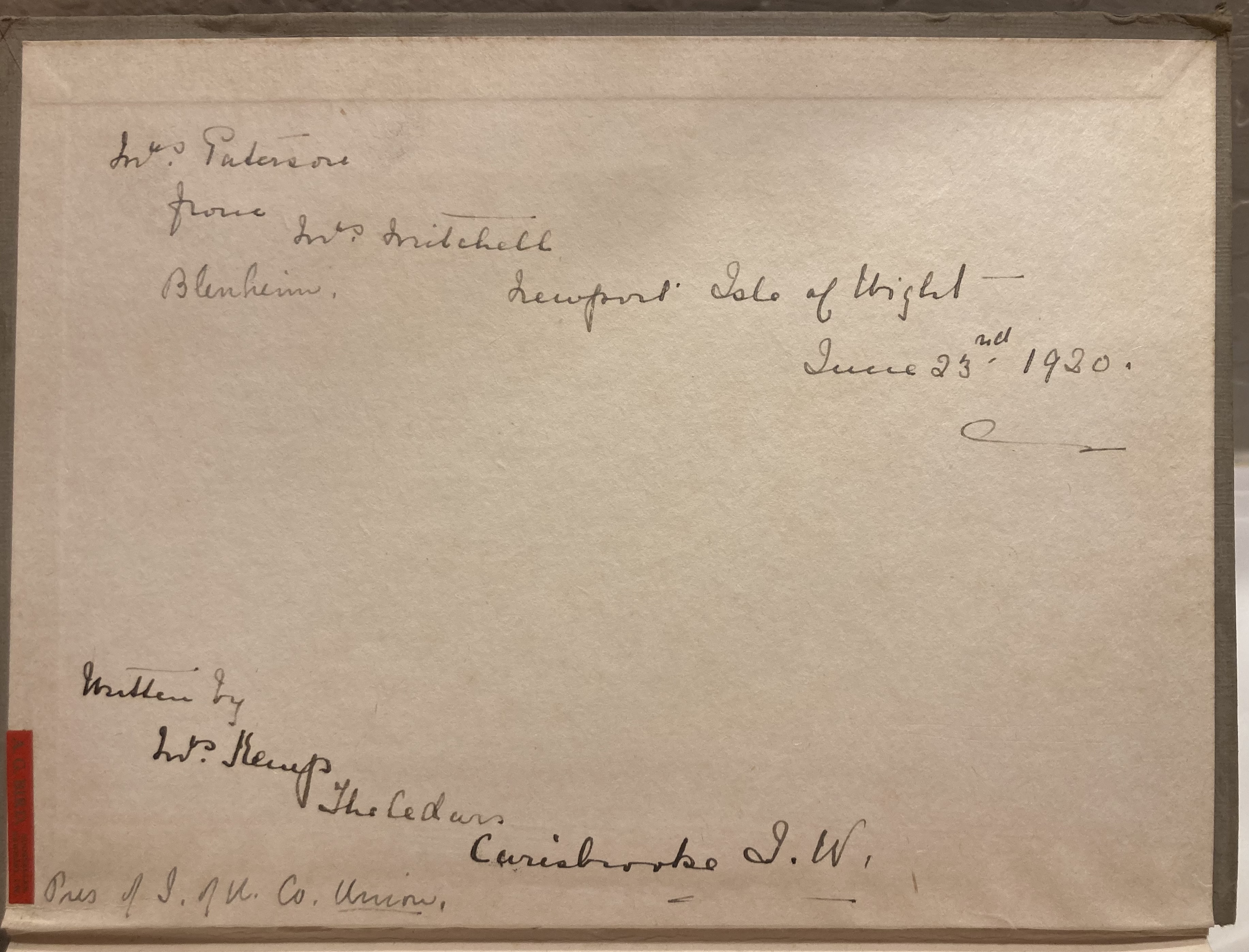
Moving to the inside front cover, there are some inscriptions of provenance:
I'm not sure what/which Blenheim is referred to in the first inscription. That's the name of at least two places in the United Kingdom. Newport and Carisbrooke are located on the Isle of Wight, a 148-square-mile island off the southern coast of England.

At first I thought The Cedars might be a neighborhood within Carisbrooke. There's no mention of it as such in Wightpedia (the wiki of Wight history) or elsewhere that I can find. But The Cedars is the name of a cozy pub on the Isle of Wight that looks like it could easily date back more than 100 years and could have also served as a residence. A 1903 church directory lists a Mr. A. Kemp at The Cedars in Carisbrooke, for what that's worth.

Then we have the bookseller's label for A.G. Bird, Bookseller, Newport, I.W. I found an obituary for Archibald Gaydon Bird that was published by Isle of Wight County Press on October 10, 1959. It states, "Mr. Bird was a native of Barnstable, where his father was a wine and spirit merchant. He spent some time in business at Croydon before coming to the Island, and in 1908 he purchased the old-established business of bookseller and stationer hitherto carried on by the Gubbins family at premises in High Street, Newport. The business has since become well known all over the Island under the style of A. G. Bird, and has now been carried on unbrokenly for well over a century."
Also in terms of provenance, there's an embossed stamp from a previous owner on the title page. It states "JOSEPH A. SADONY" and "PRIVATE." I have on my shelves another book with his stamp, Swedish Life in Town and Country (1904). Assuming I have the correct Joseph A. Sadony, he lived from 1877 to 1960 and was quite an intriguing figure. Buckle up.

First up, the Michigan estate he lived at was called The Mouth. The website SelfDefinition.org features Sadony's 1960 obituary from the Muskegon Chronicle. An excerpt:
Joseph A. Sadony, enigmatic sage of the Valley of the Pines in White River Township, died Friday evening at Hackleys Hospital, Muskegon. He was 83 years old.

"One of the best known and least understood men in Michigan," that was the opening statement of an article on Mr. Sadony in the Muskegon Chronicle on his 83rd birthday anniversary last Feb 22.

Mr. Sadony, in his cloistered life on his estate at The Mouth, devoted his years to the study and development of his theories as to the physical sciences, his theories as to the working of the human mind, and his theories as to the spiritual side of man. The insatiable curiosity of his unusual mind ran the gamut of all facets of human existence.

It was in the realm of mental phenomena that Mr. Sadony aroused the greatest curiosity and interest as to his theories. He was considered one of the world's foremost authorities on the subject of mental phenomena. It was this phase of his work which sometimes led to a misconception of the man. Mr. Sadony contended his theories of mental phenomena were based on sound psychological grounds, that there was nothing of the "clairvoyant" or "supernatural" about his mental capacities.
Sadony was the author of several books. Perhaps the most notable was his 1948 autobiography, Gates of the Mind. A review of the book at the website SearchWithin.org offers this conclusion: "What was Sadony's overall purpose for writing Gates of the Mind? He wanted to 'rescue the truth,' as he puts it, by exposing the charlatans and psychic racketeers who deceive us with tricks. He diligently demystified clairvoyance, extrasensory perception, precognition, telepathy, etc. by explaining and illustrating such phenomena in ordinary terms, and through personal examples in his life. Most of all, he wanted to show that inspiration and feeling compose the core of our heart, without which humanity would be but uninspired automatons with no purpose."

Meanwhile, there's also part of the estate called Mouth Cemetery. Jennifer Jones writes on The Dead History website that the ruins of Sadony's laboratory are visible from the cemetery. (Now this is sounding like a James Whale film.) Jones' post gets into all kinds of weirdness that goes beyond what I've already presented here, and is a fun read.

This is really only the tip of the iceberg on Sadony, who's a bit of a cult figure in certain circles. There's a website called The Valley of the Pines, The Official Joseph A. Sadony Website! (The exclamation point is theirs, not mine.) It's the official website of Sadony's estate, which is said to include "thousands upon thousands of pages of letters, books, photographs, scrap books, articles [and] journals." But it's not clear that anything new has been posted to the website in over a half-decade. There are some interesting photos, past and present, of the shops, barns, chapel, laboratory, cabins and more that are part of the estate. I'm not sure when the 30,000+ volumes from his library began trickling into the public sphere for sale as used books, but it's kind of neat that two of them have found their way to my shelves. 

Well, we've veered all the way from picturesque, century-old views of the Isle of Wight to cemeteries and psychics in Michigan, but that's what can happen when you investigate an old book's provenance. Let's finish by returning to one of Ernest Haslehust's bucolic illustrations.

Saturday, July 23, 2022

Endpapers of 1915's "The Brownies and the Goblins"

OK, let's see if I remember how to do this. The 17 indoor cats are fed, as is Tales of the Big Boi, one of the three outdoor cats we take care of...

Pictured are the dandy front and back endpapers for the 1915 hardcover The Brownies and the Goblins, which was published by Grosset & Dunlap. It was written by the brother-sister team of Nathaniel Moore Banta (1867-1932), who is listed on the title page as N. Moore Banta, and Alpha Banta Benson (1870-1922). In the preface, the authors state that their aim was to write a book that children would actually be interested in reading, thus encouraging young readers: "Too many lessons in the average school reader are dry and uninteresting in the extreme. ... It is therefore, small wonder that the child shows little, if any, interest in the ordinary reading lesson."

Nathaniel Moore Banta worked as an educator (teacher and administrator) for 16 years, according to the Arlington Heights Historical Museum. It adds: "He was an author of 27 books, including the 'Brownie Books' for children and many books about nature and bird life. His first book The Brownie Primer was published in 1905. These books were widely used as supplemental texts in area schools."

Chapters titles in The Brownies and the Goblins include "The Brownies' Banquet," "A Trip to the Moon," "A Pain in the Sawdust" and "The Jewels." 

In a 2013 interview published on the website Dread Central, author James Blaylock talks about how this book was one of his inspirations:
"There’s a book that I grew up with that had belonged to my mother, titled The Brownies and the Goblins, written and illustrated by N.M. Banta, in which a group of brownies and goblins go on a travel excursion to the moon in a wooden, open air omnibus thing. They fall in with the Man in the Moon, who is very nearly blind from watching the sun instead of watching the stars. Our heroes give him a pair of fairy spectacles, which fit him despite his enormous head, and he’s so overjoyed that he makes a solemn promise to visit Earth some day carrying a vast treasure that he’ll give away to poor people. He sends them off with pockets full of diamonds. It’s a good bet that I was genially infected by that story, and especially by the illustrations of flying machines, magic spectacles, and heaps of treasure on the moon. In other words, my attraction to the fantastic is a cosmic conspiracy abetted by my mother, who followed up The Brownies and the Goblins with books by Verne and Wells and Conan Doyle and Edgar Rice Burroughs. By the time I was fourteen-years-old, the die was cast."

What a wonderful memory of how books serve as inspiration across generations and build upon each other! But I had a question about one detail he noted. Was Nathaniel Moore Banta the illustrator of this book? No illustrator is credited. Looking through the interior illustrations and deploying my grandmother's magnifying glass (which I need more and more often), I found an illustration signed as what appears to be Dorothy OR. Aniol. And, indeed, there was a Dorothy O'Reilly Aniol who was illustrating books during this era. So I think we have our answer. Two other illustrations are signed D. OR. A., including the lower-right corner of the back endpapers, if you look closely. That seems to be the only credit she received.

Affixed to the back endpapers is a book label for Hudson's BookShop in Detroit. I'll leave you with this sweet passage about random acts of kindness from the book:

"All day long they canned blackberries and made blackberry jam. They made blackberry pie for dinner. The Goblins liked this so well and ate it so heartily, they had to wipe blackberry juice from both sides of their mouths. That night the Goblins helped the Brownies carry berries to a score of old ladies who were too old and feeble to go berrying. It was great fun to slip into these old ladies' kitchens and leave the berries. How surprised and delighted these dear old people would be when they found these treats the next morning."

I literally do not know if this is Panda or Toffee; I have trouble telling those two apart.

Tuesday, June 28, 2022

From the Readers (2022 edition), plus many cats

"I'm interested in restarting my ephemera blog, but it's difficult to find time while I'm temporarily alone in a large house in the desert Southwest with 16 cats, and anyway there's also that small matter of America's experiment with democracy appearing to spiral into the trash heap of history" ... is not a sentence I anticipated writing when Papergreat launched in November 2010. Heck, it's not even a sentence I imagined was possible when I went on potentially permanent hiatus seven months ago.

Yet here we are. That's Bandit in the photo. He's about 4 months old. Sometimes I get his name wrong and call him Bobcat. There are so many names.

Yes, there are currently 16 cats in this house. Or maybe 17. I have to go count again. The one we call Orange and rescued from the 110° desert heat had kittens this morning in the air-conditioned garage. There are either six or seven of them; it's hard to tell with all the squiggling legs and torsos.

[At this point, I had to take a break to talk to a neighbor who was curious about the cat situation. I had to admit that we have 16 or 17 cats right now. "Temporarily," I stressed several times, knowing that we're dancing precariously close to be Those People who warrant a call to the authorities for an animal hoarding situation. This is not that kind of situation.

After the neighbor left, I fed Mama Orange and was able to verify that there are indeed seven newborn kittens. So it's 17. Sev-en-teen. Temporarily.]

So, I'm interested in getting back to Papergreat. I miss the writing and doing the rabbit-hole researching. I mean, I still spend my sparse free time going down rabbit holes on the internet anyway, so I may as well get some blog posts out of it and share my obsessions with the world. And I still have so much I want to write about. Literally a closet full of things (pictured) that could become groovy blog posts.

[At this point, I had to take a break to scoop the cat-litter boxes, do the dishes and give the nine cats in the main part of the house their dinner.1]

The other things I miss greatly, in addition to writing and researching Papergreat, are sharing and interacting with the comments. Which gets me to my point (besides the cat problem): Y'all have kept Papergreat going the past seven months by continuing to provide some great insights with your comments on past posts.

So you get the first post of the relaunch. Here are the awesome reader comments since Papergreat temporarily closed up shop. For any potential new readers, I hope they also show the breadth of ephemera topics I've covered here over the many years.

1916 Thanksgiving postcard and "All good things...": Joan writes: "I have been (for probably obvious multiple-job-life-mess reasons) behind on my Papergreating, and I am reading this at 12:39 a.m. on Dec. 10, 2021, as I enjoy listening to a rare hard rain in the Arizona desert. And I can't help but think that maybe your OCD tendencies will work in my favor -- because if I post something as a comment, how could you not come back and write about it in a roundup? No matter what comes next, I hope I can read it."

Down memory lane with 1983 Topps Baseball Sticker Album: Unknown writes: "I have this sticker album, missing 3 stickers."

"Burlesque in the Church," a strongly worded 1970s religious tract: Unknown writes: "We had this tract at our church in the 1970s. My cousins and I were young teens and we were really entertained by this tract. Now that I'm OLD myself, I understand how the author felt, but at the time ... well."

[At this point, I had to pause to feed Mamacita and Shadow, a pair of semi-feral sibling cats that come to our backyard most days. They do not count as the 18th and 19th cats, because they are outdoors. That's my story, and I'm sticking by it.]

Book cover: "Cloe Spin and her Happy Family": Anonymous writes: "I was born in the early 1960s and at some point in my young life remember having a coloring book with clothespin people in it. Every once in a while over the past few years I have done Google searches for this coloring book. I finally found it and I bought a copy. I do not remember anything about the book other than the clothesspin people and am excited to have a copy after all these years. It must be a sign of aging on my part." 

The (new) oddest stuff I've found tucked inside a book: Unknown writes: "This was so much fun to read. I too, have a curious mind, as well a similar line of questioning when I happen to find items tucked into the pages."

Cheerful Card Company can help you earn extra money for the holidays: Unknown writes: "I am 67 now I sold Cheerful Card company cards. I was just thinking about them and wanted to see if I could still find something from my past on them. Oh gosh, I couldn’t believe how many memories. Thank you. It was a great time in my life."

Saturday's postcard: New Jersey trolley line in 1907: Unknown writes: "My grandfather worked for the Shore Fast Line. After he married my grandmother, he went to work for the Pennsylvania Railroad, as her two brothers worked there. He eventually ended up in Key West as a conductor working for Henry Flagler on the Florida East Coast Railway."

Does anyone still own a 1-square-inch Texas ranch? There have been several comments on this one. Blogger rlt writes: "Hey I have my deed -- Anyone want to buy it as a lark?"

And Kevin Surbaugh writes: "I have a deed for one square inch of Texas land. Sure it's a novelty but hey it's fun."

And Don M. Patterson writes: "Howdy, I found this post while doing a deep dive on the history of this ad. The backstory involves a struggling record label, copyright infringement, and several wild claims. I posted my findings here: http://www.orgivemedeath.com/one-square-inch.html

[At this point, I had to pause to give Orange a snack. She's eating for eight now.]

Frank's Pig-Pen in West Berlin: Old advertisement and some memories: Unknown writes: "I remember the Pig-Pen, Linda's Lounge, and Charlie and Hank's home bar. Pretty rowdy at Linda's"

Postcard with dramatic view of Walzin Castle in Belgium: Kumbahya writes: "The link to 'interesting old image of Castle Walzin' doesn't work -- was hoping to see that. Maybe you saved the image?"

I replied: It's been 9 years, but I think this is the same image that I was referring to in 2013: https://www.agefotostock.com/age/en/details-photo/one-of-the-first-halftones-walzin-castle-dinant-belgium-1880/IBR-1906545

Postcard: The original Christmas Tree Shops location: Unknown writes: "I found an old metal tray with this same picture among my mother keepsakes. Wondered if you know the approximate date it might be from."

My best guesstimate would be 1950s or 1960s, which probably isn't a very helpful narrowing.

Lamenting what we'll never know about Phyllis J. Stalnaker Harris: Back in February 2021, Anonymous had written: "This short bio grabs me as I have been thinking lately about how little of us is remembered or retained in memory after we die. My mother's father, William M. Hoag came to the U.S. around 1900 from Scotland. He worked in a steel mill in Pittsburgh where he was badly injured. He died of tuberculosis of the spine in the early 1920s. We have exactly one picture of him. That is the sum total of what we know about our maternal grandfather. I hope everyone else is doing a better job of chronicling their family members in 2021, as well as their ancestors."

Responding to that, Mr H writes: "Yes. You make some good points. It’s like we slowly disappear after we die. Years pass and those that knew us pass on. Very little is known after that except photos which often end up at estate sales, thrift stores, and the garbage." 

Plucked from a yard sale, Part 5: Is this Dondi the elephant? Responding to this 2011 post, Unknown writes: "You shouldn't be making judgments when you don't have facts. I knew Phil, Francine, and Dondi. She had the best of care, and LOVE. As an wildlife rehabber, I will tell you that animals in the wild can have the same issues as those in captivity. Dondi had a good life. It's expensive to keep an elephant. They needed to raise money for her care. If you don't understand that, there's something wrong with your thinking."

Fair enough. I appreciate this side of the story being highlighted. 

Ephemera from my grandfather's 300 game in Easton, Pa., in 1947: Pat Rohal writes: "Chris, my grandfather owned the bowling alleys."

A prayer card, a farm photo and a Mother's Oats coupon: Unknown writes: "My mother has a mother's oats box she stuck recipes in. It's not in real good condition. It has a small pic of a mother in a chair holding a spoon and a boy standing behind the chair at her shoulder. The box advertises that it contains a piece of Ekco kitchenware inside. Just curious to know what the date might be. I'm figuring maybe 50s or 60s???"

Ekco dates to the late 1880s and Mother's Oats dates to the 1890s, so it could be even earlier than the 1950s.

A label for Frostie Root Beer (a jailhouse-born beverage):  Csaali writes: "Just bought it today in St. Louis at Schnucks. Never knew of it before."

And as I wrote last year, I finally discovered it out here in Arizona.

"It is pitch black. You are likely to be eaten by a grue.": Anonymous writes: "I don't think a Gengar is a grue."

With that, we have the first Pokemon reference in Papergreat history.

[At this point, I had to pause to fill the cats' automatic water bowl, which is making a gurgling noise that's quite distracting. Also, Bandit has returned and is now sitting between my arms as I type.]

1915 post-Christmas postcard: "Many thanks for the stationery": Unknown, possibly commenting on the wrong post, writes: "I just found, in a box of keepsakes, four Cheerful Card Company catalogs, dated 1956/1957. I proudly sold the cards and all the misc. --- the beginning of my love for sales. I am 77 years old, and a Realtor, never forgetting even the smell of opening a box of the paper products! I would love to visit the present factory."

1938 receipt from Albert Brothers Steam Bakery: Unknown writes: "I have a display case from the bakery."

With apologies in advance... Happy Halloween! Dave Pattern writes: "'Wimpey the Clown' was Bert Hiles of Swansea, UK. He married Kassie Overend of Holmfirth ,who was famous in the 1940s for owning a pet tiger named Fenella that she'd take for walks around Holmfirth!"

This all checks out. Wow! 

Montoursville 2018: Hurr's: Anonymous writes: "I worked at the Montoursville Hurr's Dairy from high school through college. My manager was June Scott and she was a wonderful lady. I have fond memories of my co-workers and remember my high school chemistry teacher lived on the other side of the building. A wonderful Montoursville memory (and the peanut butter fudge sundaes have never been replicated!)"

Elaborately designed envelope for Bennett Printing Company: Back in March 2016, R. Armstrong had written: "My father used to work there and my grandfather was president! It was running at least a few years after I was born (1981). So cool to see someone liking what they did!"

Responding to that, Carol Brown wrote in May 2022: "R. Armstrong: I worked there in 1977. I was their only female salesperson. I believe they hired me to see if I could break ground with the very famous Adola Cooper at the Bloom Agency, which I did. Your father sat two desks behind me and your grandfather had his own office. I can't remember their first names. Carol Brown, now age 74 and living in Illinois."

Examining the Tunguska Event via newspaper headlines: Back in February 2020, Tom of Garage Sale Finds wrote: "I remember reading 'The Fire Came By' back in the 80s when I was fascinated with all things paranormal and space-related. It bothered me that Dan Aykroyd [in Ghostbusters] referred to it as the Tunguska blast of 1909 rather than 1908. Hey, I was (am) a nerd." 

Responding to Tom this year, Anonymous writes: "Having an interest in such things, Dan Aykroyd would have known the correct year, but his speech needed a cadence, and '1909' with its assonance, provides a more-pleasing and assertive final sound than the open-mouthed '1908.' In other words, he was making use of literary license."

To which I responded: "I love your reasoning for this, Anonymous. I think you're right, that it does make the line hit harder. One area in which Ghostbusters is rarely topped is in the top-notch comic delivery of lines."

Family memories: The huge Dixie Cup near Easton: Anonymous writes: "My grandfather is Harry Gehm, who designed the Dixie Cup statue. My father is Alan T. Gehm and I need more information."

Old photo postcard of Brackenhurst Hall in Southwell: Anonymous writes: "My granddad worked as chauffeur for Lady Hickling. He lived in the gatehouse with his family. My dad spent some of his childhood there. It would have been late 30s/early 40s."

Postcards: Three American motels that are now just memories: Anonymous writes: "Hi Chris. This is an old post, but wanted to thank you for the Monteagle picture. I’m from there and as a kid, always thought it was so modern and cool. It was sad to see it go."

Bookseller's label for The Norman Remington Co. of Baltimore: Robert Deblois writes: "I recently found a first-edition Babbitt by Sinclair Lewis, with the "Purdy" erratum, at an estate sale, in very fine condition, that had on its last page the same Norman Remington Co. bookstore stamp. I was very happy to learn more about that bookstore."

Superstition connection from nearly 40 years ago: Joan writes: "told you I am behind on my reading! I am just now seeing this, and I want to say how lovely it felt to read your compliment on my cards!"

Photo footnote

1.

Monday, May 16, 2022

Thursday, November 25, 2021

1916 Thanksgiving postcard
and "All good things..."

Happy Thanksgiving!

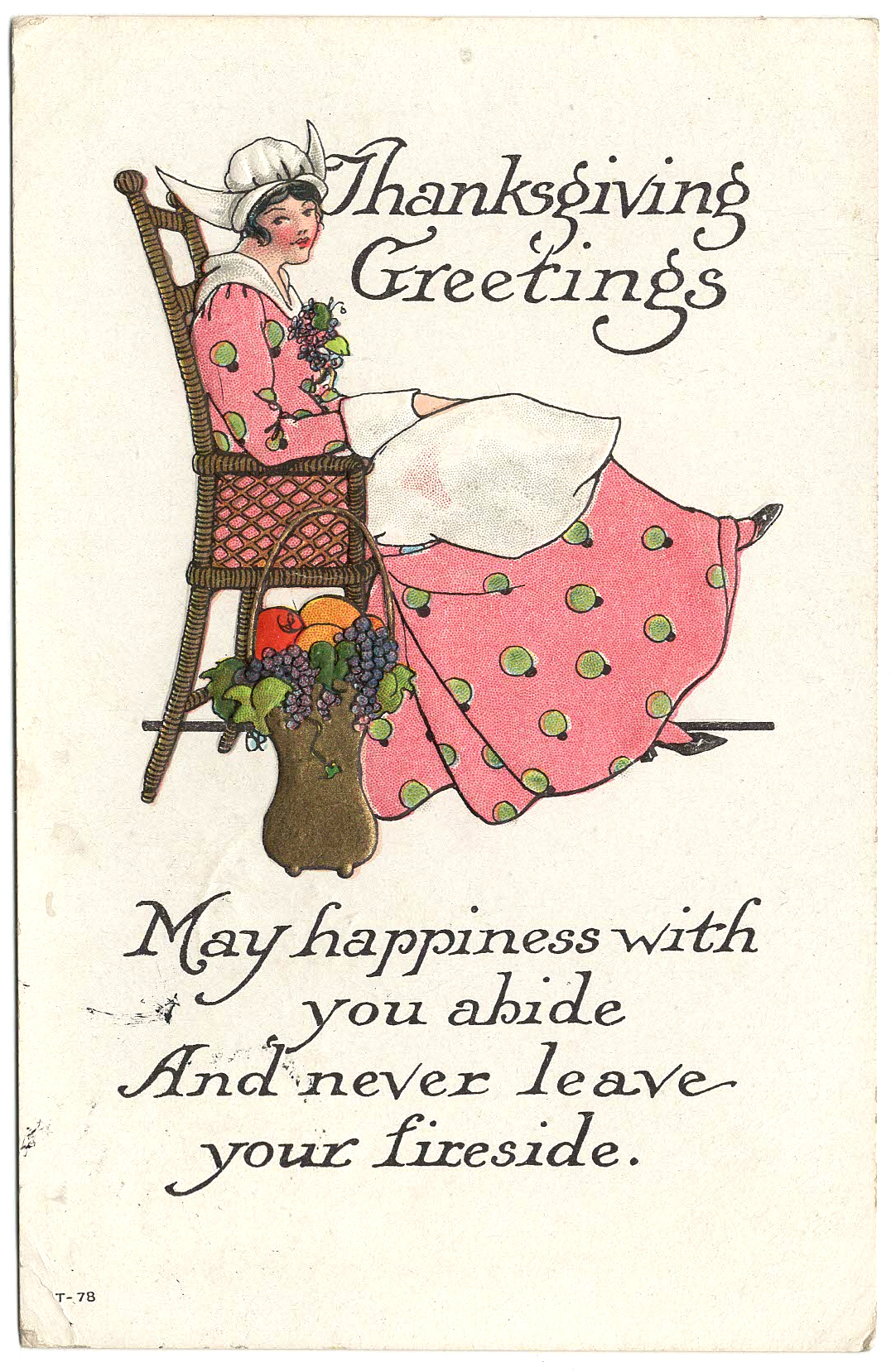
I like the message on the front of this vintage postcard: "May happiness with you abide and never leave your fireside."

It was postmarked and mailed to New York state in late-November 1916. The cursive note states:
"How is every one? We are all well but father. Had doctor for him Sat. Why don't you write? Where do you spend Thanksgiving?"
Today's an anniversary. I began Papergreat with this post 11 Thanksgivings ago. Thanksgiving also fell on November 25 in 2010. 

So there's symmetry if this is the final Papergreat post. Eleven years on the dot, 3,498 posts. Now, 3,500 would be a rounder figure, you might say. But 3,498 divided by 11 works out to exactly 318 posts per year, on average, so there's your round number. And, wow, that's a lot of posts, if I do say so myself.

Do I still have a Papergreat to-blog list? Of course. It includes Fisher-Price advertisements1; sci-fi author Jesse Miller; the Winchester Mystery House; the 1971 board game Drug Attack; the haunting Miss Christine; poster artist Bonnie MacLean; the Essex House book Lovely by David Meltzer; my Pappy's World War II reminiscences; the Steve Jeltz Fan Club, the postcard tales of Loren E. Trueblood; and essays I still want to write about a half-lifetime of working in the newspaper business and watching movies.

But there's always going to be a list, right? There won't come a day when I reach into a box and pull out the very last slip of paper that I could possibly write about. That's not how ephemera — or ideas — work. 

So regrets about unfinished business can't be the driving reason to keep writing Papergreat.

Is this the last Papergreat post? I don't know. I've wrestled enough with that question recently to know I don't have a definitive answer. At the very least, this is the last post for a while. Beyond that, I'm not sure. I know I don't want to continue with the short daily items I've sometimes posted merely to satisfy my self-mandated, OCD goal of a certain number of entries per week. 

Maybe I'll transition to only writing super-sized holiday or seasonal posts. And/or continue to put longer ephemera-themed writing projects here when they're ready. I am compelled to continue writing, and I want to try some longer pieces moving forward.

I suppose there's a chance that some writing might show up on resimplify.me, an intriguing domain name I've been squatting on for awhile. No guarantee of that, but I thought I'd mention it for posterity. And I still plan to maintain a Twitter presence. 

I'm still fascinated by history and ephemera. The stories that can be told and the questions that can be raised by mere pieces of paper. As the year-end holiday season approaches, I am reminded of one of my personal favorite Papergreat posts: A merry Christmastide to you, Marguerite E. DeWitt.

Finally, as I was mulling this post, I think it's kismet that I came across an amazing Twitter thread about the power and importance of ephemera. It's by @PajamaStew, and I'm going to share it here in its entirely. Again, for posterity. These stories do matter. And I'm grateful on this Thanksgiving for PajamaStew's amazing piece of writing and that it was released into the world:
I may regret sharing this, but I have a very personal story I would like to tell. I hope it doesn't get too long... Anyway...

I was 20 years old when I was sent to erase a man from existence and became haunted by him.

I was going to college in Texas at the time and a group of us were contacted about a service project. The State needed a handful of young volunteers over the course of a Sunday afternoon and I was one of about ten that agreed to help. We were asked to go to the home of an elderly gentleman that had recently died and help sort his belongings. He didn’t have any close relatives and his estate was going up for auction.

So, we were tasked with tearing everything out of his home and identifying items that had value to place inside “Auction” boxes, while the rest would be tossed in “Trash” boxes. I was excited about spending an afternoon doing service work with a group of friends.

I was not prepared for what I was about to face in this dusty little house somewhere in west Texas. It was immediately unsettling to step into a stranger’s bedroom and try to assign value to his possessions. Should we really be digging through his drawers trying to decide if any of the tiny bits remaining of his life were of any value now that he was gone? The truth hurt, as I was forced to admit that almost none of it had any value.

No one would want to buy an old deck of cards or a worn sweater. There’s no value in VHS tapes or water-damaged paperbacks. The “Trash” boxes grew heavy. The “Auction” boxes sat mostly empty.

I was already rattled by the experience when halfway through I opened a closet in a guest bedroom and found a stack of banker boxes. Inside I uncovered something that made my heart freeze.

I’m shuddering as I write this. The boxes were filled with several old photo albums.

I was tempted right then to just throw the entire cursed things in the trash without ever opening them. But I couldn’t do it. I was drawn by the mystery of those albums. They were covered in dusty fingerprints as if a ghost had prepared them and then led me to find them. And they were now pulling me gently down, begging me to open the covers and to be a witness of what was inside.

Inside I found a man’s life, compartmentalized into a stack of images, bound together in leather books. Photos.

At first of a young boy. Black and white. Faded. Surrounded by strange people. Happy. Brothers together in a field. A sister with long black hair. A dog on a porch somewhere. As I turned the pages, I watched as the boy grew. His hair became longer. He became a young man. He grew a mustache. It went away. Sometimes he was in the pictures. Sometimes the pictures were a vision seen through his eyes.

I saw what he saw. I saw what he valued and found beautiful. Stones. Light. Shadows. And then, suddenly, as if conjured from those stones and shadows, he was joined by a young woman. She was also beautiful. Flowing brown hair and brown eyes. Always seeming caught mid laughter. I could hear her. I still hear her. It was haunting. I fell in love with her, or rather, I fell in love with the way he had fallen in love with her. It was a love that caught in my throat.

They grew. Held hands. Were married. I smiled, seeing their joy as they stood together at the altar. My heart nearly stopped seeing her in her simple white dress, as if this man had possessed my body and was looking at these photos with me, through my eyes, one last time.

Time passed as I sat cross-legged on the floor meditating over the albums.

I heard my friends as they banged around in the kitchen and elsewhere struggled to move a dusty red couch from the living room, but I sat solemnly in the closet desperately looking at every picture in the dead man’s album. I felt torn. I could not look away.

So, I hid, and I forced myself to look at each and every picture.

I turned the pages, and the young man and the young woman grew old.

Here was a happy couple standing together at a white fence in front of a small house somewhere in west Texas, him in a tan fedora and matching suit coat, her in a dark green dress. Here was a woman on the porch drinking tea watching the sunset. There was a speckled dog sitting on the porch beside her.

Time passed so quickly as I turned the pages. It felt unfair as if I were hurrying their life on to its conclusion. The couple stood together and smiled at me apologetically from an old polaroid. I kept going.

There were no children. Only various friends. Side characters appeared for a time and then disappeared at random as new ones arrived. But always it was the two of them, the man and the woman. Adam and Eve standing in their dusty garden around a flowering Creeping Thyme.

The sun flickered in spirals across the pages. And then suddenly it happened. The woman, the beautiful woman, she started to change quicker than the man.

Her eyes became sad. Her laughing smile became less frequent. She looked tired. There were no more trips to the Grand Canyon. No more summer drives and picnics in the forest.

She was dying.

And then I turned a page and she was gone. There were still several more albums of this man’s life, but from that point on he was alone.

Instead of this beautiful laughing woman, he took pictures of stray cats. Instead of posing with her in front of motels on some blazing yellow-tinted adventure, he took photos of the moon over a dark house shrowded in purple twilight.

The man was less visible in the images now. As if he were already fading out of existence.

Sometimes he showed up in mirrors or reflections in dirty shop windows. An old man in a tan fedora, alone, in a house, somewhere in west Texas.

I closed the last album and sat for a long time on the closet floor, resting my head back against the wall.

My fingers burned with the realization of what they had to do next. It was time to make the choice about where the photo albums should go. Where was this man’s life going to be placed? Did it have value or was it “trash”? The answer to the question hung over my head like a sword.

I closed my eyes, replaced the lid of the box, and put it back in the dark corner where I had found it. I couldn’t do it. I quietly closed the closet door and walked away.

Later I returned to help some friends move a dresser from the same room and out the corner of my eye I saw where a shaft of light now fell onto a blank patch of carpet in the corner. The photos were gone. Maybe they had never actually even been there.

I thought about this as I helped maneuver the heavy dresser through the now empty ribcage of the home.

As we were preparing to leave, we were met in the yard by the person from the state that had called us to help. They thanked us for our efficient work.

I just stared at the ground in shame watching a cloud of ants as they carried away bits of something hidden in a tuft of nearby grass. We were ants. I shook my head. No. We were vultures.

As payment for our work, we were told that we could take one item from any of the “Auction” boxes to keep for ourselves. My coworkers leaned their heads into the cardboard tombs and somberly held treasures up to the sun.

They playfully fought over who could take the old jewelry that looked as though it hadn’t been worn in years (Only I knew how many). One boy took a heavy flashlight, another took a pocket knife.

I waited, uneasy with the whole ghoulish activity, and as I waited I wander through the ocean of “Trash” boxes. I ran my hands over the items with a reverence that I did not fully understand.

I felt like I knew this man, and it humbled me that I may be the only living person on Earth that did.

Was it possible that I was the only person to contain the knowledge of him, the only one to watch him grow from a young boy into a man, the only person to watch from a distance as he fell in love, the only person that saw him as he watched his love die?

I was a stranger, but I had, by strange chance, followed him through his life watching as his life boiled and dissolved down to a small collection of silent images, preserved and rifled through in the course of 30 minutes time by some young boy hired to erase him. That alone would be the gift, I decided. Just carrying the memory of this man secretly inside my soul. That is all I would take with me.

But then I passed a box full of black garbage bags and something caught my eye. I froze in place. I was suddenly unable to even breathe. With a trembling hand, I reached deep into the pile of discarded debris and touched it. It was real.

A tan canvas fedora. The same exact tan canvas fedora that I had seen this man wear so often in photos that it had almost become a part of him. It was in the pictures with his wife, and it was in the years that follow. This hat had gone with him.

I held it gently by the brim and lowered it onto my head. It wasn’t a perfect fit, but it somehow felt right. It felt, providential. I felt like something quiet and sad had led me to find it and now that it was on my head there was a change in the air. There was contentment.

I slowly walked back to meet up with my group as they waited to climb into the van. As I stood in line with them I stopped for a moment and turned around.

I was standing just inside the gate of a white picket fence on a paved walkway leading to a small house somewhere in west Texas. I turned to look at the house one last time, I adjusted my hat, then I closed the gate and left.

I wore that hat for the next ten years of my life.

It traveled with me around the world. I was yelled at once by a Ukrainian woman for placing it on the ground in a park. And I nearly caught it on fire by foolishly hanging it on a lamp in Mexico City. It was on my head as I climbed to Machu Pichu and it ducked through a stone doorway with me as I explored the Coliseum of Rome. And I was wearing it at the airport in Kiev as I waited for the plane carrying the woman that would later become my wife, and I held it behind her back in the rain a few days later as we kissed under the watchful eye of Lenin.

I have albums of pictures hidden away and I’m proud to say that this old canvas hat shows up in it often. I stopped wearing it around the time that my first daughter was born.

It was starting to get dingy and show its seams and there was something that felt disrespectful about that. So, one day I took it down off its hook and I walked to the shed and placed it in the box where I save my most loved possessions.

Someday, perhaps a long time from now, a young boy might open the lid of that box and find an old canvas hat and then ... who knows? 

— @PajamaStew

Footnote

1. If this is going to be the last post, there has to be a silly footnote, right? So, I ask, what fresh hell is this, Fisher-Price?