Tuesday, January 24, 2023

Some of the books that helped to inspire Ruth Manning-Sanders

There's really interesting news this week regarding Ruth Manning-Sanders (1888-1988), the English poet and author who wrote dozens of beloved books for which she collected and retold folk and fairy tales from the all over the world.

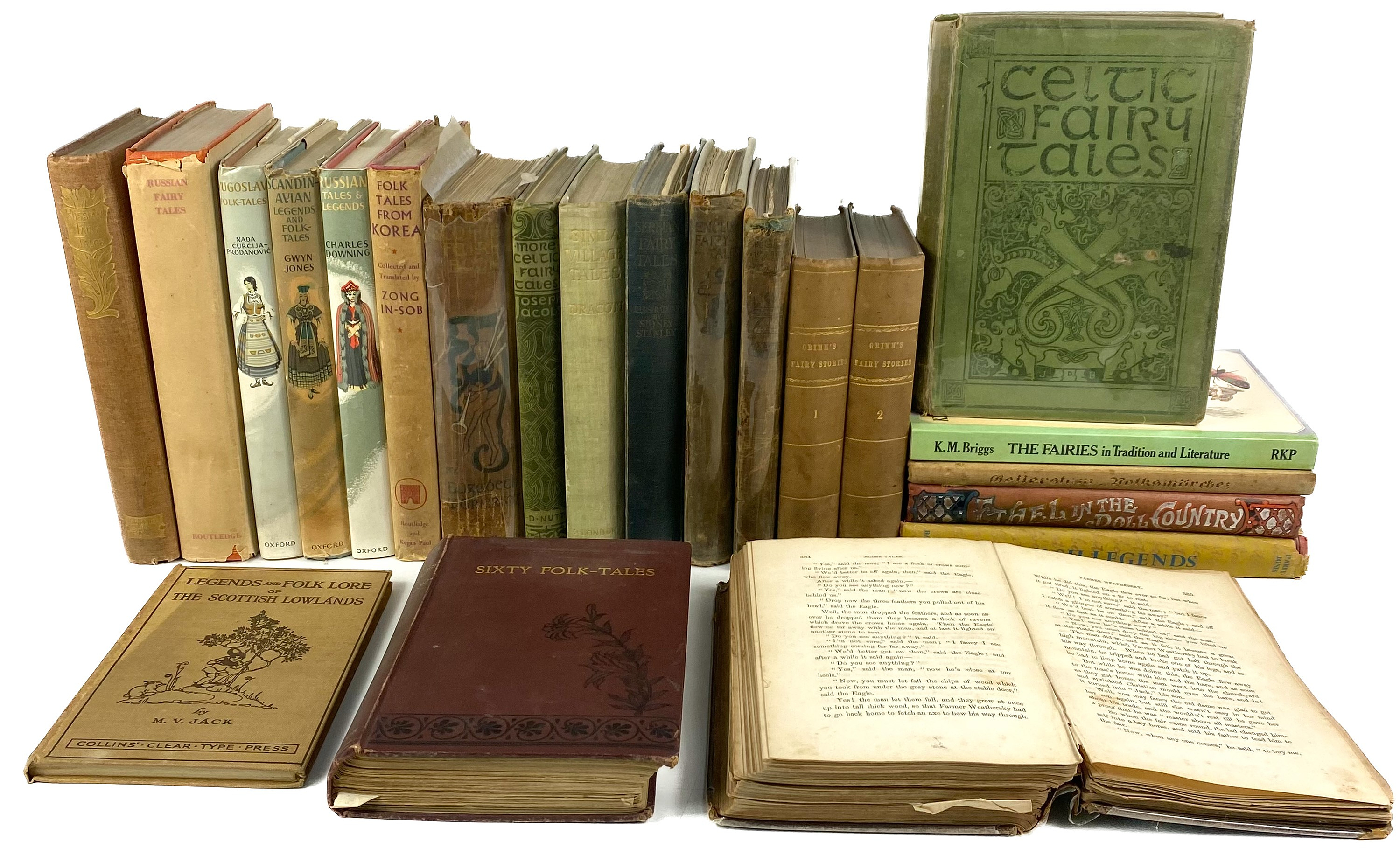
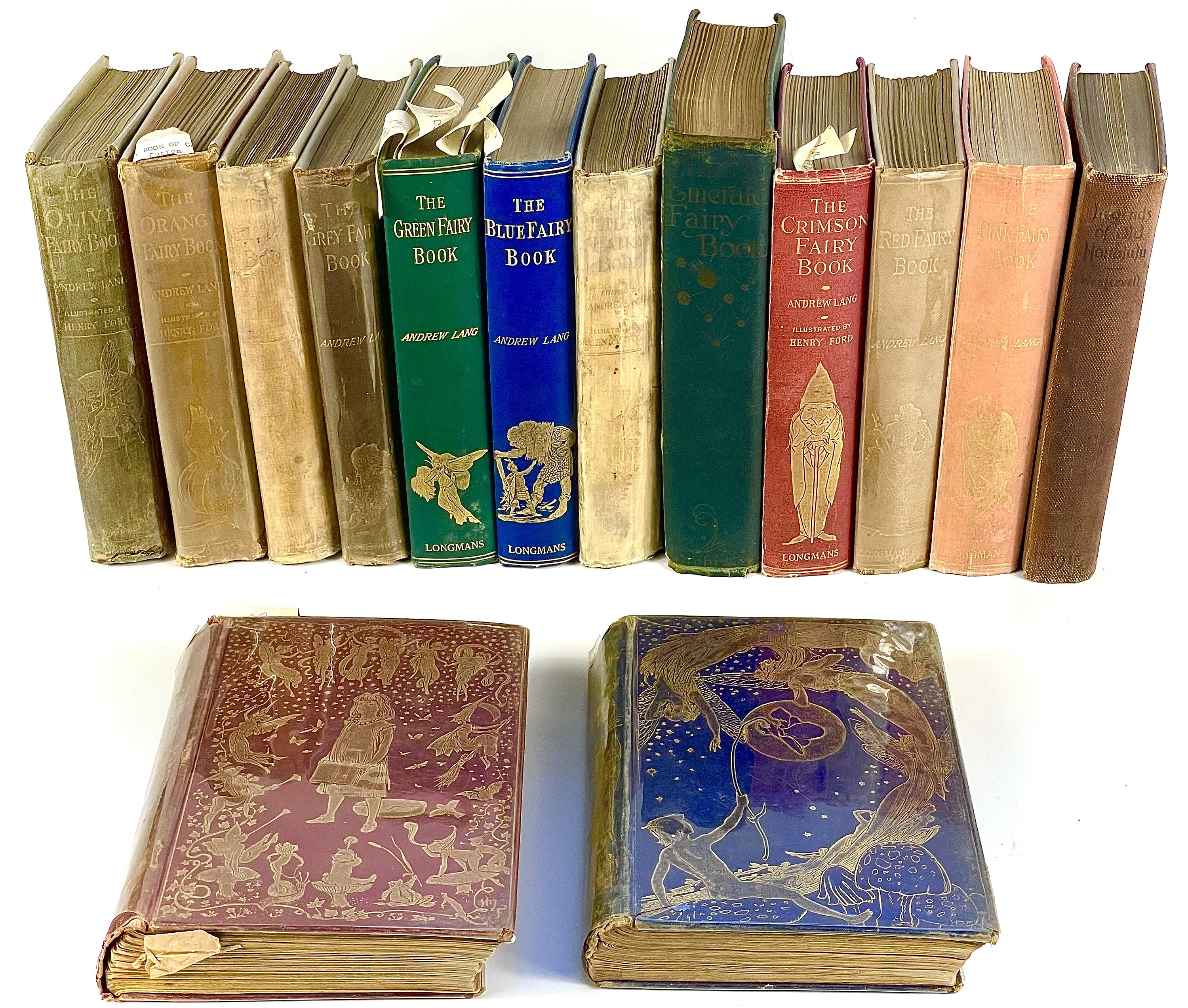
Many books from Ruth's personal library — the actual copies that inspired and informed the unique style she built as a teller of tales — are up for auction now at Lay's Auctioneers in the United Kingdom. I've included the pictures from handful of the lots in this post.

Copies of many of her own books, including her early fiction and poetry, appear in the auction listings, too. But, to me, the most fascinating lots involve the books by others that once sat on her shelves. The very books she read, possibly from childhood in some instances, and that worked their way into her fiber. For example, there an many volumes of Lang's Fairy Books, each with a color in its title, that were published between 1889 and 1913 by Andrew Lang and his wife, Leonora Blanche Alleyne.

There are dozens of other titles, too, collected into lots. This is just a small sampling, from reading the listings and zooming in on the pictures of the spines:
  • Scandinavian Legends and Folk-Tales by Gwyn Jones
  • Russian Tales & Legends by Charles Downing
  • The Fairies in Tradition and Literature by K.M. Briggs
  • Legends and Folk Lore of the Scottish Lowlands by M.V. Jack
  • Bygone Lancashire by Ernest Axon
  • Legend of the Micmacs by Silas Tertius Rand
  • Hero-Tales & Legends of the Serbians by Woislav M. Petrovitch
  • Greek Folk Poesy by Lucy Mary Jane Garnett and John S. Stuart-Glennie 
A few lots contain fairy tale books in languages other than English. We know from biographical information that Ruth had an important collaborator regarding these volumes. Joan Manning-Sanders (1913-2002) helped to research the stories that her mother then retold. Family members say that Joan learned to read French, German, Russian and several other languages in order to discover new source material for her mother. The magic wouldn’t have happened without this mother-daughter teamwork.

I'm going to see if I can get lucky with the winning bid for something, because it would be a treasure to have some of these volumes alongside my Manning-Sanders collection. But I have no idea how these auctions will play out on the other side of the pond. 

In a dream scenario, all of these books would remain together at the Ruth Manning-Sanders Children's Library and Archives in some quaint village along the coast of Cornwall. But that's not in the cards, and no such place exists. Maybe the next best thing is for them to fan out to new homes. Ruth spent much of her life pulling fairy tales from all over the world into her orbit. Now, the process can reverse itself, and those fairy tale volumes from her library can go back out in the world in a Big Bang of imagination, inspiring future generations.
 

Sunday, January 22, 2023

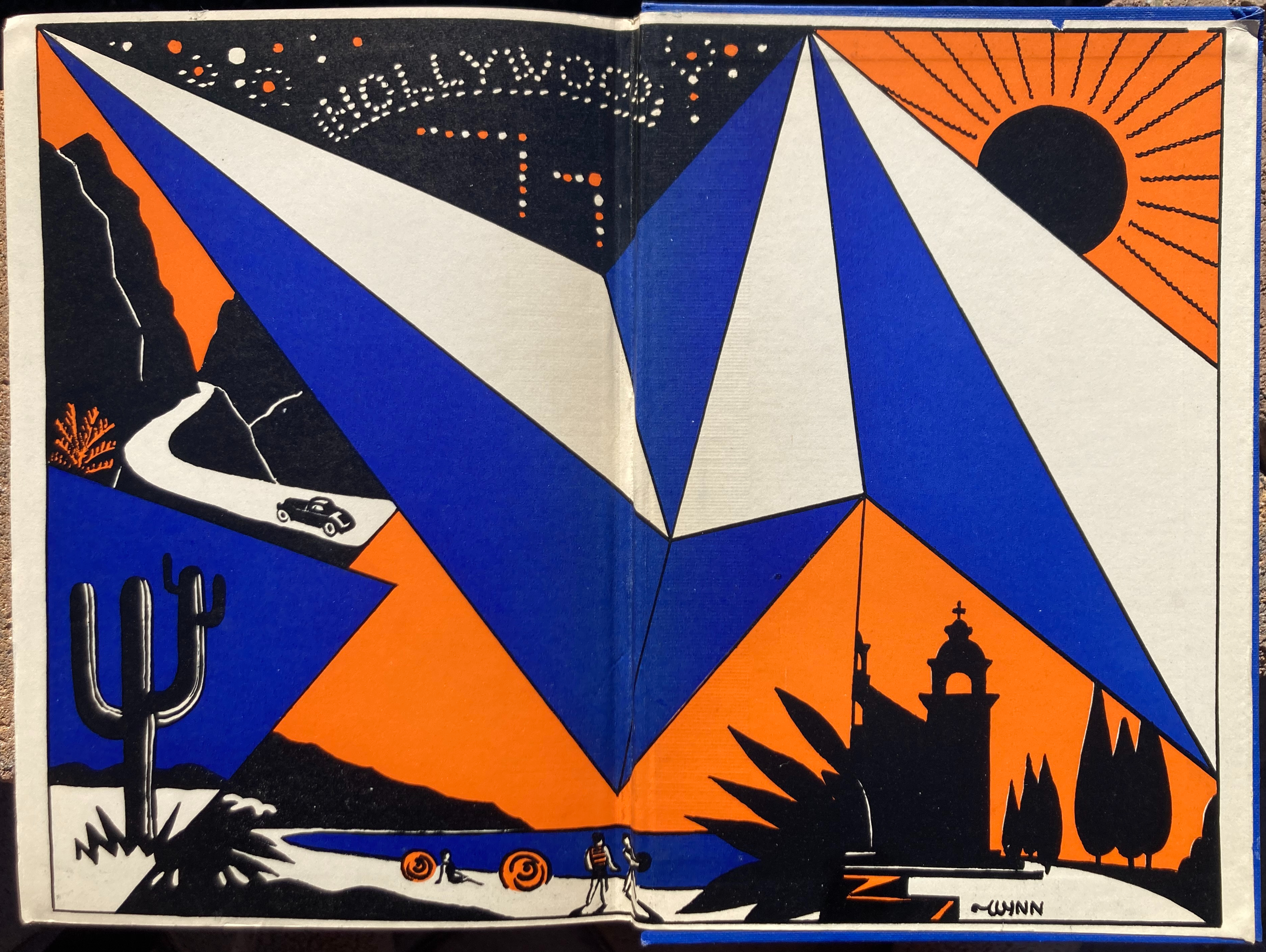
Wynn's dandy endpapers illustration for 1933's "Incredible Land"

These are the dazzling endpapers of Basil Woon's 1933 travel book Incredible Land, which is subtitled A Jaunty Baedeker to Hollywood and the Great Southwest. (Karl Baedeker published a series of guidebooks for tourists in the 1800s. They were so popular and respected that, well into the 20th century, Baedeker served as a synonym for any travel guide.)

My copy of the book doesn't have Wynn's equally dazzling dust jacket illustration, but I've included an online image of it here for posterity. I can't find much information about Wynn; having only a common four-letter moniker doesn't help much with the search engines. Any information sent via the comments would be appreciated!

This travel guide — with its hedonistic focus on finding women, food, beds and bootleggers in the West — was written during the late years of Prohibition and then essentially hit the booksellers' market just in time for Prohibition's repeal on December 5, 1933: Rotten timing for an author who had worked hard to let people know where to find illicit booze.

As The New York Times noted on December 10, 1933: "The lapse of time since this book was written has been less than a year, yet so much alcohol has flowed under the bridge during that period that many of Mr. Woon's pages have a distinctly historical flavor. This fact he himself acknowledges in a last-minute chapter of 'Addenda and Errata' in which he points out that repeal alters 'the entire entertainment map of the United States.'"

Here are a few tidbits about Arizona from Woon's book:
  • "The city of Tucson, once capital of Arizona, has of late been adopted by Eastern fashionable folk, many of whom have built fine homes there. The climate is said to be a cure for sinus trouble."
  • "During the rainy season in late summer the Arizona section of the road is sometimes impassable, due to cloudbursts transforming the desert arroyos into sudden torrents."
  • "From Roosevelt [Reservoir and Dam] one may continue southeast to Miami and Globe, copper smelting towns, and on through the Apache reservations to the Mormon colonies near Safford."

Other posts with endpapers illustrations (for your online browsing pleasure on a rainy or snowy day)

Thursday, January 12, 2023

Scholastic book: "Arrow Book of Spooky Stories"

A few days ago, author J.D. King asked on Twitter, "Do you guys remember Scholastic Book Fairs? Did you have those in your school?" It's one of the great evergreen Twitter prompts for bookish types, because it always spurs plenty of enthusiasm and nostalgia in the replies.

But responses these days also leave me feeling a bit old. They're from people happily reminiscing about times long, long after I was attending Scholastic book fairs and filling out those monthly forms to order books. Some folks talk fondly now of the "good old days" when they got Goosebumps and Animorphs books.

For me, the heyday of Scholastic fairs and in-class order forms was about 1978 to 1983. So I was getting stuff by Judy Blume, Three Investigators books, Peanuts-themed novelty books like the Peanuts Lunch Bag Cook Book that's on my list to write about, and maybe a compilation of Garfield strips.

For me, though, the keenest nostalgia is for the time even before that. I love discovering and writing about Scholastic books from the 1960s and early to mid 1970s, and have have fifty-plus post on that topic over the years.

In 2015 I wrote about 1960's Arrow Book of Ghost Stories. Today, it's the paperback volume that was a followup to that title: 1962's Arrow Book of Spooky Stories, also edited by Nora Kramer1, and this time illustrated by Erwin Hoffman. It's Scholastic book TX 331 and initially had a cover price of 35 cents.

Here's the table of contents:
  • Horace the Happy Ghost, by Elizabeth Ireland
  • Never Mind Them Watermelons, by Maria Leach
  • The Tinker and the Ghost, by Ralph S. Boggs & Mary Gould Davis
  • The Lucky Man, by Maria Leach
  • The Stubbornest Man in Maine, by Moritz Jagendorf
  • Here We Go, by Maria Leach
  • The Friendly Ghost, by Elizabeth Yates
  • The Dancing Jug, by Lupe De Osma
  • The Strange Visitor, by Joseph Jacobs
  • A Shiver of Ghosts, by Cyril Birch
  • The Ghostly Fisherman, by Natalie Savage Carlson

Some of these authors show up in other Scholastic anthologies. Leach, a folklorist who wrote The Soup Stone: The Magic of Familiar Things, and Jagendorf have stories in Nine Witch Tales. Cyril Birch was also a folklorist who wrote a book about Chinese myths that I discussed last summer. (When you've blogged this long, you can almost always find ways to connect to past entries.)

There are, of course, a lot of fond memories of this book. Some folks specifically remember that it was through Scholastic that they discovered the book. Writing an Amazon review in 2011, The Grey Piper stated, "Great spooky stories! Aimed for kids of course, I had this when I was a kid and just wanted to revisit. Some of these might even make good stories for adults, told in a more mature style around a fireplace on a winter's night! Very nice introduction to the ghost story for young readers."

And in a short review for Goodreads in 2014, Pamela wrote: "I read this when I was in third grade. It is best read with a flash light in a tent with your girl friends or with your Girl Scout troop. Lots of fun."

Footnote
1. Nora Kramer lived from 1896 to 1984. Her obituary in the July 6, 1984, edition of The New York Times described her as an author, editor, and expert on children's book, adding, "She was founder and director of the Book Plan, a personalized book selection service for young people, which she began under the name of Eleanor Brent." She also went by Edna Mitchell Preston for some works.

Tuesday, January 10, 2023

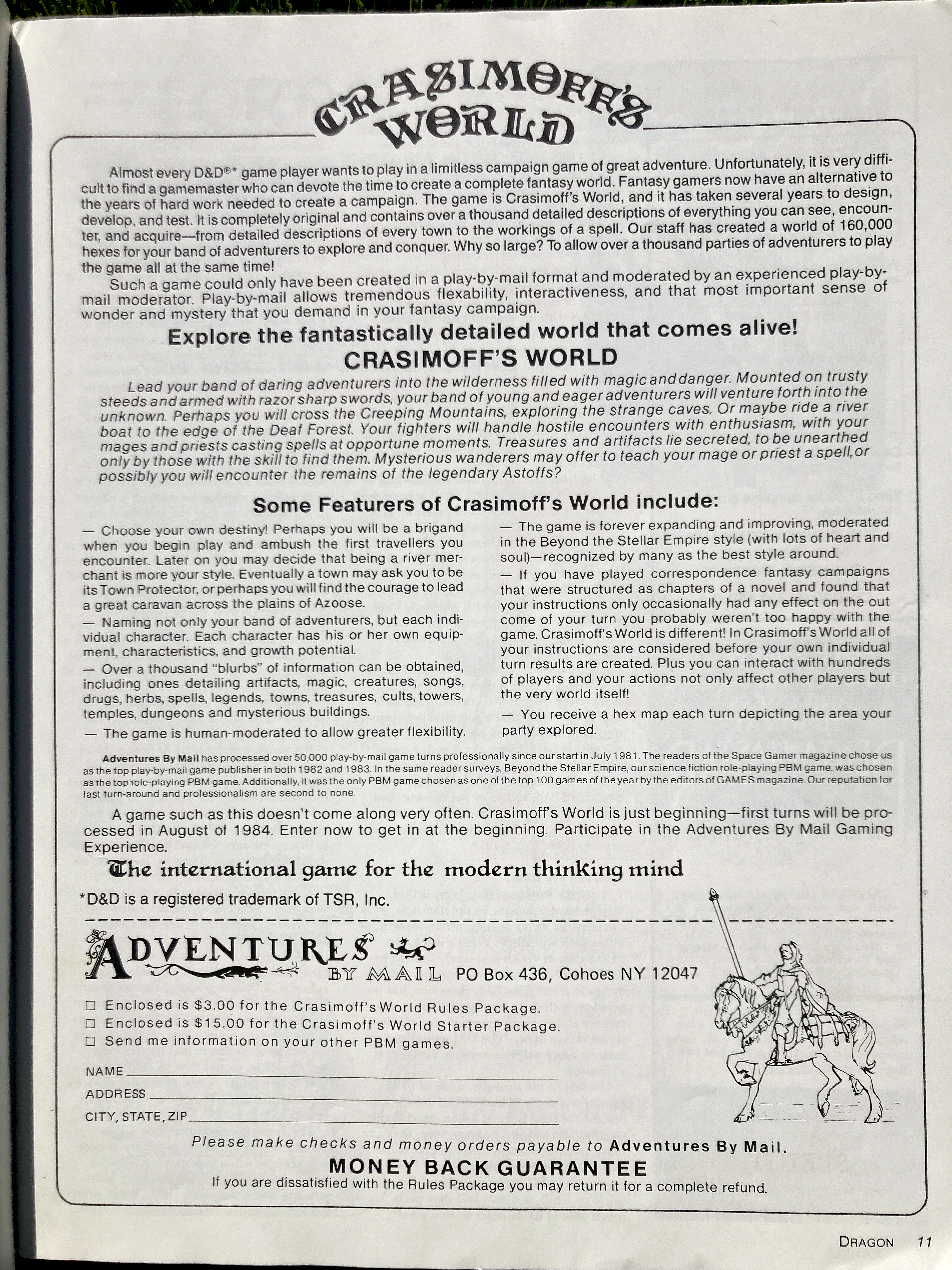
1984 advertisement for play-by-mail game Crasimoff's World

This full-page advertisement from Dragon magazine #87 (July 1984) touts the play-by-mail roleplaying game Crasimoff's World.

In that era, if you didn't have a group of gaming friends on your block, in your dormitory or in your city, play-by-mail RPGs offered an opportunity to participate in some dungeoning and dragoning with folks from around the country in the years before participation in MUDs (playing by modem) became more feasible and served as the bridge to the dawn of the online multiplayer gaming that dominates today.

For Crasimoff's World, you needed a few dollars, stamps and envelopes. And plenty of patience. Wikipedia states that the game was the brainchild of Kevin Cropper and launched in 1980 in the United Kingdom, where it was very popular. This advertisement was part of the 1984 launch of the game in the United States, through a licensee. It states that "first turns will be processed in August of 1984."

Here's how the Wikipedia article describes the UK gameplay in the early years:
"Players paid £2.50 for the rulebook, selected a cast of nine characters who were either priests, fighters or mages, and gave the group a name. Cropper would then place the new band of adventurers somewhere in his campaign world, and send the new player a letter that described their starting location, as well as campaign news, recent events in the new group's locality, and some rumours. The player would then respond with what they wanted their party to do, including which direction the party was travelling, trades or purchases, possible actions if encountered by hostiles, and any special instructions or requests. Cropper would then send further information and updates, and the player would respond with their next turn. Each turn cost £1.25. If one player's party wandered into an area already inhabited by another player's party, Cropper would give each player the other's contact information so the players could confer directly to share information."

The advertisement pitches the exciting possibilities of the game experience, including being a river merchant, agreeing to protect a town or leading a caravan across the plains. Discovering "the remains of the legendary Astoffs" is hinted at. It touts that the game's human moderators (as opposed to computer code) allowed for surprises and flexibility within the RPG, which was experienced by players like a good fantasy novel each time a new thick envelope showed up in the mailbox. 

There's not a whole lot out there in terms of first-person memories about Crasimoff's World. James Maliszewski of Grognardia, my go-to online historian for 1970s and 1980s fantasy roleplaying, wrote last summer that "PBM gaming is a huge black hole in my own experience of the hobby, so I must admit to having a general difficulty in comprehending how they worked in practice."

I did find a couple other things of note:
  • Mike Lay's website includes a Crasimoff's World section that by some miracle of the interwebs is still online, even though it hasn't been updated since 1999. It contains descriptions of two parties (The Thanatari & The Silent Guard) and some descriptions of the parties' moves. If PBM RPG history is your jam, I might suggest printing out some of Lay's content before it's gone forever.
  • Iain Wilson of the podcast and Twitter account Roll to Save, which are devoted to RPG history, has mentioned in passing on Twitter that he used to play Crasimoff's World.
Related posts

Sunday, January 8, 2023

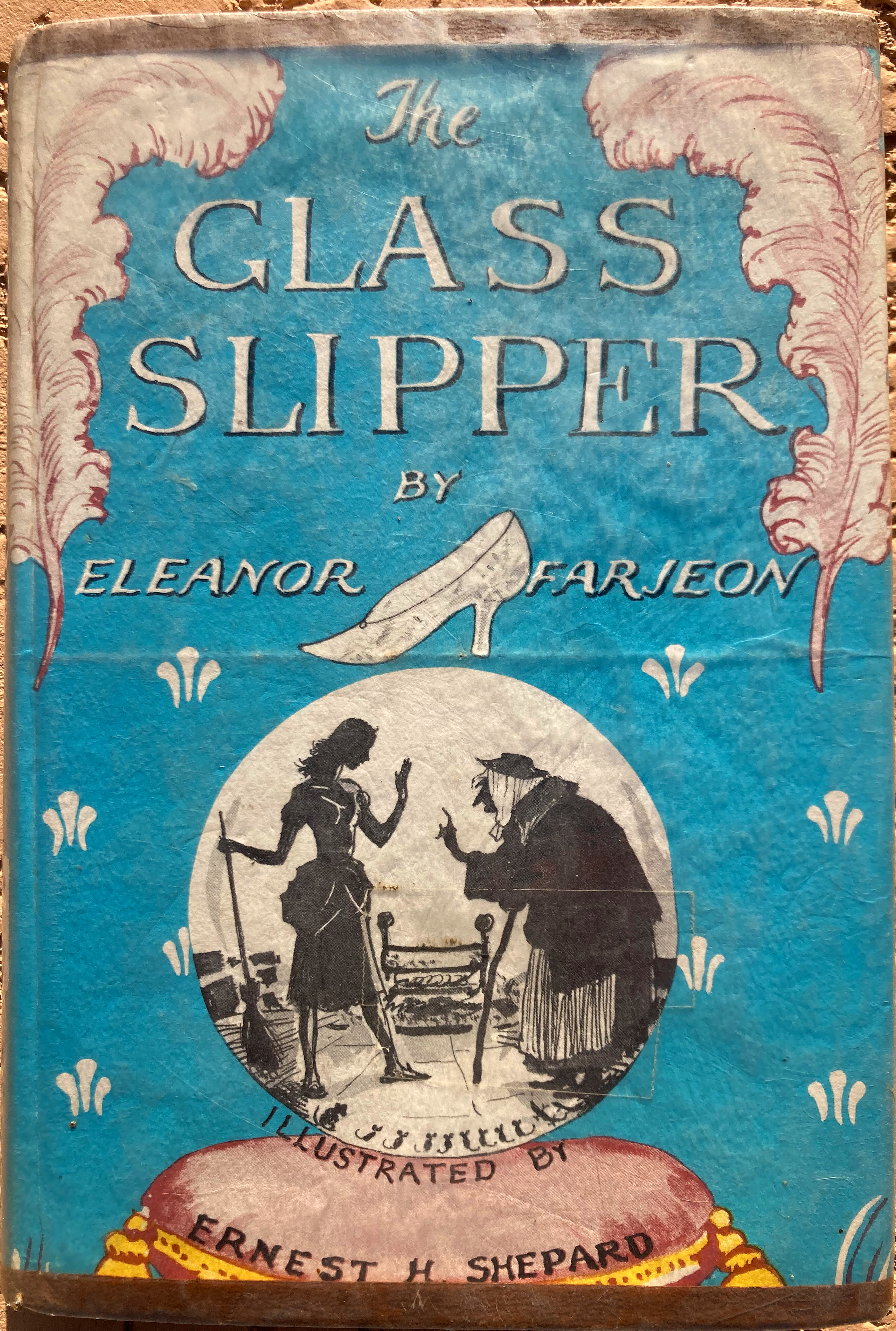
Old school library copy of "The Glass Slipper"

I discovered this old school library copy of The Glass Slipper, written by Eleanor Farjeon (1881-1965) and illustrated by Ernest H. Shepard (1879-1976), at the Salvation Army store in Casa Grande, Arizona. First published in 1955 (this is the 1967 printing) it's a new version of the old tale of Cinderella. "Eleanor Farjeon's magical way of re-creating an old folk-tale with fresh and original beauty has endeared her to thousands of devoted readers," states the dust jacket.

The book is actually a novelization of a play by the same name that Farjeon published in 1944 with her brother, Herbert Farjeon.

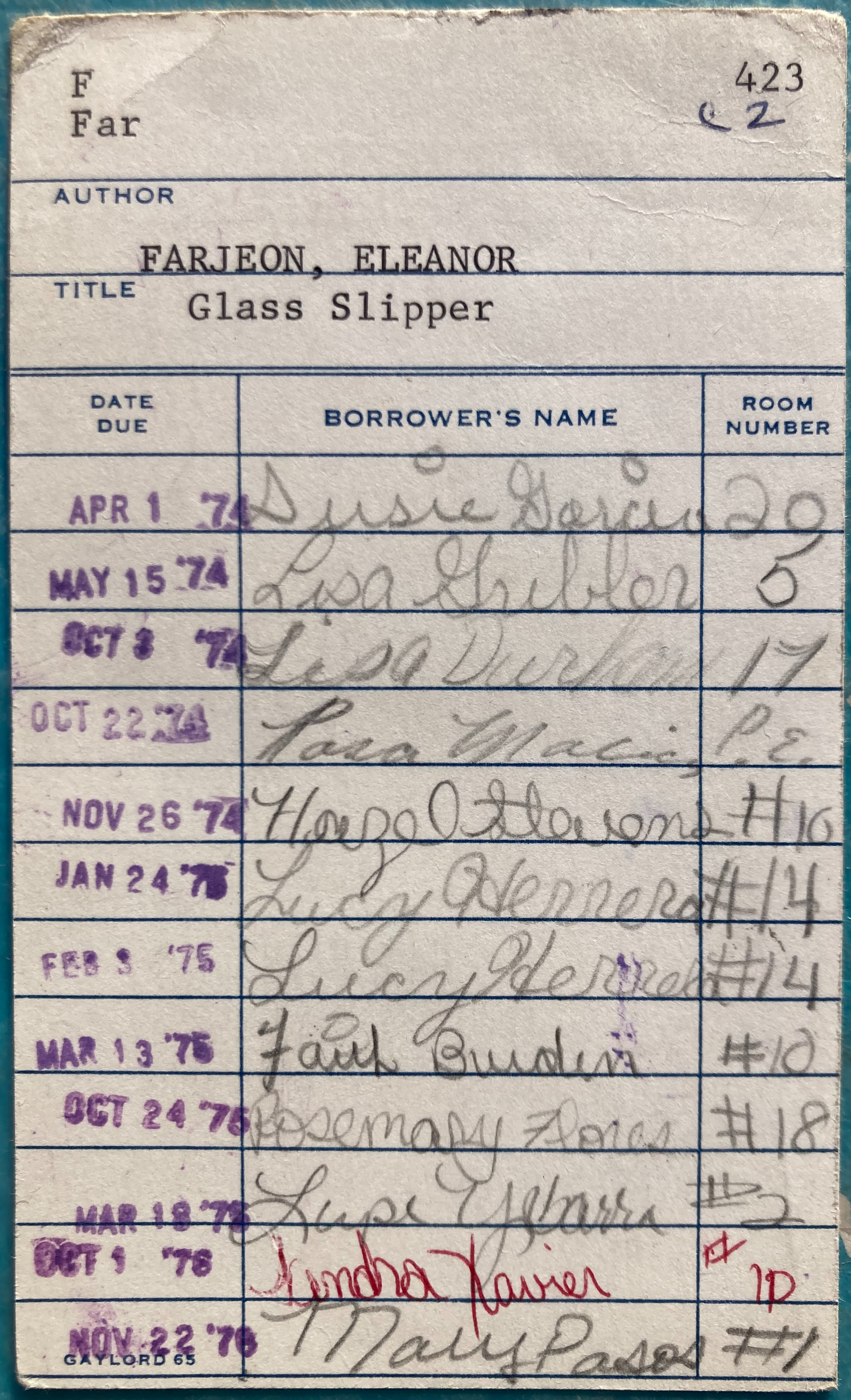
This copy spent a long time in school libraries. There are checked-out dates between 1971 and 1989. It is stamped inside with both WEST SCHOOL and ELOY JUNIOR HIGH LIBRARY, which is a Phoenix-area school. (So, the book didn't wander far.)

This cursive note appears on the title page:
November 13, 1967 — Viking — $3.30 — Alesco [?]
West School 423
1/70 Gift from West
The book is generally well-reviewed and beloved over at Goodreads. I thought this 2020 review from Julia Wise nicely summed up the pros and cons: "Delightful wordplay and rhymes, frothy, fun. My six-year-old was desperate for each next chapter even though it's not exactly a surprise how it ends. Typical early 20th-century fat shaming which I edited out on the fly, but for its age it wasn't as sexist as I thought it might be."

Here's a portion of a page that I think gives a good example of both the prose and Shepard's fun illustrations. 
It's always fun to find a used book with its circulation card and card pocket intact. It's a wonderful snapshot of all those who read it (or at least checked it out) over the years. In this instance, it appears that The Glass Slipper was read exclusively by girls here in Arizona. And they all had very good handwriting. It also spy one student who checked out the book out twice: once in the autumn and then again in the late winter. I suspect she must have really liked it.

Monday, January 2, 2023

1972 conversation pit (aka sunkenarium) at a Holiday Inn

This postcard, mailed in 1972, showcases the the grooviness that is "The Conversation Pit" that once resided within the "fully appointed lobby" of the Holiday Inn at the corner of Routes 22 and 512 in Bethlehem, Pennsylvania. "Sunkenarium" is a synonym for "sunken living room" that a select groovy few of us have used over the years. And this conversation pit certainly qualifies, complete with its very 1970s carpeting that certainly saw more than its share of cigarette ash and spilled drinks. Grody.

Speaking of sunken living rooms, I stumbled across the existence of a 2000 book titled Quads, Shoeboxes and Sunken Living Rooms: A History of Los Alamos Housing. Then I learned more about this extremely niche topic via an August 2022 post on the blog "Kendra Ruminer's Two Cents of Real Estate." Kendra writes:
"In the late 1940s and early 1950s, housing was the constant social topic in Los Alamos. Norris Bradbury was very concerned about living situations for his workers at the Laboratory and there was no doubt that things were tight."
To tackle the need for housing, one neighborhood that was quickly constructed contained, Kendra notes, "13 two bedroom duplexes – 26 units – that had 'Sunken Living Rooms'. These quickly became the most sought after homes in Los Alamos thanks to this 'unique' feature!"

(To set aside sunkenariums for a moment, if the United States could once manage a mini-Manhattan Project of construction to tackle the housing needed for the actual Manhattan Project, you'd think our nation today could prioritize another construction surge to tackle the dual, crisis-level shortfalls in affordable housing and quality long-term shelter for the homeless. Just saying.)

Getting back to this particular postcard, it was published by KARDmasters of Allentown, Pennsylvania. The message is dated July 15, 1972, and it was written in Absecon, New Jersey, which is about two hours southeast of Bethlehem. It was mailed to Lancaster, Pennsylvania.

The cursive message states:
Dear Florence, 
We are here at my sisters — one of her grands Carol is being married to-day — 3 weeks ago we were to the wedding of Carol's brother. We are hopeing to get to see you one of these days. Will give you a call before we come to see if it suits. Hope this finds you doing OK. love as always
H and Anna

Sunday, January 1, 2023

First postcard of 2023: A card written while drunk in 1975

Happy New Year! This is the 950th Papergreat post that falls under the "Postcards" label. That's a lot of postcards. Featured on the front of the card is the lobby of the Memphis East Ramada Inn in Tennessee. The hotel was located at 5225 Summer Avenue and that location later became a Welcome Inn and then an Extended Stay Memphis, which is now listed on Google as "Permanently Closed." But perhaps permanent isn't exactly permanent. The Google reviews from the past few months seem to tell a sad story of a badly struggling hotel whose owners may be trying to get it back on its feet.

This is what it looked like a half-century ago, anyway. I don't think the photograph does it any favors. While that carpeting may be gold, it comes off as vaguely pea-green in the image. I have plenty of misplaced nostalgia for the 1970s, but even I know it wasn't the prettiest period in history.

The preprinted back of the postcard pitches the Memphis East Ramada Inn as having a friendly atmosphere for weary travelers, vacationers and "the casual party-giver." 

"Casual party-giver" is not a phrase you see very often, especially on postcards, but it feels very much like 1970s code.

This card was mailed in August 1975 with a Skylab stamp that was first issued in May 1974. It was mailed to Rick, (aka "Z") in Sharon, Pennsylvania, and the message — from someone who appears to be nicknamed "No-Bake" — is a hoot. The writer has added marginalia all over the card, including "I'm drunk" on the right-hand side. There's a line stating, "Why are you holding this card upside down?" And "P.S. — Ah — skip it!" 

The primary portion of the message to "Z" states:
Greetings geek,
Having a wonderful time, glad your not here! But seriously, this place is great, huge rooms, party every night, school — well 3 out of 4.5 ain't bad — wait — 2 out of 3 ain't bad (same thing). Well, rember above all BOOGIE

Guess Who? (Natchez?) No-Bake.  

"Rember," indeed.

Wednesday, December 28, 2022

The movie books before the internet and IMDb

This is the first movie book that I remember reading.1 My parents had a copy in the early 1980s, when I had little to no idea who Al Pacino (pictured on the cover) was, or that he would much later portray Penn State football coach Joe Paterno in a movie that nobody who followed Penn State football in the 1980s could have ever imagined.

Movies on TV, which we had on our living room bookshelf, was authored by Steven H. Scheuer (1926-2014). According to Wikipedia, there were 17 editions of Movies on TV between 1958 and 1993, and it was "the first guide of its kind," preceding the 1969 launch of Leonard Maltin's famous guides by more than a decade.

We eventually gravitated to those Maltin guides in the 1990s. And by the late 1980s I was also devouring the film writing of critic Roger Ebert through his annual Movie Home Companion books.

But I loved browsing Scheuer's book, which is just an amazing encyclopedia of thousands of movies, most of which I never imagined I'd be able to catch up with before the eras of TCM, video rental stores, DVDs, Netflix and streaming services. As Scheuer notes in the introduction, you had to be much savvier back in the day to catch films on television: "Careful planning, a carefree schedule, and the luck to live in a community within reception range of a TV station whose program manager or film buyer is a knowledgeable film fan will permit today's movie buff to trace the careers of their favorite performers."

Scheuer's book is fun right from the first page, which is filled with Abbott & Costello's many titles. (I was, of course, familiar with Abbott and Costello Meet Frankenstein, but not the others.) It concludes with 1962's Zotz! and 1964's Zulu.

Mom loved to browse through it, too. She would go through it and put a little pencil dot in front of the titles of all the movies she had seen during her lifetime. If I still had that family copy, I would know all the films she had seen. At least I have a good idea of what her favorites were.

If those 1980s guides had a drawback, it was that they typically only covered English-language films made in the United States and Britain. Of course, even if Fellini and Kurosawa had been covered, there would have been almost no way for viewers to watch their classic films at home.

We are definitely in the Golden Age of having the opportunity to watch almost any movie (if a print still exists) that has ever been filmed, in any country. That's how I'm able to have such an eclectic list of my 20 favorite "first-time watches" of 2022, presented here in alphabetical order:

  • 8½ (1963, Federico Fellini)
  • Chungking Express (1994, Wong Kar-wai)
  • The End of Summer (1961, Yasujirō Ozu)
  • Evenings on a Farm Near Dikanka (1961, Alexander Rou)
  • The Flavor of Green Tea Over Rice (1952, Yasujirō Ozu)
  • The Girl on a Broomstick (1972, Václav Vorlíček)
  • The Grand Budapest Hotel (2014, Wes Anderson)
  • In Heaven There Is No Beer? (1984, Les Blank)
  • Let the Right One In (2008, Tomas Alfredson)
  • Licorice Pizza (2021, Paul Thomas Anderson)
  • Night of the Demon (1957, Jacques Tourneur)
  • The Passion of Joan of Arc (1928, Carl Theodor Dreyer)
  • Plague of the Zombies (1966, John Gilling)
  • Rashomon (1950, Akira Kurosawa)
  • The Secret of the Blue Room (1933, Kurt Neumann)
  • Sazen Tange and the Pot Worth a Million Ryo (1935, Sadao Yamanaka)
  • Shang-Chi and the Legend of the Ten Rings (2021, Destin Daniel Cretton)
  • Smile (1975, Michael Ritchie)
  • Spring Night, Summer Night (1967, Joseph L. Anderson)
  • Suspiria (1977, Dario Argento)
Footnote
1. Unless you count Supermonsters by Daniel Cohen, which I wrote about in October 2021.