Saturday, February 25, 2023

Book from the Renaissance Festival: "Hill Walking in Snowdonia"

Ashar and I spent the day at the Arizona Renaissance Festival in Gold Canyon (about 35 minutes from our house) on February 19. The festival is held for two months each winter and it's huge. We did a lot of walking that afternoon to check out the demonstrations, food, shops, animals, jewelry, artists and more. There was live jousting, a museum of medieval torture (egad!), a show featuring birds of prey and a vendor selling scrumptious European chimney cakes (Kürtőskalács). I would guess we only saw about 20% of everything on the grounds. And we definitely got lost at one point and had no choice but to retrace our steps to the entrance.

One of the things that was most interesting to me is that there was a full-blown bookstore on the premises! It had four rooms and wide variety of new and used books focusing on medieval history, English history, magic & mysticism, various religions, Shakespeare, royalty, costume-making, craft-making and much more. Several frightful books piqued Ashar's interest, possibly because we had just come out of the museum of torture.

I was "good," mostly because I didn't want to haul heavy books around the rest of the afternoon (the car was parked a mile away). So the only thing I bought was a lightweight booklet for $2. And so that will be today's book to examine here.

  • Title: Hill Walking in Snowdonia
  • Subtitle: "Routes up fifty 2000 foot peaks in the Snowdonia National Park"
  • Where's Snowdonia? It's a mountain region containing a national park in northern Wales.
  • Author: E.G. Rowland (Edward George Rowland, 1879-1958, though I found just one source on the year of birth)
  • Photographer: W.A. Poucher (William Arthur Poucher, 1891–1988)
  • Publication history: The book was first published in 1951. It was then fully revised in 1958. This is the 1972 reprint edition by Vector Publications.
  • Cover price: 25 pence
  • Dimensions: 4¾ inches by 7⅛ inches
  • Binding: Staplebound 
  • Pages: 80
  • Dedication: "Dedicated to the youth of Britain"
  • Title page note: "Indication of a route in this book does not imply a right of way"
  • Provenance: Written in cursive on the title page is "Barbara Be---- Wales 1973." I can't decipher Barbara's last name after the "Be."
  • Excerpt from back cover: "While the main object of this book is to encourage beginners to come to the hills for a sport that will give them lifelong pleasure, more practised walkers will find new routes to interest them. It is not a rock climbing manual — the average holidaymaker with a clear head and reasonably strong leg muscles should have no trouble on any of the walks."
  • Some of the 53 mountains in Snowdonia with distinct peaks of 2,000 feet or higher (as spelled in the book): Snowdon, Crib y Ddysgl, Carnedd Llywelyn, Carnedd Dafydd, Penyrolewen, Foel Grach, Elidir Fawr, Moel Siabod, Pen Llithrig-y-wrach, Drum, Yr Aran, Garnedd Goch, Cnicht, Tal y Fan.
  • Excerpt #1: "Snowdonia, a name with some warrant from antiquity, covers some three hundred square miles of mainly mountainous country, centred on Snowdon itself."
  • Excerpt #2: "The big moorland rising up from Pen-y-Gwyryd to Siabod is not very inviting, but it gives a pleasant stroll on a clear evening."
  • Excerpt #3: "All hill walkers who take more than a very casual interest in the sport should pay the modest membership fees necessary to join one or more of the following Associations. This will keep you in touch with those that share your enthusiasm and you will receive much useful guidance. Even if you prefer to ramble in solitude, you should support movements that do much to preserve the countryside from threatened spoilation and provide facilities for those of moderate means."
  • List of Associations: The Rambler's Association, The Camping Club, The Youth Hostels' Association, The Holiday Fellowship, The Central Council of Physical Recreation, The National Trust, The Council for the Preservation of Rural Wales. 
Wednesday, February 22, 2023

Vincent Price and "The Devil's Triangle"

For kicks, Ashar and I watched the 1971 documentary The Devil's Triangle last night.

There weren't many kicks. But at least it was all over in 52 minutes.1

There were really only two highlights:
  • Vincent Price's narration
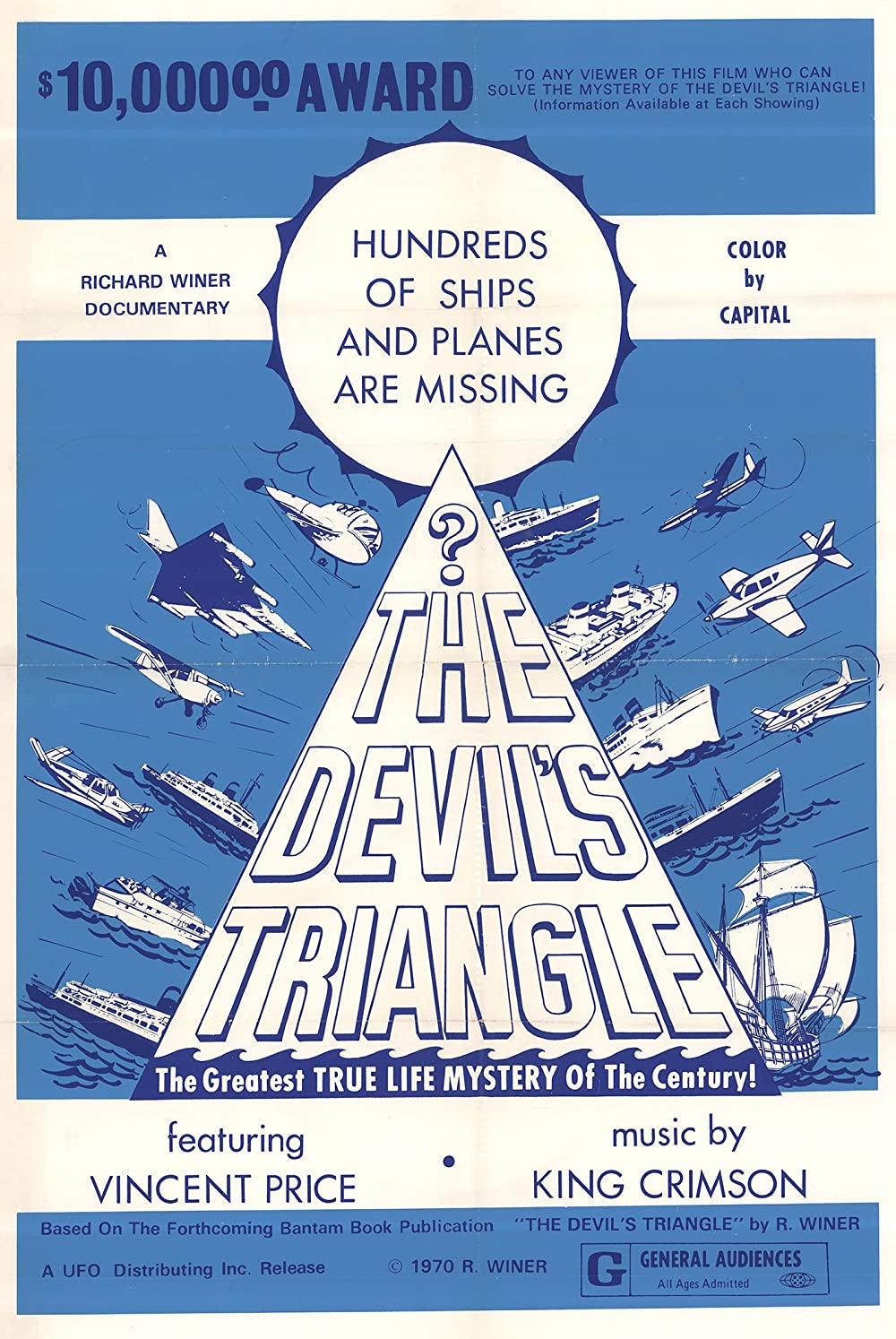
  • The original poster, which far outkicks the documentary's quality

It's not even really a documentary so much as an assemblage of stock footage interwoven with a few short interviews with subjects whose only common thread is that they didn't disappear into the Bermuda Triangle but knew some folks who might have. (Those poor folks weren't abducted by aliens or Atlanteans or seafaring members of the Deros civilization, of course. They were simply unlucky victims of crashes, explosions and sinkings on an unforgiving sea.)

The poster contains these outrageous blurbs: "HUNDREDS OF SHIPS AND PLANES ARE MISSING" and "The Greatest TRUE LIFE MYSTERY Of The Century!" (Fact check: False.)

Across the top, it announced a $10,000 award "to any viewer of this film who can solve the mystery of the Devil's Triangle! (Information Available at Each Showing)." I am quite sure that the $10,000 was never awarded.

In addition to somehow wrangling Vincent Price to serve as the narrator, the documentary improbably includes music by King Crimson, an English prog-rock band that got its start around the same time as Genesis. I don't know any of King Crimson's music, so I couldn't discern what noises on the muddled soundtrack belonged to them. I'm guessing the band didn't have this on its resume.

The documentary was released by UFO Distributing Inc. (natch). Based on my Googling, UFO Distributing only ever distributed one other film, a 1974 drama titled And Baby Makes Three. (Tagline: "A Drug Addicted COUPLE... A Drug Addicted BABY... THEN WHAT?")

Finally, The Devil's Triangle was directed by Richard Winer (1925-2016). This was his best film, as the only other one he helmed was 1972's 96-minute film Santa and the Ice Cream Bunny. That children's film has a catastrophically low rating of 1.3 stars (out of 10) on IMDb, probably due to the notoriety that comes with being selected as a subject for RiffTrax. 

The good news for Winer is that he had some success as an author. He was a ghost hunter who wrote several books on that topic, and he also wrote three books about the Devil's Triangle, one of which I'm pretty sure my parents had at some point. Apparently the books are more even-handed and skeptical about the idea of shenanigans in the Bermuda Triangle; it's a shame, I guess, that the same couldn't be said for the hyperbolic documentary.

Footnote
1. When it was over, we still had time to cleanse our palate with a fun episode of Night Gallery in which Larry Hagman appeared to be doing an impersonation of Orson Welles on the sly.

Monday, February 20, 2023

Snapshot & memories: Our little bookstore

Facebook served this up today as my photo memory from 12 long years ago. Have I posted this picture before on Papergreat? With 3,500-plus posts, who knows? Who hell even writes an ephemera blog with 3,500-plus posts?

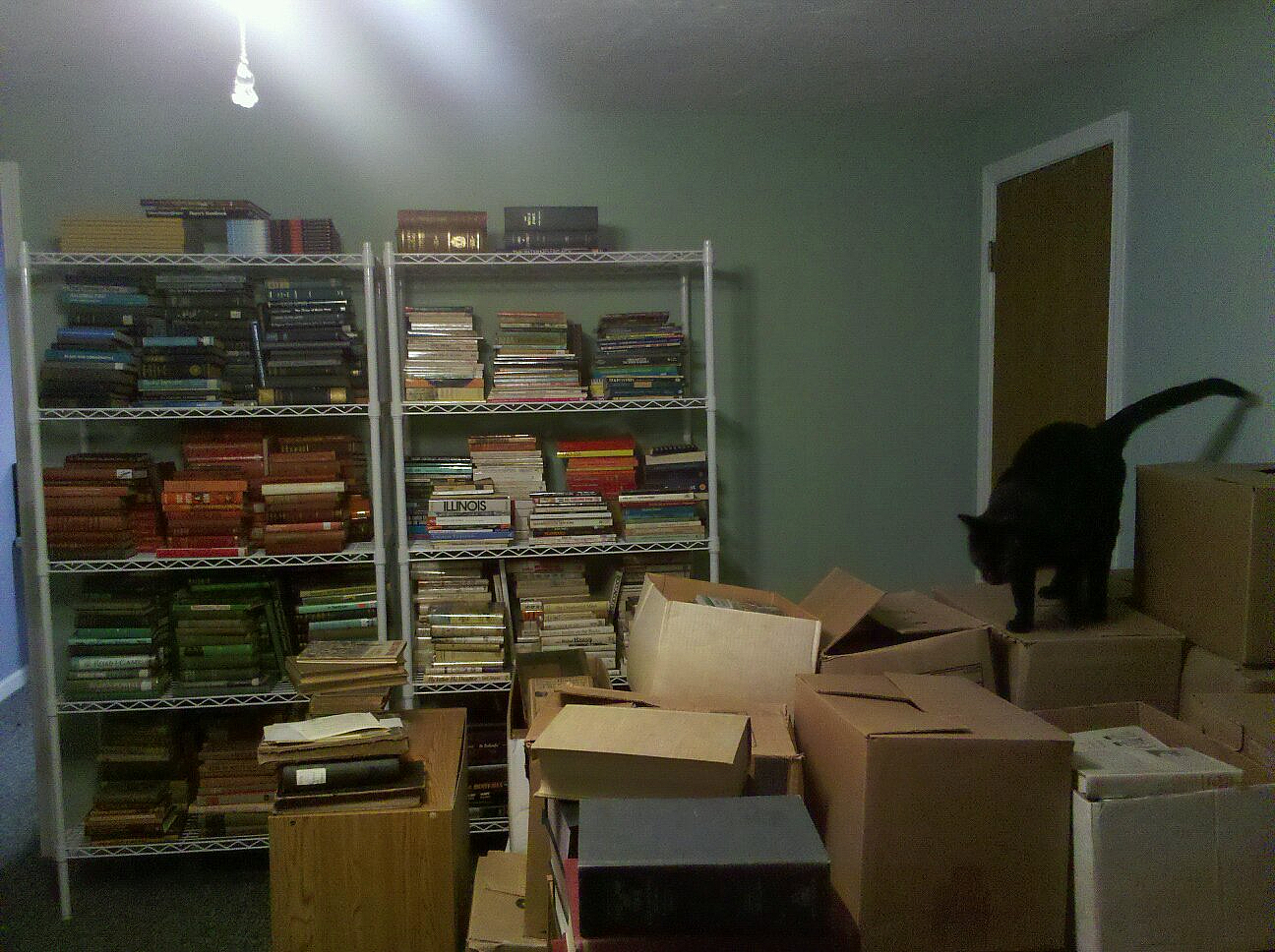
This is the "guest room" in the basement of our house on Ashland Drive in West Manchester Township. That was two houses ago. Most of the time we lived there, the guest room was actually occupied by human beings who were staying with us for various reasons. But there was a period when we had no lodgers and, simultaneously, Joan and I were expanding our long-running side business of selling used books on Amazon and, later, at the Dover Antique Mall. It was not what you'd call a lucrative side hustle, but it was a tremendous amount of fun. We did eventually get overambitious, though. At one point our entire garage was filled with boxes of books. We eventually winnowed that down and moved the remaining boxes to this basement room. This photo from February 20, 2011, shows we had gotten to the point where Mr. Bill could fit into the room alongside the books, too. 

After books were assessed and listed for sale on Amazon, they went onto the shelves to await sale and shipping. Most of the books you see here never did sell. Books sales on Amazon were always a long, slow affair, until they completely cratered with the flood of mega-volume sellers and penny books. A lot of folks got out of online book-selling at that point and never returned. 

But I'm not going to digress about the crash of used book sales online. What interests me about this photo is that I sorted our "for sale" books by color. I'm not entirely sure what the point of that was. I suppose each book had a photo with its online listing, so I had a starting point for searching after a sale was made. But it's a truly odd way to sort books (not to mention that they're vertically stacked!). It probably helped that I had a much, much better photographic memory back then, so I had a Spidey sense for where everything was. But this wouldn't have worked with my cognitive function as it now stands. Alphabetical or bust, baby.

This was also the room where I kept items that could be turned in Papergreat posts. I had a couple drawers full of such stuff — a lot of early material came from those boxes of used books and the things that were tucked away inside of them. Twelve years ago today, the Papergreat post was "A photo of Ruth Manning-Sanders." That was only the 31st post ever on the blog!! This is the 3,546th!

Tuesday, February 14, 2023

Paperback cover: "Tales from the White Hart"

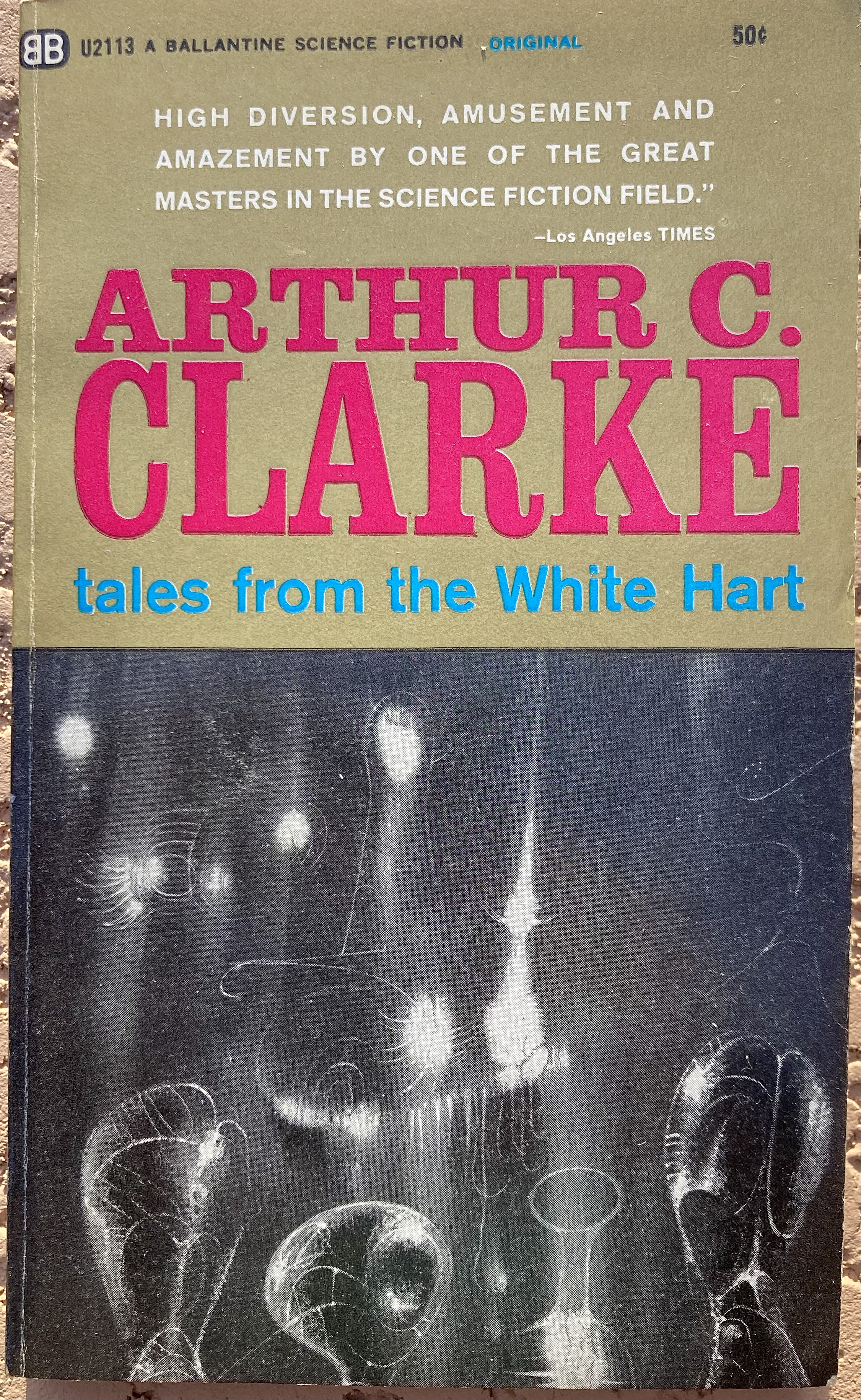
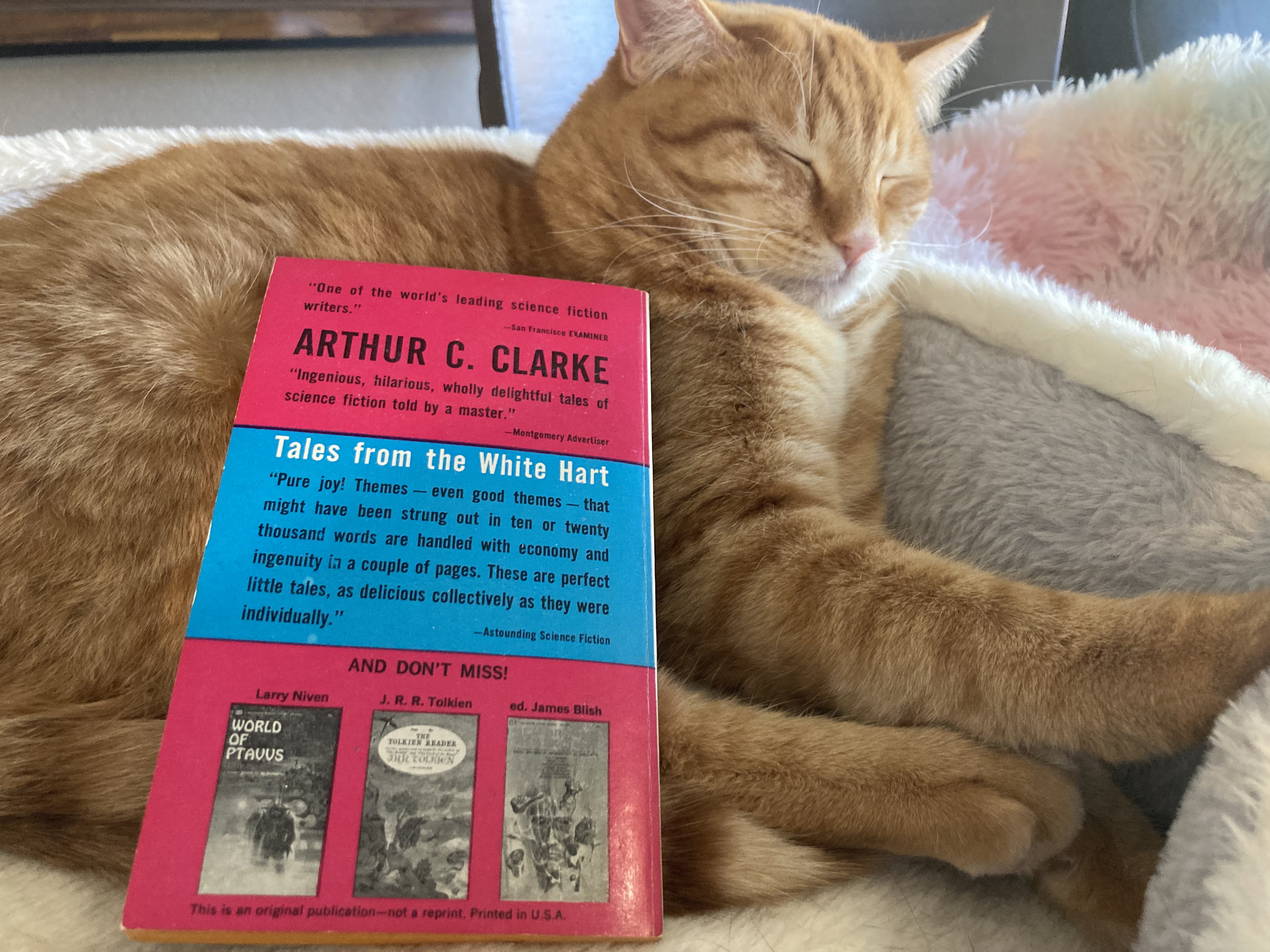
  • Title: Tales from the White Hart
  • Author: Arthur C. Clarke (1917-2008)
  • Cover artist: Richard M. Powers (1921-1996), according to Internet Speculative Fiction Database
  • Original publication date: 1957
  • Publication date of this edition: Third printing, November 1966
  • Publisher: Ballantine Books (U2113)
  • Cover price: 50 cents
  • Pages: 151
  • Dedication: To Lew and his Thursday night customers
  • About: This is a collection of short stories by Clarke with the shared theme of being club tales told by a man named Harry Purvis. For more about club tales and Lord Dunsany's part in the subgenre, see the 2020 post "Stay-at-home shelfie #57."  
  • Table of contents: You can find it on Wikipedia, with hyperlinks to most of the individual tales.
  • First line of preface: "These stories were written in spurts and spasms between 1953 and 1956 at such diverse spots on the globe as New York, Miami, Colombo, London, Sydney, and various other locations whose names now escape me."
  • Colombo? He's talking about the city Sri Lanka. Clarke lived in Sri Lanka from 1956 until his death in 2008. He was an avid diver and wrote books about his underwater explorations.
  • First passage of collection: "You come upon the 'White Hart' quite unexpectedly in one of these anonymous little lanes leading down from Fleet Street to the Embankment. It's no use telling you where it is; very few people who have set out in a determined effort to get there have ever actually arrived."
  • Random sentence from the middle: "It was obvious that the orchid had a highly developed nervous system, and something very nearly approaching intelligence."
  • Goodreads rating: 3.93 stars (out of 5)
  • Goodreads review excerpt: In 2020, Erik wrote: "I read this when really young up at paternal grandmother Lajla's cottage on the southwest shore of Lake Michigan — on the great wicker couch in the living room, to be exact. It was a cool night outside. Clarke's device, setting up his stories in the context of tale tales told in a pub, the whole grownup Englishness of it, enchanted me thoroughly, made me think consciously that 'now, this is a good book!'"
  • Amazon rating: 4.5 stars (out of 5)
  • Amazon review excerpt: In 2011, Paul wrote: "Readers of some of my other reviews know that I am partial to science fictional tavern or club stories. There are basically two ways of relating fantastic events in such settings. The first is to have the events occur in the tavern itself (as in the Gavagan's Bar stories or the Callahan's Crosstime Saloon tales). The second method is to have a "tall tale" spun out by a plausible narrator (as in the Jorkens stories or the Brigadier Ffellowes tales). ... The White Hart stories are funny. I have read them over a dozen times, and I still laugh at them. But you should understand. The humor is not a slapstick American humor. It is a dry British humor. Alec Guinness rather than Jerry Lewis."

Sunday, February 12, 2023

Sunday's postcard: Christmas greetings with Mary Kelynack

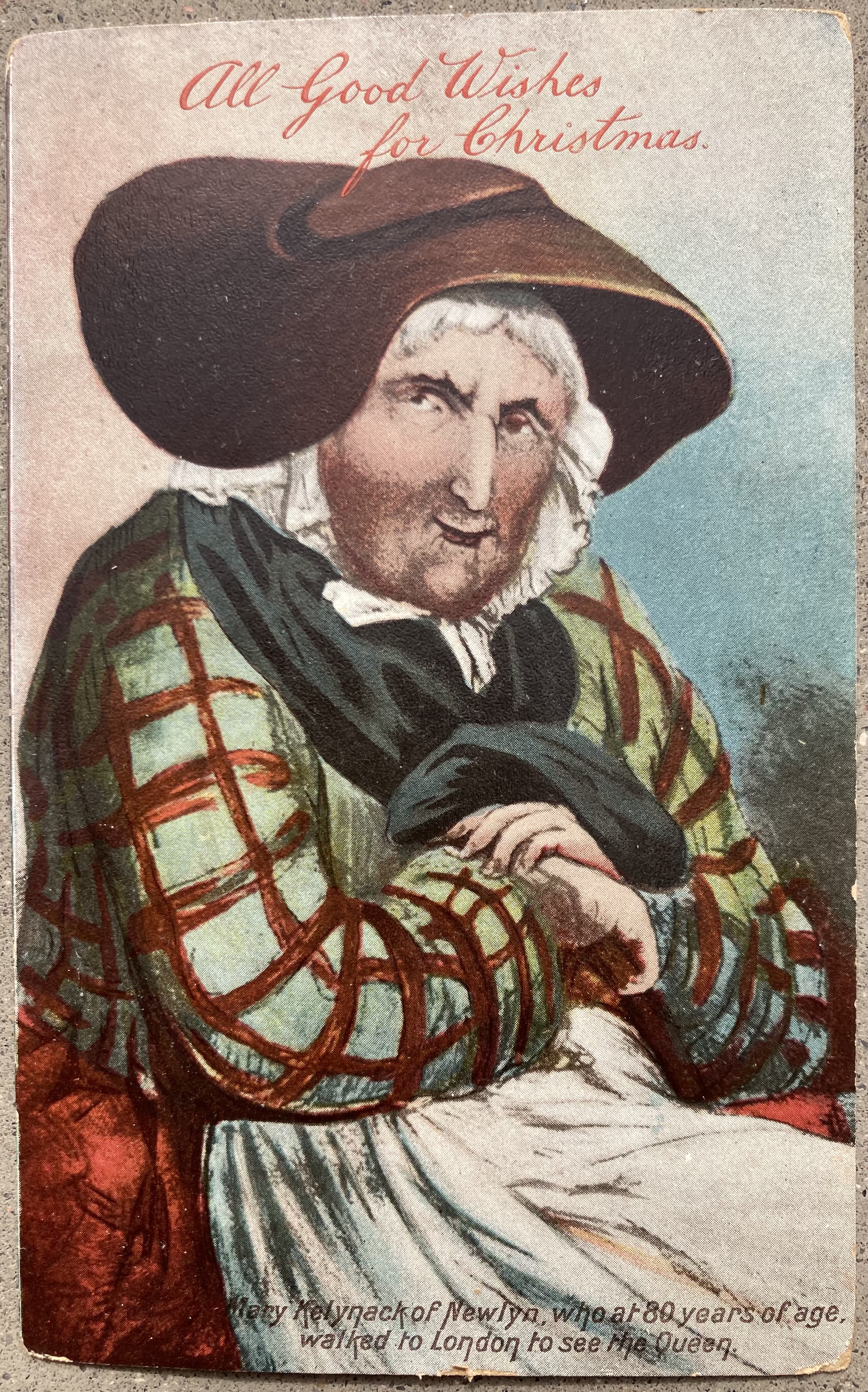
This undated, split-back postcard was published by F. Frith & Co. of Reigate, England.1 Across the top, it offers "All Good Wishes for Christmas." Across the bottom, the caption states: "Mary Kelynack of Newlyn, who at 80 years of age, walked to London to see the Queen."

I pulled bits and pieces of Kelynack's story, some conflicting, from several websites. It goes something like this:

Mary Kelynack lived in Newlyn, a seaside town in Cornwall, down in the southwestern tip of England. She had been having trouble receiving a pension to which she believed she was entitled (she was a widow whose husband had served in the navy). So, in the middle of 1851, she decided to walk about 300 miles (350 miles, by some accounts) to Mansion House in London and plead her case. The journey took her about five weeks. She carried a basket and "her dress would have consisted of a large shepherd’s hat of black beaver, a gaily coloured calico jacket, a coarse flannel skirt, an apron and buckled shoes," states an article on Cornwall Yesteryear. That's the traditional outfit of a Cornish fishwife. (In Cornwall, they called themselves fishjousters.)

By various accounts, Mary was either 75, 80 or 84 years old at that time.

One of Mary's other goals in making the arduous journey was to visit the much-ballyhooed Great Exhibition of 1851 held in the Crystal Palace at Hyde Park. Goods and wonders from all across the United Kingdom had been shipped to London for the exhibition, which ran from May through mid-October in 1851. Those in attendance included Charles Darwin, Karl Marx, Charlotte Brontë, Charles Dickens, Lewis Carroll and Alfred Tennyson. 

Mary wanted to see the spectacle. But, for a brief moment, she became the spectacle.

Some newspapers had documented her long journey, so, by the time she arrived in London, she was a minor celebrity. Upon being greeted by the Lord Mayor of London, she said, "I never was in such a place as this. I have come up asking for a small sum of money. I am 84. ... I had a little matter to attend to, as well as to see the Exhibition. I was there yesterday and intend to go again tomorrow."

At some point during her whirlwind time in London, Mary was granted an audience with Queen Victoria and Prince Albert. In her diary, Queen Victoria wrote: “The old Cornishwoman who walked several hundred miles to the Exhibition was at the door to see me, a most pale old woman, who was near to crying at my looking at her.”

Artists made portraits of Mary, and she received a number of gifts amid all the attention. At least one folk song was written about her.

Ultimately, Mary was able to make part of the return trip to Newlyn by train. But, despite her moment of national fame in 1851, her death in 1855 went mostly unmentioned and she was buried in a pauper's grave. She was 86. Or maybe 89. 

* * *

This postcard was never stamped or addressed, but a cursive message, written in pencil, covers the entire back of the card. It states:
My dear Lily,
Glad to hear you liked Washington. We trust you and Mr. Marshall will enjoy good health & be spurrd [?] & see old England again some day. Often think on you and pleasent [sic] hours we use to enjoy together. 

With kind love & best wishes,
Alfie [?], Aunt M. [?]
God be with us till we meet again.
Footnote
1. There's an interesting firsthand account of the final years of Frith & Co., in the late 1960s and 1970, at The Francis Firth Collection. The account concludes: "Sadly, it fell to me to print the very last Frith postcards. The final standard size postcards were cut off the last bulk roll and given an extra wash to better preserve them. They were then hand glazed, but not back printed. I still possess my copy as a memento, together with its machine negative. The other card (cards were printed two abreast) was given to the machine assistant. By the summer of 1970 my short career at F F & Co. was over and I got my P45 once the firm went into liquidation. The building was demolished and houses now cover the site."

Friday, February 10, 2023

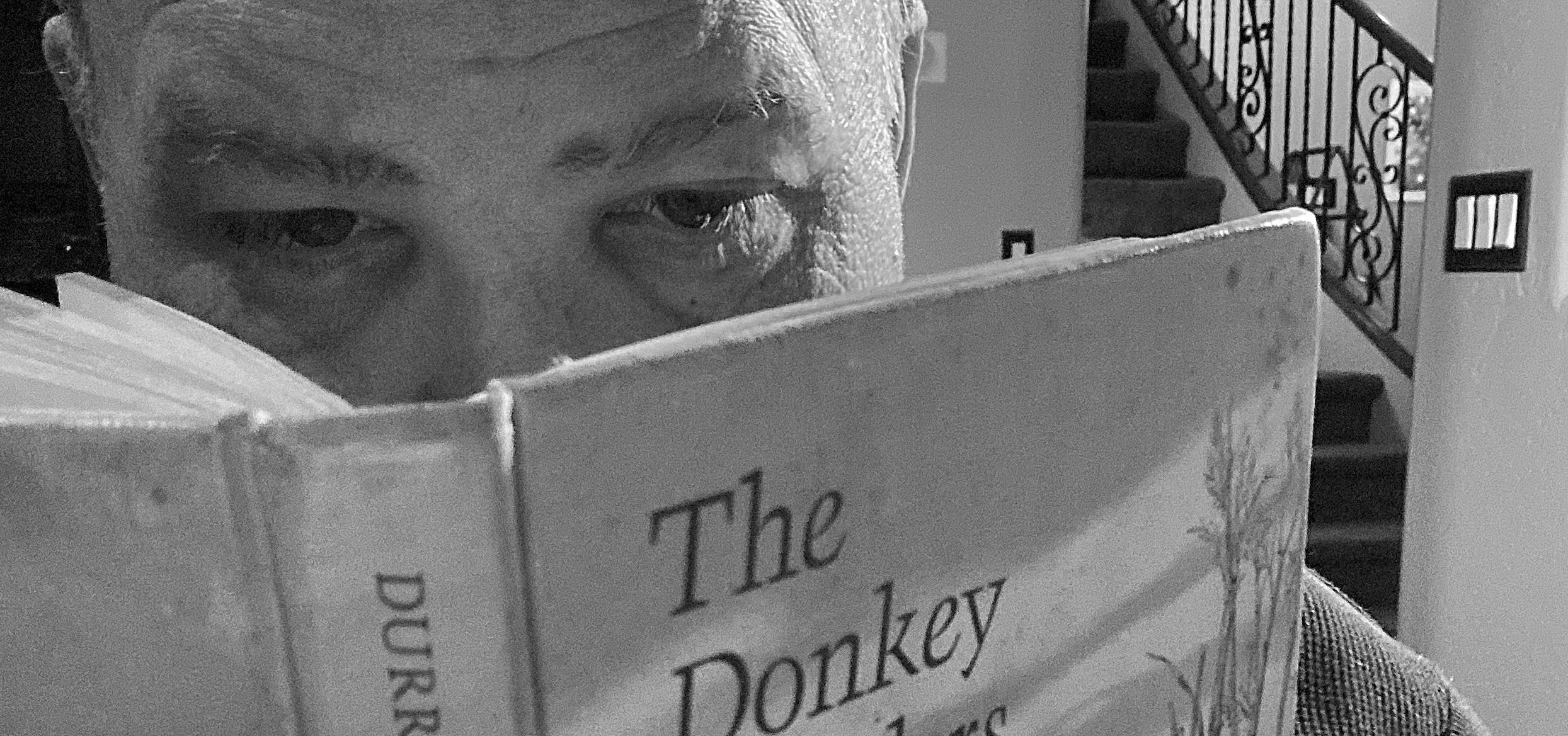
Answering questions about my reading history and habits

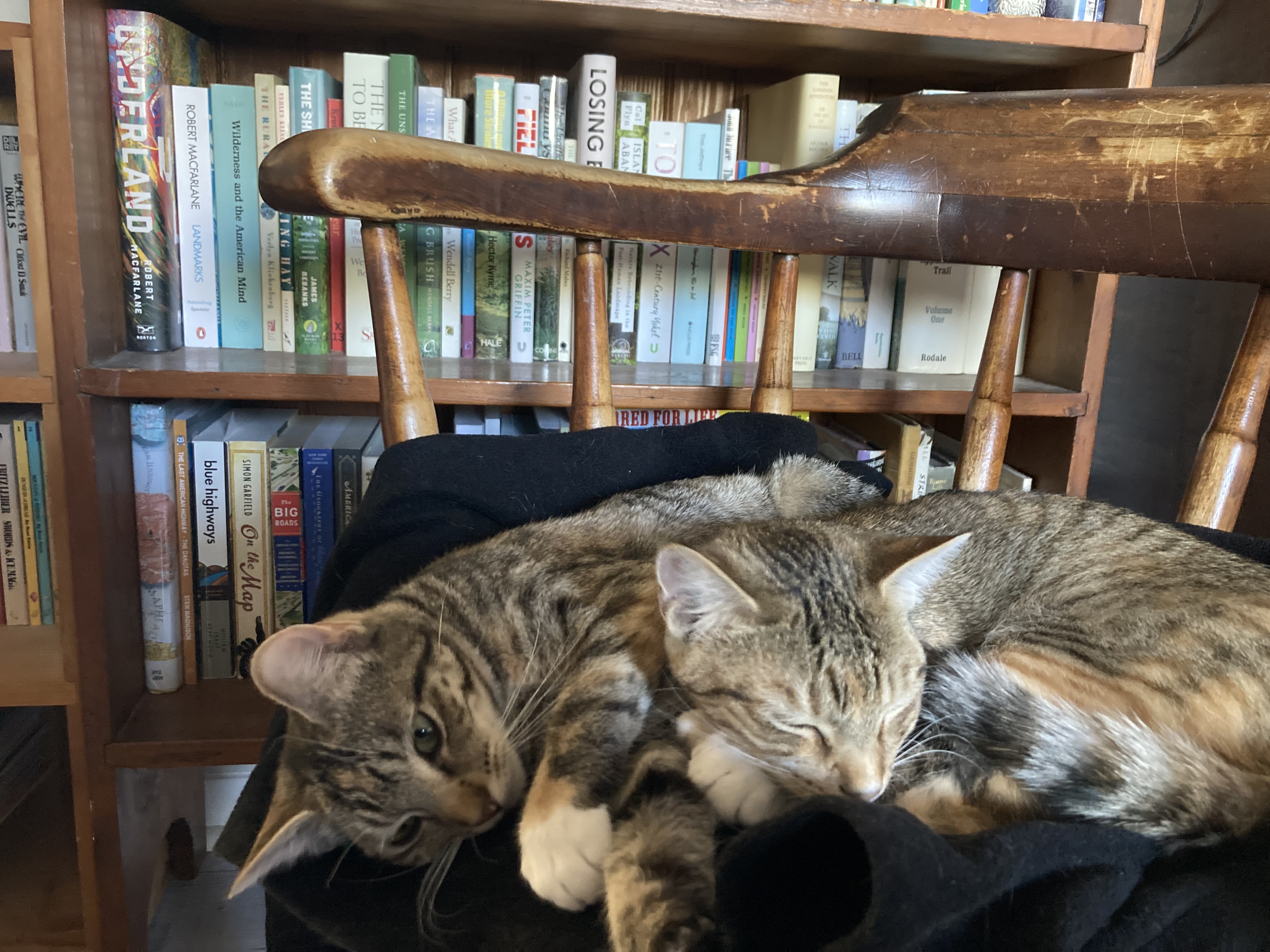
It's a quiet Friday night. Or at least as quiet as it gets in a house with 14 cats. They just had some cheese, and most of them are now resting. It sounds like one of them is trying to eat a chair in the other room, which is the biggest commotion at the moment. To my left, Nebula is a little riled up, but nothing too bad. Spice, Monkey and Titan are asleep to the right of me.

For fun, I gathered some "Questions for book lovers" from various websites and thought I'd just give it a whirl at answering some of them. 

1. What book are you reading right now? The photo above is staged. The actual answer is Maude Adams: Idol of American Theater, 1872-1953, by Armond Fields. I wrote about it on January 31 and am near the end now. 

2. What’s your next read going to be? I have no idea. Choosing the next book is so hard. I often end up staring at the shelves for a long time. Usually, it comes on a whim; whatever genre I'm in the mood for at a particular moment. So we'll just have to see...

3. What’s your favorite childhood book? Longtime followers of this blog know that's an easy one. It would be a Ruth Manning-Sanders book. I'll go with A Book of Wizards, because that's the one that stuck in my memory enough from the early 1980s so that I could track down a used copy in the early 2000s. There were plenty of other favorites from throughout childhood, too, including Dr. Seuss, Beverly Cleary's books (especially the Ramona series), The Three Investigators and the Mrs. Piggle-Wiggle books by Betty MacDonald (which I've yet to really write about).

4. Can you remember what your parents used to read you before bedtime? I'm sure it happened, but I don't have any specific memories from that far back. If Mom were still alive, I'm sure she could answer this question.

5. How many different books do you manage to read at once? I typically have one primary book that I'm reading, and then three or four other books beside my bed that I might pick up depending on my mood and/or if I only have a few minutes to read. One of them is always a browsing book, while there's also usually a collection of ghost stories in the pile.

6. Can you name a book that kept you up at night? When I was a teenager, I could read late into the night, perhaps plowing through a hundred or more pages. Most often, those were Stephen King books. Now, it doesn't matter how great or compelling the book is. If I read for 15 minutes before dozing off, it's an amazing accomplishment.

7. What is the saddest book you read? Most of the literary fiction I read these days is sad and/or downbeat. Two that come to mind from recent years are Signs Preceding the End of the World by Yuri Herrera and Like a Mule Bringing Ice Cream to the Sun by Sarah Ladipo Manyika.

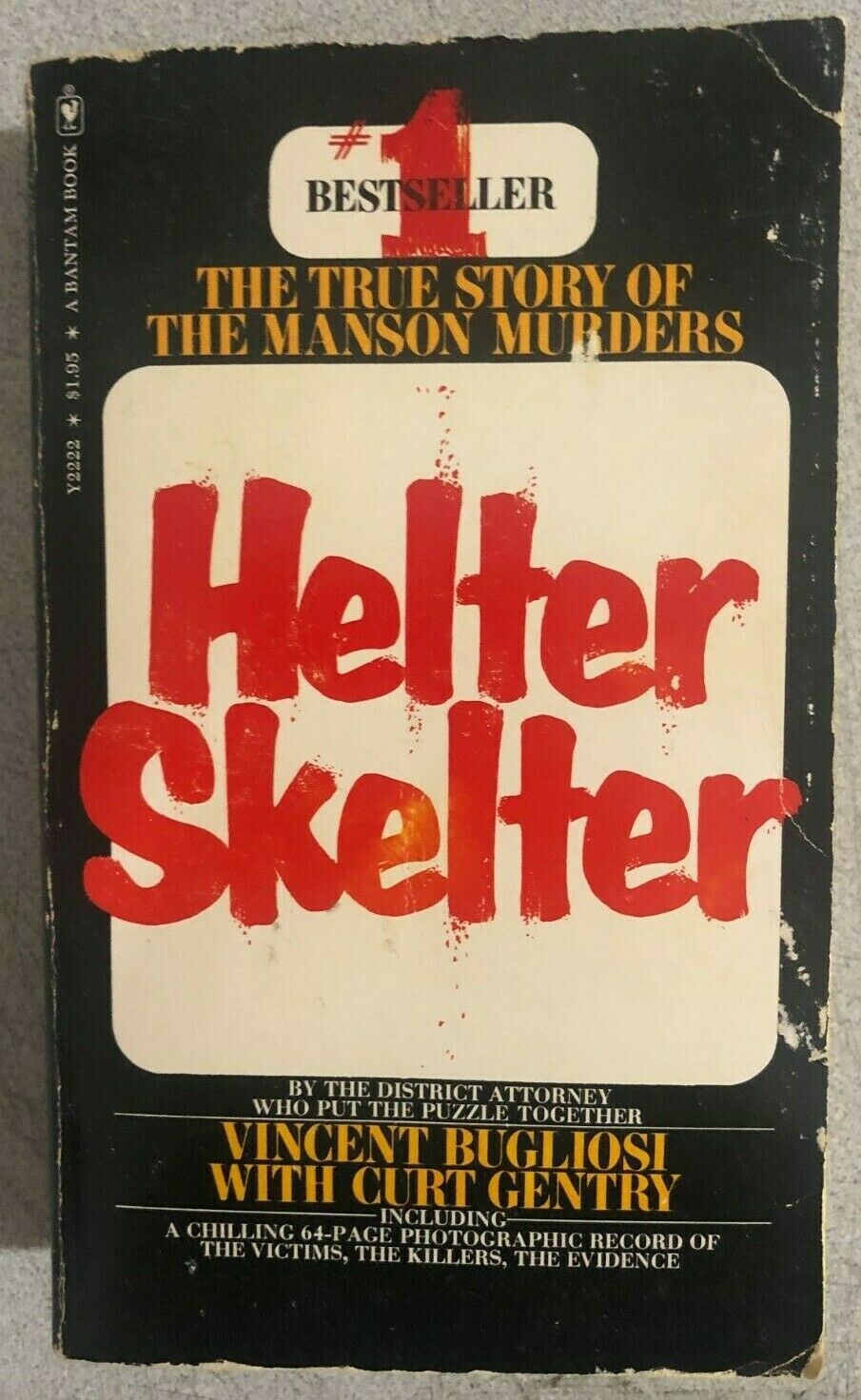
8. Which horror book did you find the scariest? I think the younger you are, the scarier the scary books are. I enjoy ghost stories and horror novels now; I find them entertaining and a nice form of escapism, because it's the real world that turned out to be scary. I'm sure I'm forgetting some that traumatized me as a kid, but a few that stick out are The Amityville Horror by Jay Anson (yes, it's a novel), the "ghost hunter" books by Hans Holzer and Susy Smith and, from Stephen King, probably It and Misery. And, when it came to Generation X getting an early education that the real world was far more terrifying than anything horror writers could muster, there was nothing scarier than the Helter Skelter paperback, with its blood-red lettering on the cover.

9. Do you prefer e-books or physical books? Physical books! I've still never read an e-book.  

10. Do you enjoy audiobooks? They're fine, but I rarely find myself in a situation where listening to them is something I want to do. I've occasionally listened to them on long drives. I know some folks who listen to audiobooks while multi-tasking or doing chores. I don't want to do that. If I'm interested enough in a book, I'll read it. And if I'm listening to an audiobook, I need to give it my full attention. If I'm going to listen to something, I'd rather listen to a podcast, as there are so many good ones out there.

11. Do you read out loud? I sometimes read out loud for my job with the newspaper. When I'm editing copy or going over something that I wrote, reading aloud can help me make sure I didn't miss anything and that it reads smoothly.

12. What are your favorite and least favorite genres? I have many favorite genres! I will read almost any topic when it comes to nonfiction, because I always want to learn something new: history, science, health, computers and technology, sociology, anthropology, architecture, civil rights, weather, film history, books about books, nature, hiking, farming, transportation, food, mythology, gaming — and the list goes on. I also enjoy most kinds of fiction, but will admit that westerns and romances aren't my cup of tea. I've never read much poetry, but I'm trying to make a concerted effort to mix a little of that in.

13. Do you ever annotate books? Occasionally. I've found myself doing this with some books that would fall under the rubric of sociology or personal essays. Two authors, of many, who give me a lot to think about are Rebecca Solnit and Ta-Nehisi Coates. I fill those with highlighting and marginalia.

14. Do you write reviews about the books you read? I generally find myself more interested in reading reviews and analysis by others. I like to seek out perspectives I might have missed, praises and criticisms after finishing a book. I am more likely to review a book if not much else has been written about it. I figure that's when I can best contribute to the vast ocean of knowledge on the internet. For example, I posted my thoughts on Ruth Manning-Sanders' 1938 children's novel Adventure May Be Anywhere on Goodreads.

15. Did you ever buy a book you had already read? Only with a select few books, if I like the design or cover of another edition. I have a few different duplicate books by J.R.R. Tolkien, because the covers are so gorgeous. And I am strangely drawn to the various covers for William Hope Hodgson's The House on the Borderland.

16. Do you want to visit a city or place just because you read about it in a book you loved? Does Hay-on-Wye count for this question? I'd love to go there. I like reading books about bookstores and their history, and I'd love to visit some of the iconic bookstores in the U.S., which is probably more feasible than hopping the Pond to get to Hay-on-Wye.

17. Have you ever met a writer in real life? I have many, many friends, colleagues and classmates who have written and published books. An incomplete list includes: Larry Alexander, Buffy Andrews, Ted Anthony, Mike Argento, Alisa Bowman, Joan Concilio, Dan Connolly, Bridget Doherty, Kimi EiseleMegan Erickson, Andrew Ervin, Leigh Gallagher, Mike Gross, Jessica HartshornDennis Hetzel, Tom Joyce, Bill Landauer, Lauri Lebo, Jim LewinCaroline Luzzatto, James McClure, Rissa Miller, Isabel Molina-Guzman, Kevin NaffDana O'Neil, Gregory Scopino, Leslie Gray Streeter, Beth Vrabel, Michael Weinreb and Laura Wexler. Go check out their works and discover something new to read!

Sunday, February 5, 2023

Weekend things: "The London Nobody Knows" and "Marjoe"

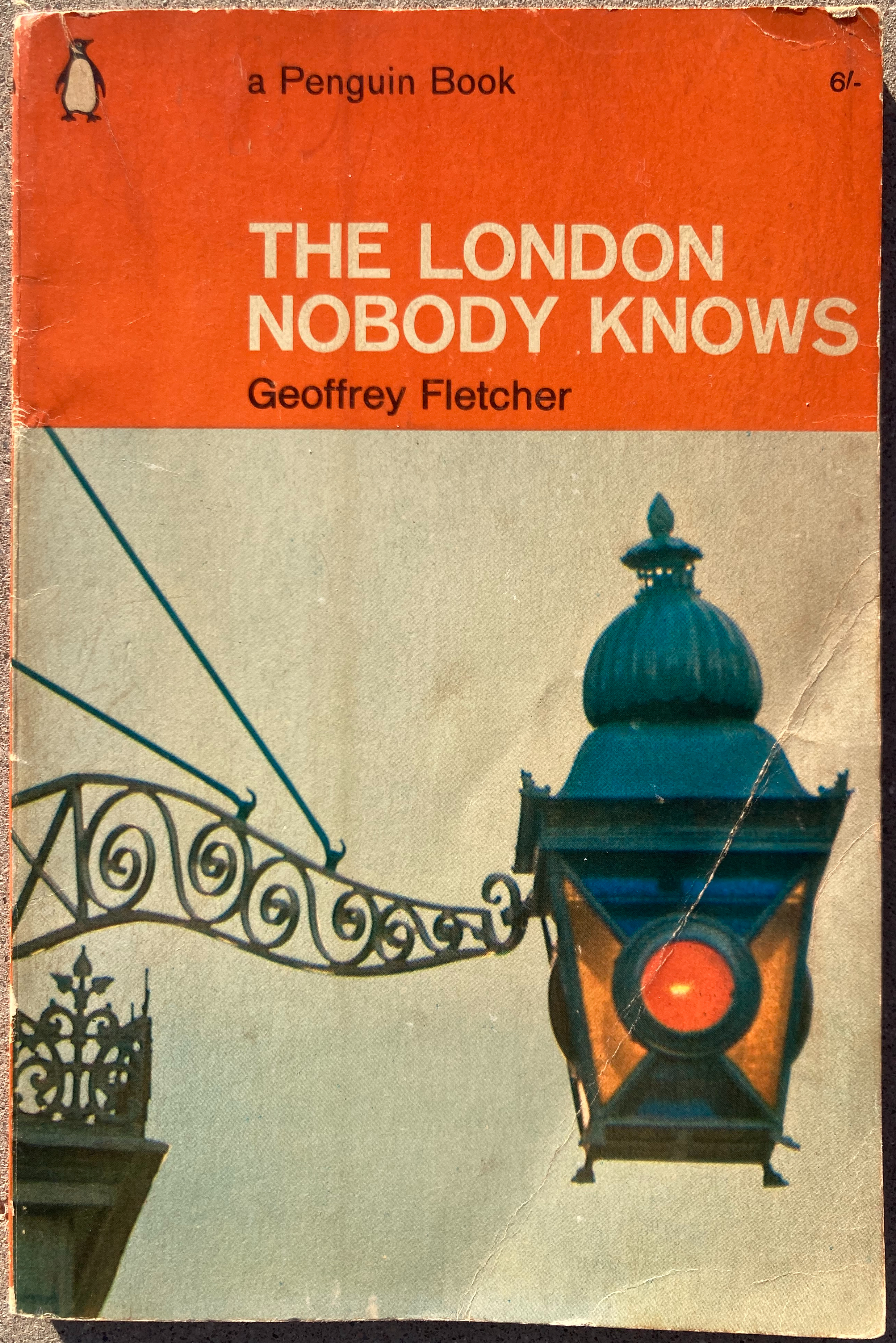
This is my worn-but-fine copy of The London Nobody Knows, which was written and illustrated by Geoffrey Fletcher (1923–2004) and first published in 1962. This is the 1965 Penguin paperback; so, it's not bad for a 58-year-old softcover that's been through multiple owners and bookshops. 

The nonfiction book's title is fairly self-explanatory, but the blurb on the back cover gives additional insight: "Geoffrey Fletcher, as the Sunday Telegraph has said, 'has an eye for what most of us miss.' His delightful scrapbook of off-beat London, with its clean drawings and entertaining text, is as enticing as Portobello Road on a Saturday afternoon." Fletcher checks out the "enamel advertisements, seedy terraces of perfect proportions, decorated cast-iron public lavatories, monumental masonry and fallen arches. Here is a rococo Victorian funeral parlour, there a splendid Hawksmoor Church, threatened by indifference and the breaker's hammer. And look! here is positively the last Yiddish theatre in London."

Of course, many things have changed in the six decades since this book's publication. Some of Fletcher's hidden gems are certainly gone forever. But there is good news, too. The "Hawksmoor Church" mentioned above is Christ Church Spitalfields, designed in the 1700s by Nicholas Hawksmoor. This book was written during its low point, but a multidecade restoration has returned much of the structure's former glory, as Wikipedia notes:
"By 1960 Christ Church was nearly derelict and services were held in the Church Hall (an ex Huguenot Chapel in Hanbury Street) as the roof of Christ Church itself was declared unsafe. The Hawksmoor Committee staved off the threat of wholesale demolition of the empty building — proposed by the then Bishop of Stepney, Trevor Huddleston — and ensured that the roof was rebuilt with funds from the sale of the bombed out shell of St John's, Smith Square, now a concert hall. ... In 1976 the Friends of Christ Church Spitalfields, an independent charity, was formed to raise money and project manage the restoration. ... the church was restored to its pre-1850 condition, working from the original building documents where possible, a process that stretched over more than 25 years."
Fletcher does most of his exploration on foot and many of his observations are of the type one can only glean via shoe leather on the sidewalk. In the chapter about Islington, he writes of the sights to be seen along Chapel Market: "The weeks before Christmas are the best time to go there, for it is then that market is most fully stocked with fruit, vegetables, poultry, and toys. Here the crowd gathers round a man selling boxes of cheap crackers, and a hawker with several days' growth of beard sells magic mice  —  white mice which run up and down his greasy sleeves. Those who buy them will find that there is nothing but a mouse of white wax inside the bag; the secret is in the manipulation; that is all."

I was surprised to learn that this 1962 book served as the basis for a 1969 documentary of the same name, which features actor James Mason as the guide/narrator. 

Much had changed — culturally if not structurally — in the seven years between 1962 and 1969. So I'm guessing the documentary has a different flavor. 

One IMDb reviewer, writing in 2011, describes the documentary as "a perfect artifact of a Britain before the almost complete Americanisation of its streets, industries and culture that was to come in the late 1980s and throughout the 1990s." Another reviewer recommends it for fans of psychogeography. And I love this comment from a 2007 review: "I never had James Mason pegged as one to go wondering around the back streets of Spitalfields (where, then, some were still alive who could remember the Ripper murders....), old theatres in Camden, and Salvation Army hostels interviewing the unfortunates there."

Speaking of documentaries... 
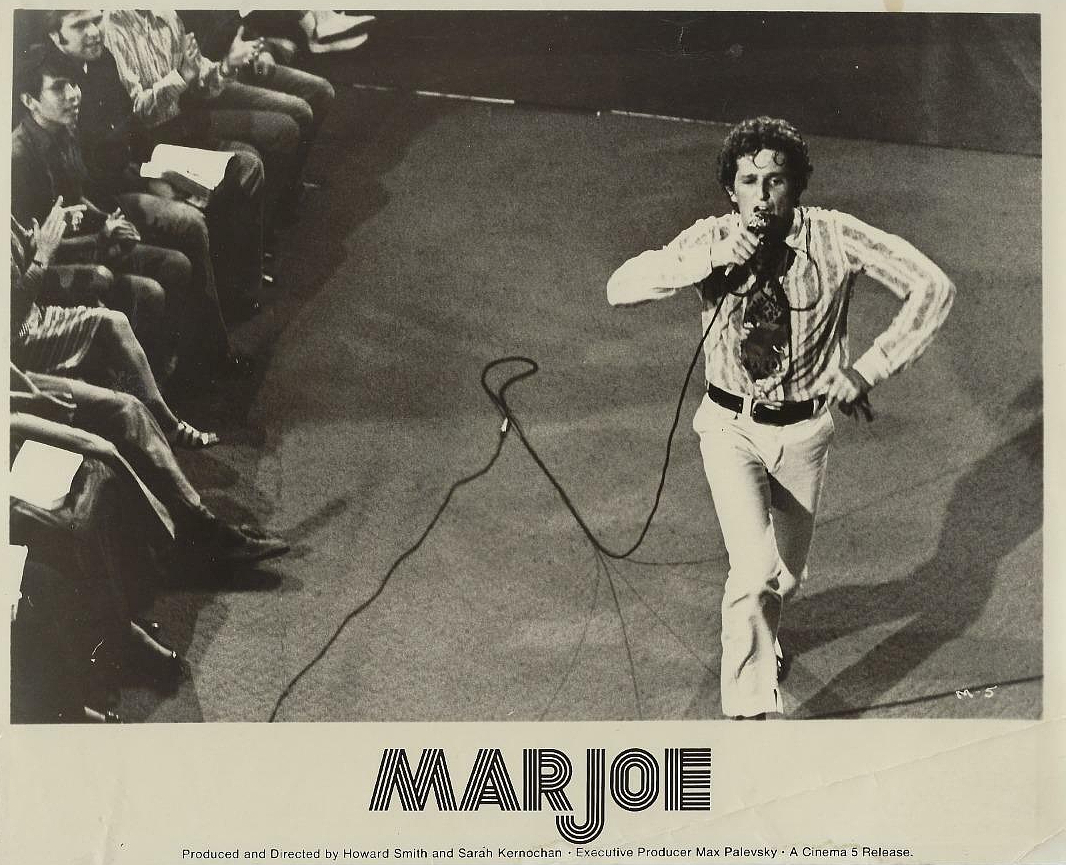
... on Friday night I finally caught up with the Oscar-winning 1972 documentary Marjoe, and I'm still trying to wrap my brain around all of it. What an incredible story and historical document it is. 

For those unfamiliar, Marjoe Gortner (who recently turned 79) was forced into preaching by his parents at age 4; perhaps not a surprise, given that his first name is a portmanteau of Mary and Joseph. For more than a decade, his parents parlayed his speaking talents and precociousness into a cash cow on the revival circuit. He never saw any of the money (he says they made millions) and set out on his own in San Francisco at age 16. Eventually, in need of money as a young adult, he returned to the only thing he'd ever been taught: deploying his charisma and persuasive speaking about God and the Bible as a traveling preacher. The money was great, but he grew tired of the deception. 

So, in 1971, he agreed to let a documentary crew "out" him as a charlatan during one final tour of the revival circuit. The documentary switches back and forth between Gortner's sermons, all of which end with his call for parishioners to "get our your wallets," and hotel interviews in which he conveys a sense of self-loathing but also anger at how that type of evangelism is a rigged to separate the faithful from their money.

Gortner knew the gig would be up for him after the documentary was released, and in fact that's what he was counting on, so that he wouldn't be tempted to live his double life any longer. He worked as an actor throughout the 1970s and 1980s. Interestingly, many of his roles cast him as a villain or deceiver, including the TV movie The Gun and the Pulpit, Bobbie Jo and the Outlaw (co-starring Lynda Carter) and the movie that critics tend to his consider his best performance, When You Comin' Back, Red Ryder?

With a running time of less than 90 minutes, Marjoe has a dizzying amount to say about bad parenting; the lifelong effects of childhood trauma; the greed, deception and hypocrisy of some religious institutions and leaders; the gullibility of the masses and the state of America in the early 1970s. And this was before that decade's rise of televangelism, which allowed people to be separated from their money without even having to leave their homes.

I think this headline on one IMDb review sums up Marjoe well: "Award-Winning Documentary that Had No Effect on Americans." 

(As an aside, it's also incredibly depressing to watch the young documentary filmmakers, who are often in the shots in which Gortner is interviewed, essentially chainsmoking through each scene. But the rise and marketing of Big Tobacco to generations of Americans is a topic for other days and other documentaries.)

Watching a documentary as compelling as Marjoe often jump-starts me down a rabbit hole of finding other documentaries about niche elements of culture and our world, especially from the 1960s and 1970s. I already mentioned 1969's The London Nobody Knows. A few others I now want to track down include 1967's Holy Ghost Peoplethe 1967 Soviet documentary 235 000 000, and 1971's The Moon and the Sledgehammer. Other recommendations heartily welcome!

Thursday, February 2, 2023

Dust jacket of Ruth Manning-Sanders' "The Growing Trees"

I was happy to stumble across this new-to-me internet image of the dust jacket of Ruth Manning-Sanders' 1931 novel The Growing Trees. According to the UK bookseller, the very rare jacket is from the third Faber and Faber impression. 

My copy of this book is from the William & Morrow Company edition published in New York, also in 1931. It has no dust jacket. The novel, which I mentioned in passing in a 2016 post, is split into two parts: Nether Brook and Primrose Hill. This is the first paragraph:
"James Brock first experienced the joys and sorrows of a romantic attachment when he was tens years of age. It happened in the holidays, like most of events of importance in his life so far, and the object of his love was a Scotch farm girl of fourteen, called Margaret; who, with her long strands of bleached hair, and her deep-set blue eyes, reminded James of the picture of Rapunzel in the colored woodcuts in his big old edition of Grimm's Fairy Tales."
As I've noted before, Manning-Sanders was writing about fairy tales decades before she was penning her own retellings of fairy tales. In the first pages of The Growing Trees, there are also mentions of Red Riding Hood, the princess and the pea (and its feathered mattresses), Arabian Nights, and "riding to the accompaniment of silver bells like the queen of elfland."

The Faber and Faber dust jacket illustration, featuring a man and a young woman riding carousel horses, is signed Hookway Cowles. He got a lot of work with dust jackets and interior illustrations from the 1930s through 1950s; he has a listing on the Internet Speculative Fiction Database.

A 2020 post on The Folly Flaneuse provides some biographical information: Hookway Cowles lived from 1896 to 1987, and was the son of a Yorkshire clergyman. He was most famous for his work illustrating novels by H. Rider Haggard.

(The Folly Flaneuse is a wonderful and professional site that I'll have to dive into at some point. It describes itself as "rambles to, and ramblings about, follies and landscape buildings." Follies are expensive ornamental buildings with no practical purpose. They are often towers or mock ruins constructed in gardens or parks.)