Tuesday, August 31, 2021

"Owning a library was the most important thing for him in life"

The final withdrawal of United States troops from Afghanistan this month has been a devastating process on so many fronts, not least for the shattered families of the 13 U.S. service members and approximately 70 Afghan citizens who were killed in an airport suicide bombing on Aug. 26. 

There are so many personal stories intertwined with the withdrawal. This is just a small, poignant one that caught my eye. Obaid Mahdi posted this book-related tweet on Aug. 27 about his father's library in Kabul.


Here's a closer look at the before and after photographs.
There's an article about the evacuated library on the website Kronos, written by Gülnur Hasesoǧlu. Unfortunately, it's in Turkish. So I had to use Google Translate to get the gist of the story. Here are some details I could glean from the imperfect English translation:

  • Writer Obaid Mahdi shared on his Twitter account the library of his father, Mohaiddin Mahdi, a professor and writer from Afghanistan, before and after the Taliban took over Kabul. The tweet showing the full and empty states of the library was shared by more than ten thousand people around the world, and it became the symbol of the "change" that came with the Taliban. “This library represents a generation that is no longer around,” Mahdi told Kronos.
  • Obaid Mahdi, who has been in France the past three years, said the library dates back more than 50 years, having been started by his grandfather. His 65-year-old father left a few days before the Taliban took over Kabul. The thousands of books, plus some artifacts, are now hidden elsewhere in Afghanistan. The family plans to take the library abroad and re-establish it.
  • The library includes books from Turkey, Iran, India, Tajikistan and Pakistan. There are handwritten books, history, literature and poetry, plus books about multiple religions. One of the books is 750 years old.
  • Mohaiddin Mahdi is a researcher who loves his books. He values them not only as a library for his own research, but for everyone else who can benefit from them. "Owning a library was the most important thing for him in life," Obaid Mahdi said of his father.
  • Obaid Mahdi summed up: “This library was not only for ourselves, it represented the generation of people of culture in Afghanistan different from the Taliban. People who engage in books, knowledge and research. Now these people are disappearing."

Sunday, August 29, 2021

Spinnerin selling the privileged
yarn-based lifestyle in 1963

Here are some scans of the model photography within a pattern magazine published by the Spinnerin Yard Company of South Hackensack, New Jersey, in 1963. The staplebound booklet measures 8¾ inches by 11¾ inches and has 56 pages, including the front and back covers. There's a clear tie-in with Coca-Cola; it must have paid Spinnerin for the product placement. 

The magazine is the work of Alice Carroll (editor) and Claudia Manley (assistant editor) and contains patterns and instructions for all sorts of aspirational yarn-based attire. Plus numerous reminders that "gauge is the most important element in knitting and crocheting." Also, yarn clothing should never be dried in the sun.
Related posts

Outtakes with Angelino

Saturday, August 28, 2021

Papergreat research assistant of the week: Titan

Mystery portraits of long ago

I don't think I've posted either one of these miniature portraits before. I did my due diligence in trying to search past Papergreat posts. But there are 3,400+ of them, y'all, and sometimes it's impossible to keep track of what I've posted. 

These are both 2½ inches wide. They would have been with one of the collections of photos and ephemera that were packed into the Oak Crest Lane house. They are probably distant relatives or friends of distant relatives, but there are no captions or notes on the back, only the photographer's information. 

Printed on the back of the photograph of the woman is: "The Number of this Negative is 10562 which please designate when ordering Duplicates. From Garrett's, Wilmington, Del. Unless this Negative is purchased it will be preserved only one year from the time of takin." (Yes, it's spelled "takin.") 

Printed on the back of the photograph of the girl is: "J.K. SUTTERLEY, 302 Market Street, Wilmington, Delaware. Photographer. No. _____. This negative kept one year. Copies can be had any time from it at reduced prices."

Friday, August 27, 2021

Nostalgia for nostalgia,
and how times have changed

The time-memory continuum is weird, if you stop to think about it. I sit here in 2021, being nostalgic for Nick at Nite's TV Land of the mid-1990s. Back then, it aired reruns of my favorite 1980s show, St. Elsewhere, and ran vintage commercials from the 1960s and 1970s. So, to sum up, I'm nostalgic for that time a quarter-century ago, when I could watch a TV show that debuted 39 years ago and commercials from a half-century ago.

One of those TV Land retro-commercials that has stuck in my head since I saw it repeatedly in the mid-1990s is the one for the 1969 Pontiac GTO called "The Judge." The catchy, psychedelic commercial features Paul Revere & the Raiders. You can watch it here on YouTube. There is, of course, a whole generation of folks who still remember this from when it first aired circa 1969. And another generation of folks like me who were introduced to its second life via TV Land. 

Car sales have changed a lot over the years, too. Not just the marketing and advertisements, but the process of buying a vehicle. Dad isn't a fan. He wrote this on Facebook earlier this month:
You buy a new car and finance it, so you get a dealer discount.
You get a letter from the bank telling you how to manage your account online.
You pay off your loan in full 10 days before the first payment is due.
You get an email confirmation regarding your payoff.
You never see or speak to anyone from the bank. 
The bank doesn’t ask if they can provide more services.
Does the bank’s computer get a commission on my loan?
Sorry, 35+ years selling face to face led to long-term relationships with my customers and repeated sales.
I’ll never do any future transaction with this bank. If it really exists.
A harsh sentence, but The Judge has ruled.

From the readers: Cheerful cards, swinging bridge & a night marauder

As we barrel toward the end of August, here's another batch of your always-appreciated comments on Papergreat posts:

Old photo postcard of Brackenhurst Hall in Southwell: Linda writes: "I also lived at Brack (Brackenhurst) Farm Estate 1954 to 1973). Lots of great memories." I'm going to get in touch with Linda and see if she wants to share some of those memories and stories from this 19th century estate in Nottinghamshire, England. Stay tuned.

Postcard: Zeppelin moored atop the Empire State Building: Responding to this 2016 post, Unknown writes: "Bonjour, Je possède la même carte postale reçu par ma grand-tante en 1933 par une amie de Boston. La seule différence est qu'elle n'a pas de numéro. La vôtre porte le numéro 102. J'ai également celle du Barbizon Plaza et du Skysrapers from East River. Merci."

That's French, of course. And it translates roughly to: "Hello, I have the same postcard my great aunt received in 1933 from a friend in Boston. The only difference is that it doesn't have a number. Yours is number 102. I also have the one at Barbizon Plaza and Skysrapers from East River. Thank you."

Cheerful Card Company can help you earn extra money for the holidays: I continue to be astonished by all the happy memories this 2012 post brings out. Anonymous wrote: "I used to sell Cheerful House Cards and products in the 70s. My wife and I were cleaning out a box today and found an ad for their Bicentennial Flag special offer. It was in a box I had stored some of my father's stuff in. The box came from Cheerful House, Bevis [Industries], from Baltic, Connecticut. That box is 46 years old. Brought back many memories."

Vintage postcard: "The Night Marauder": I'm having some back-and-forth exchanges with Jim, who notes that the linen postcard was published by A. Wolfmueller, who is his wife's grandfather. "She would very much like to have that one and any others by him," Jim writes. And so I'm trying to find where this postcard presently resides. The move from Pennsylvania to Arizona at the beginning of the year jostled my sense of knowing where most things are. Is it in one of the shoeboxes, or is it in the closet? As soon as I (hopefully) find it, I'll be sending it Jim's way.

The pencils of Seminole Middle School: Matt, whose blogs include 4 Color Cowboy, writes: "I do remember those [NFL] pencils from school in the early '80s. Despite my strong aversion to pro football or organized sports of any kind, I liked them. Maybe it was the colors and the subtle design with the little helmet silhouettes."

1970s Woodsy Owl bookmark: "Give a Hoot! Don't Pollute.": Kim Gilbert Pintozzi writes: "I also entered the contest in 1970. My slogan was 'Give a hoot don’t pollute don’t be a dirty bird.' I won the contest and received a ribbon and there was an article in the Courier-Post. I was 12 and lived in Collingswood, N.J."

From the readers: Treasured copy of "Andersen's Fairy Tales": Unknown writes: "I also have a copy #0546 ... Charles E.Graham. It has an inscription, 'Merry Xmas to Fredrick. Love your Father and Mother 1918.' It could have been used when they gave it to him. I bought it online for $2. I love it."

Greta's visit to Tahiti Beach: Joan writes: "I was just bummed that they did not in fact go to Tahiti, which is still on my bucket list!"

Swinging Bridge in York, Pa. (And you thought your commute was bad): Beverly Griffith emailed to say, "Thank you for sharing the pictures and information on the swinging bridge over the Codorus Creek. My dad lived on 5th Avenue in North York growing up and told us about it."

A morning for marvels and magic: Commenting on Facebook, Nena Zachary Challenner writes: "I love these whimsical illustrations."

Trying to decipher a 1942 postcard: Commenting on Facebook, Wendyvee writes: "I was just looking at some old mail a few weeks ago that my sister has which belonged to my grandmother. At least twice on postcards (and once in a letter) blackouts were mentioned."

Book cover: "Strangely Enough!": Commenting on Facebook, Tom Beiter writes: "I have several different copies of that book. All the same content, although arranged slightly different. I loved those kind of books as a kid. Anything to do with ghosts and mysteries."

Same here, Tom. Same here.

Thursday, August 26, 2021

Greta's visit to Tahiti Beach

Eighty years ago, on January 25, 1941, my great-grandmother, Greta Miriam Chandler Adams, visited Tahiti Beach in Coral Gables, Florida, according to the note written on the back of this EKC real photo postcard. She was 46 years old at the time. A detail shot of the beach/lagoon at the bottom of the post shows a water slide and a pier.

According to a great 2019 article by John Allen for Coral Gables Magazine, the bullet-point history of the beach goes something like this:
  • 1925: George Merrick buys an overgrown stretch of bayfront property in Cocoplum from the Deering family. In a media blitz, he crowns it the future hot spot of Tahiti Beach.
  • First half of 1926: Development proceeds quickly on Tahiti Beach. There are special events and lots of dancing. All the cool kids want to be seen there. Times are good.
  • September 1926: The Great Miami Hurricane levels Tahiti Beach.
  • Late 1926: The newly formed Coral Gables Hotels Corporation takes over and rebuilds Tahiti Beach in speedy fashion.
  • January 1927: Tahiti Beach reopens to the public. Admission is 50 cents.
  • February 1927: Admission is now free.
  • Labor Day 1928: Everything is free: Admission, parking, dancing.
  • Summer 1930: Tahiti Beach tries to reinvent itself again in the wake of the Great Crash. The tragic drowning of a child stifles any buzz.
  • 1930s and 1940s: Tahiti Beach is simply a lagoon with occasional beach parties. This was when my great-grandmother visited.
  • 1974: Real estate developers commence with plan to create waterfront luxury estates and a marina, ending the era of Tahiti Beach.

Wednesday, August 25, 2021

Sphere Corporation's "Pleaser" PC from the mid-1970s

This advertisement appears on the back cover of the June 1976 issue of Interface, a home computerist magazine of the Southern California Computer Society. (I've seen the magazine elsewhere referred to as SCCS Interface Age.)

Here are some of the personal computer's specs, as described in the advertising copy:
  • "We have a Central Processing Unit (CPU) that contains the most advanced technology available today. That means to you that the CPU will do what a CPU ought to do. It's reliable."
  • "We have a Serial Interace Module (SIM) that is a very powerful idea in the computer world today. Let me explain. You can have an inexpensive audio cassette player/recorder as a mass-memory storage device. ... For just pennies you can store vast amounts of Data on an ordinary audio cassette."
  • "We have a Program Development System (PDS) that is an aid to programming. What an idea! It remembers its job even when the computer is off."
  • "As if that weren't enough ... we have a newly added feature THE 4K ROM BD. A board containing up to 4000 bytes of Read Only Memory."

This "powerful" machine seems to be a version of the Sphere 1, which, according to Wikipedia, "featured a Motorola 6800 CPU, onboard ROM, a full-sized CRT monitor, 4 KB of RAM, and a keyboard with a numeric keypad." Also according to Wikipedia, it sold about 1,300 units between 1975 and 1977 before the computer and the Utah-based company faded away. 

The Sphere 1 cost $860 as a kit or $1,400 assembled; in today's dollars, that's $3,971 and $6,465. 

There were also expensive upgrades available. You could add a modem, 20K of memory, a floppy disk drive and a line printer. The top-of-the-line Sphere 4, with all of those enhancements, cost $7,995 assembled, which is the equivalent of $36,922 today. 

I agree with Joan, who says, "That's a lot of dollars." Home computing was crazy expensive in the 1970s.

Sphere 1 was the creation of Michael Donald Wise (1949-2002), who, as history-computer.com notes, did leave a legacy within the industry:
"Michael Wise was an inventor and creative genius, not a businessman. His company began advertising before the product was fully debugged in order to finance its growth. Enormous, unexpected demand overwhelmed the company, which was literally killed by success. ... Competitors quickly filled the void. Nonetheless, the Sphere had made its mark on the history of the personal computer, and contributed to both the specs and design of future generations of hardware. Sphere 1 inspired many copycats."

Another part of Wise's legacy is that he essentially came up with the idea of Control-Alt-Delete. As bugbookmuseum.blogspot.com noted in 2013:

"One feature that Michael designed into the [Sphere 1] computer was the ability to reboot the computer by holding down 2 keys at the same time. This was the first for this kind of hard reboot. Now were have the (Ctrl-Alt- Delete) function  & it is same idea of gaining control of your computer."

The version of Control-Alt-Delete that we're more specifically familiar with today is credited to engineer David Bradley

Tuesday, August 24, 2021

Crate label for Triton apples

This is a nifty old crate label for Triton Washington dehydrated apples, packed by the Valley Evaporating Co. of Yakima, Washington. It measures 10⅛ inches wide. There must be bundles of these still available, because they're for sale in various corners of the internet for cheap. So if you want one to decorate your dorm room, work-from-home office or she-shed this autumn, get 'em on eBay, Etsy and all the other standard places. Add some Triton to your life. And, no, it's not entirely clear what a Greek god of the sea wants with dehydrated apples.

According to a 2010 article in The Wenatchee World, Valley Evaporating Co. was established in 1927. The oldest mention I found of the company on Newspapers.com was in an advertisement in the January 31, 1943, edition of The (Spokane) Spokesman-Review. The advertisement states that "All-Out War Needs Okanogan County," referring to raw materials like lumber, minerals, and agricultural products. Valley Evaporating Co. of Oroville is listed as one of the sponsors of the advertisement.

The Hallauer family ran the company over the decades. An article in the July 20, 1966, edition of The (Spokane) Spokesman-Review states:
"State Sen. Wilbur G. Hallauer, D-Oroville, has announced he will not seek election to the two-year senatorial term for the new 2nd Legislative District. ... 'The recent death of my eldest brother, Harley, changes substantially my responsibilities within Valley Evaporating Co., our family owned fruit processing business,' Hallauer said."
Wilbur George "Web" Hallauer (1914-2013) lived to the age of 99 and was quite a character. The aforementioned Wenatchee World article states that he took a six-month trip around the world at age 22, around 1936: "He went first to Japan, across China and Russia on the Trans-Siberian Railway, and into Nazi Germany where he saw a Nazi rally. Traveling third class and enjoying every minute, he ran out of money in Stockholm and had to wire home for more funds."

It seems that "Web" had quite the life in business and politics in the 20th century. He fought against McCarthyism and stood up for free speech and civil rights. His oral history, told to Thomas J. Kerr, is available as a PDF here.

Book cover: "How to Master the Video Games"

  • Title: How to Master the Video Games
  • Additional cover text: "The first complete guide to the 30 most popular games" and "Simple strategies to improve your scores"
  • Author: Tom Hirschfeld
  • Originated by: Roberta Grossman and Walter Zacharius
  • Cover photo: Bill Cadge
  • Publisher: Bantam Books
  • Year: 1981
  • Pages: 177
  • Format: Paperback
  • Cover price: $2.95
  • Sales trivia: According to Wikipedia, the book sold about 650,000 copies and appeared on the The New York Times mass-market paperback best-seller list.
  • Back cover claims: "A revolutionary 7-step method for learning each game better and faster" and "Unique exercises to flexibility, strength and timing."

  • Dedication: "My thanks to Leo Daniels, Greg Davies, John Epstein, Sydney Gruson, Bill Heinman, Julie Herman, Alan Hirschfeld, John Hirschfeld, Leonard Hirschfeld, Phyllis Hirschfeld, Stan McEntire, Wayne McLemore, Al Michaels, Ben Roberts, Rick Scott, and Ray Tilley, and to Walter and Roberta, without whom this book could never have appeared on the screen."
  • First sentence (penned 40 years ago): Video games are not a fad.
  • Last paragraph (penned 40 years ago): All in all, if you like video games, you should definitely take home video into consideration. Once you make the initial investment for equipment, new cartridges are available at low prices. You or your friends or family can play exciting, challenging, imaginative games.
  • Random sentence from the middle #1: Once you are conscious of the spider's location, you can move to the other side of it and know that you are safe, since it cannot reverse its lateral motion.1
  • Random sentence from the middle #2: Once the hall monster has actually entered the dungeon, the best policy is to flee in the opposite direction.
  • Amazon rating: 4.6 stars (out of 5)
  • Amazon review excerpt: There are a lot of interesting reviews, but I'll go with this one: In 2016, Angie's Shandy wrote: "On emulators, hand-held devices, or original arcade hardware, people are still playing every game Hirschfield dissects. Great video games don't die. Hirschfield's strategies are just as relevant today as they ever were, possibly more so."
  • Goodreads rating: 4.14 stars (out of 5)
  • Goodreads review excerpt: In 2012, D.M. Dutcher wrote: "It's fun if you can find it, and know about old games. 5 stars from me mostly because this book keeps following me around all my life. I always seem to discover it again ever few years."
  • My memories: I discovered this book at one of the public libraries in Pinellas County, Florida, and checked it out multiple times, even though (1) I didn't spend much time at arcades in the early 1980s, (2) I stink, stank, stunk at arcade games. My video game playing consisted primarily of Intellivision in the early 1980s. So maybe I should have sought out Hirschfeld's sequel, How to Master Home Video Games.
A peek at inside pages

Footnote
1. Speaking of spiders, yesterday I had to wade into the deepest end of my pool to investigate and try to eradicate a spider situation that alarmingly turned out to be a nest of black widows and their egg sacs. Insert flamethrower/nuke it from orbit reference here.

Monday, August 23, 2021

Clickbait bug story from 1917

This headline from the Sept. 20, 1917, edition of the Courier-Post of Camden, New Jersey — "When Mr. Mantis met a Boogeyman" — promised much ... and delivered little. The "clickbait" headline of its day, perhaps.

The overwritten nature article by Benj. W. Courter is about a literal praying mantis that has met its match in the insect world: a katydid. They have a staredown on a leaf, and the praying mantis eventually backs down, bringing the elevated bug tension to an end and allowing them to both go on with their days. It appears that Benj just sat there and watched the entire spectacle, which he claims went on for "ten, fifteen minutes, probably more."

I can only imagine the conservation between Benj and his editor back in the Courier-Post newsroom.

"Benj, whadda ya got for me today?"

"I have a cracking narrative about a praying mantis and katydid."

[Long pause.]

"Bottom of page four! Tell 'em to punch up the headline."

Here are some lines from the article:
  • "There was a stir on a distant ragweed just as though a sephyr had fanned the delicate tracery of faded yellow florets."
  • "One claw tapped Mr. Kaydid on the very top of the his emerald-hued head."
  • "Indeed, Mr. Mantis had met a boogeyman, and there was not the least doubt but that he was as fearful as the average little boy who thinks he sees things at night."

In good news, it appears that Courter's article of 104 years ago is accurate. I did eight seconds of fact-checking online and am fully satisfied by the January 2020 Reddit post by HellfireOrpheusTod that states: "If you watch Monster Bug Wars, you'll know that mantids always lose against katydids." So there you have it. If only the Courier-Post copy desk had thought to use "Monster Bug Wars" in the headline.

Trying to decipher a 1942 postcard

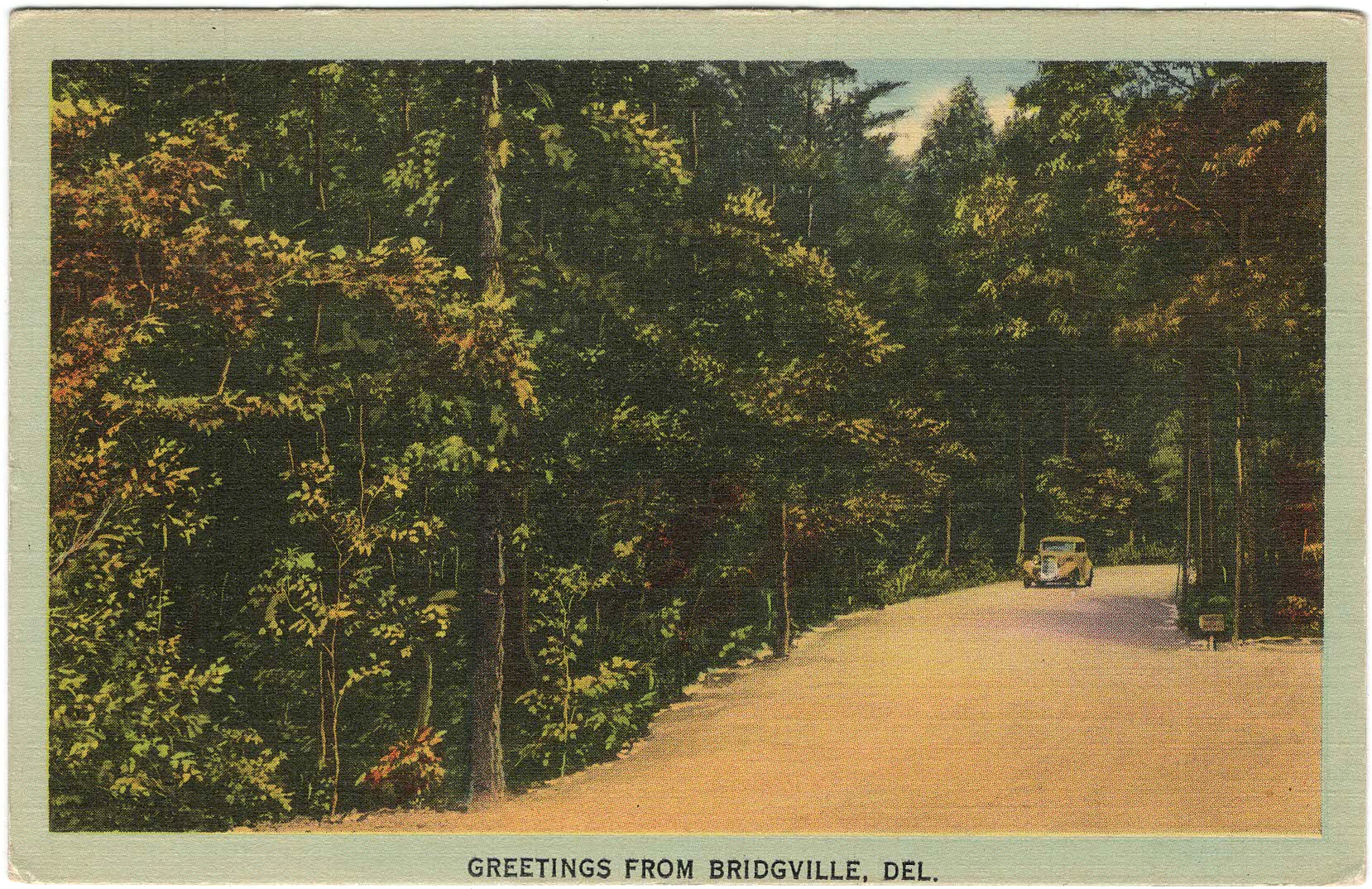
This linen postcard, with its misspelled "GREETINGS FROM BRIDGVILLE, DEL." on the front, was mailed in 1942 from tiny Bridgeville, Delaware, to the small city of Johnstown, New York.

It was addressed to 527½ North Market Street, which is this small house, according to Realtor.com. It was built in 1895, has about 1,300 square feet and sold last December for $84,800.

After some searching and guessing about the cursive, I successfully determined that the recipient was Mrs. L.G. Lipe. That would be Lettie May Hill Lipe (1902-1976), who was the wife of L.G. Lipe (1896-1959). Further, as the postcard is signed "Mother" and was sent from Delaware, I'm fairly certain that would be Lettie's mother, Grace Brinsfield Hill (1873-1949), who died in Delaware, so is fairly likely to have been living there in 1942.

Grace's writing is messy in some places, though. (She would have been about 69 when she wrote this, so we can cut her some slack.) Here's my best guess at what it states:

Monday Mar 2, 1942

Dear Lettie & L.G.

I commenced a letter to you this morning had company and [?] [?] Ralph were gone to Seaford and I had to entertain, you see. I did not not get your letter finished. got your nice letter Saturday, will ans. it tomorrow. We have our blackout tonight. Ralph has just gone to Milford to take Shortie [?] to the Dr., he say his side hurts him, guess something is rong [sic?] walk to much in cold. (Hop [?] you both fine)

love Mother & all

Regarding the mention of a blackout in Delaware, there were many, especially along the coasts, but they were considered more of a patriotic duty than a necessity in the defense of the United States.

Sunday, August 22, 2021

Dad's memories of sledding and amusement parks

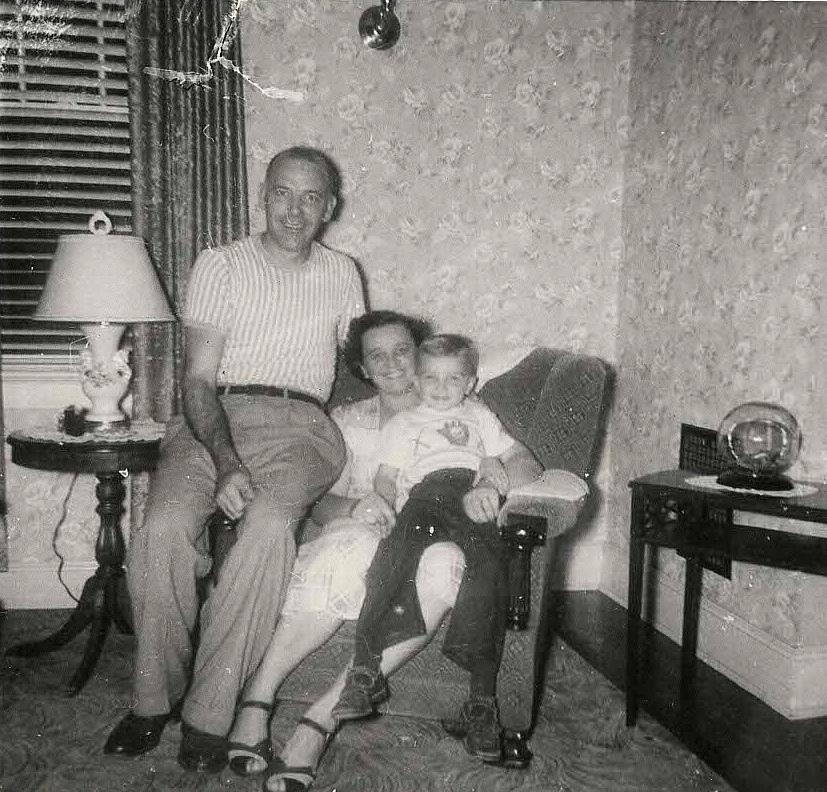
Snapshot from 1952: My Dad, John Alan Otto, on his fifth birthday with his parents, John Alexander "Pappy" Otto and Olive "Bambi" Otto. This was years before Dad could go out sledding by himself or walk to the amusement park or swimming pool by himself.

***

It’s so important to listen to, and record if possible, the lessons and stories our parents and relatives tell us. In a series of text messages on June 6, Dad conveyed the following about growing up in Easton, Pennsylvania in the 1950s and early 1960s:
Crazy world! There is no one out there setting a good example that might unite the divide in the USA demigods! Yet the problems within and without are many and so complicated. Average Americans need to step up to the forefront and say “I’m mad as hell and I can’t/won’t take it anymore.”

I knew the name of everyone in our neighborhood (18 houses) growing up. Everyone was simpatico. Life didn’t revolve around the BS on the evening news. We sat on our porches in the evening and watched the kids play in the street and mothers and fathers talked to other mothers and fathers about their work day and whatever. 

50+ years ago

Yes things have changed

In the winter after a snowstorm we would take our sleds to the top of Hackett Avenue and sled down the half mile to the bottom. Maybe one trip back up to sled again. The road was a mile from our house. Memories. Oh, it was steep. 30 degree slope. Speed racer. 

Hackett’s Creek Park at the top led to the back side of the hill down to the railroad tracks and Bushkill Creek. Not far away was the Binney and Smith Company, the original makers of Crayola crayons. I caught some trout in the stream next to their factory. Not far up the railroad tracks was the amusement park. Spent many a day in the penny arcade. Memories.
A few days later, I asked Dad to expand upon his memories of sledding and his memories of the amusement park he mentioned, which is historic Bushmill Park. He wrote back:
Sledding. Seemed like I always had a sled. Wooden. Handle/foot bars at front, with a rope for pulling it. Growing up we had snow most winters. The city blocked some hilly streets for night-time sledding. Age? 8 to 12.

The trek to the very long steep road leading to Hackett Park was about a mile to the top of the hill. It too was blocked off for sledding. But unplowed. Most cars didn’t attempt going up or down the hill. Maybe you would sled down the hill twice. It was a tuff walk to the top.

Bushkill Park. It was more than a mile from the house. So, I must have been 10, otherwise Bambi wouldn’t let me walk there alone. There was a shorter route by following the railroad tracks that paralleled the Bushkill Creek. The tracks passed by the Binney and Smith factory, where Crayola crayons were made.

The park had a penny arcade. Spent time there playing Skee-Ball. If your score was high enough, you got tickets. So you could use tickets to buy novelties. The carousel or merry-go-round was fun. You tried to get the brass ring as it went around.

The park had a swimming pool and sometimes I would swim there. I usually went in afternoons with Mom and Dad.

But I mostly swam at the city swimming pool on Northampton Street, because most of my friends were there. It was about a 10-city-block walk from the house. Went there in my early teens.

If I went to an amusement park with Mom and Dad, it was Dorney Park in Alllentown. Dad drove us there. They had a stage or bandshell. I remember seeing Soupy Sales there.
The Bar'l of Fun at Bushkill Park, 2017. Mr6507, CC BY-SA 4.0, via Wikimedia Commons

Bushkill Park has an interesting history. It originally opened in 1902 and operated continuously until 2004, when Hurricane Ivan caused floodwaters from surrounding Bushkill Creek to rise and wreak havoc throughout the amusement park. On top of that, vandalism in subsequent years left the park in a sorry state. But it partially reopened in 2017, and its operators are working to renovate and reopen the damaged attractions. 

Wikipedia notes that the Bar'l of Fun funhouse, built sometime before 1935, is notable "notable due to the amount of untouched Folk art painted on the walls and on banners inside the building." 

A morning for marvels and magic

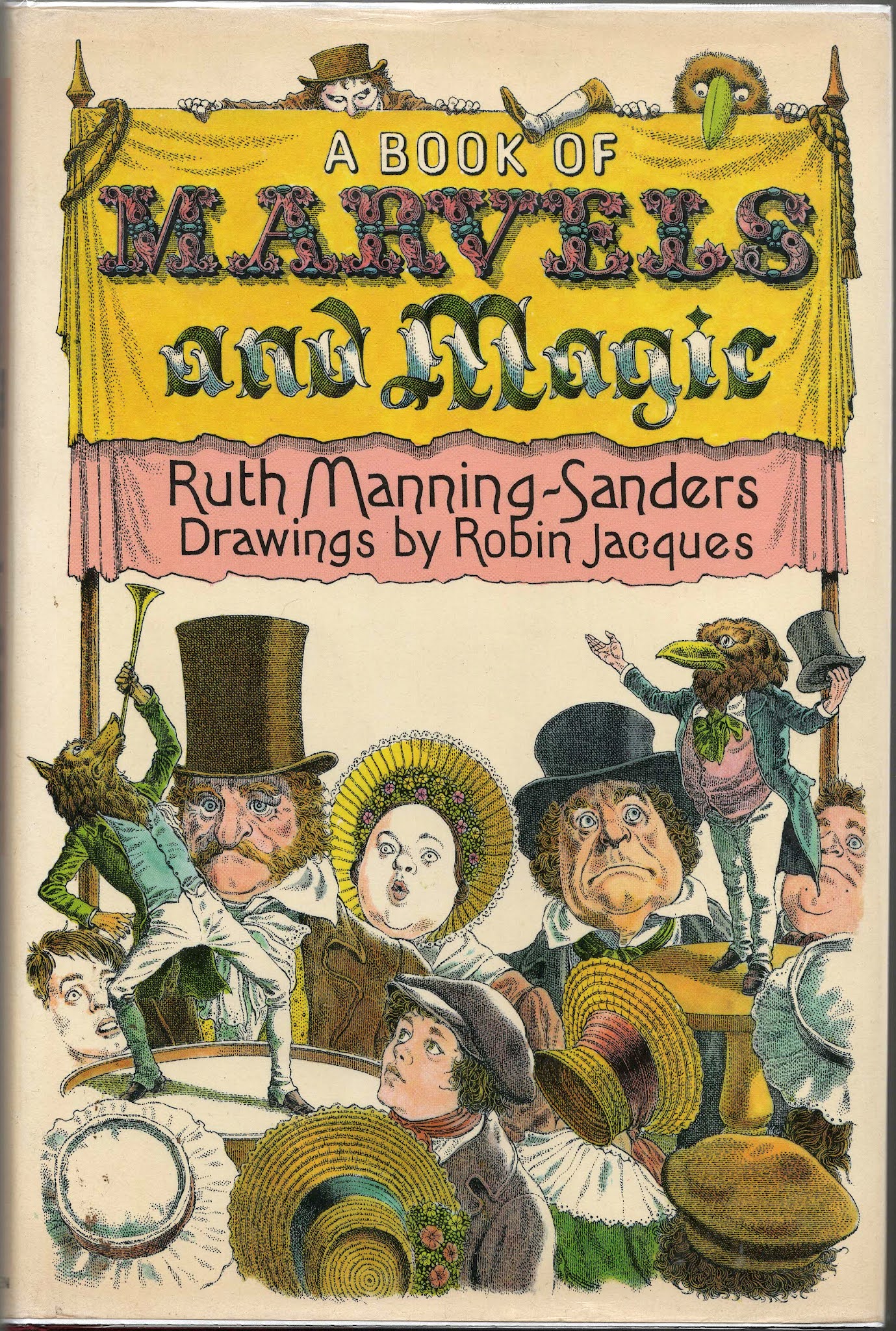
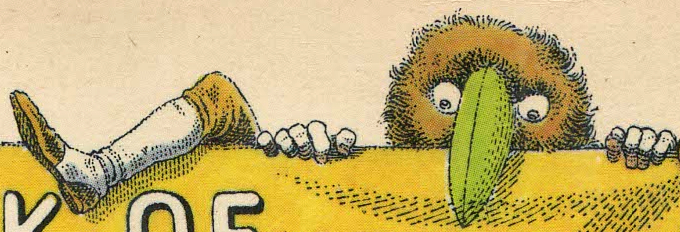
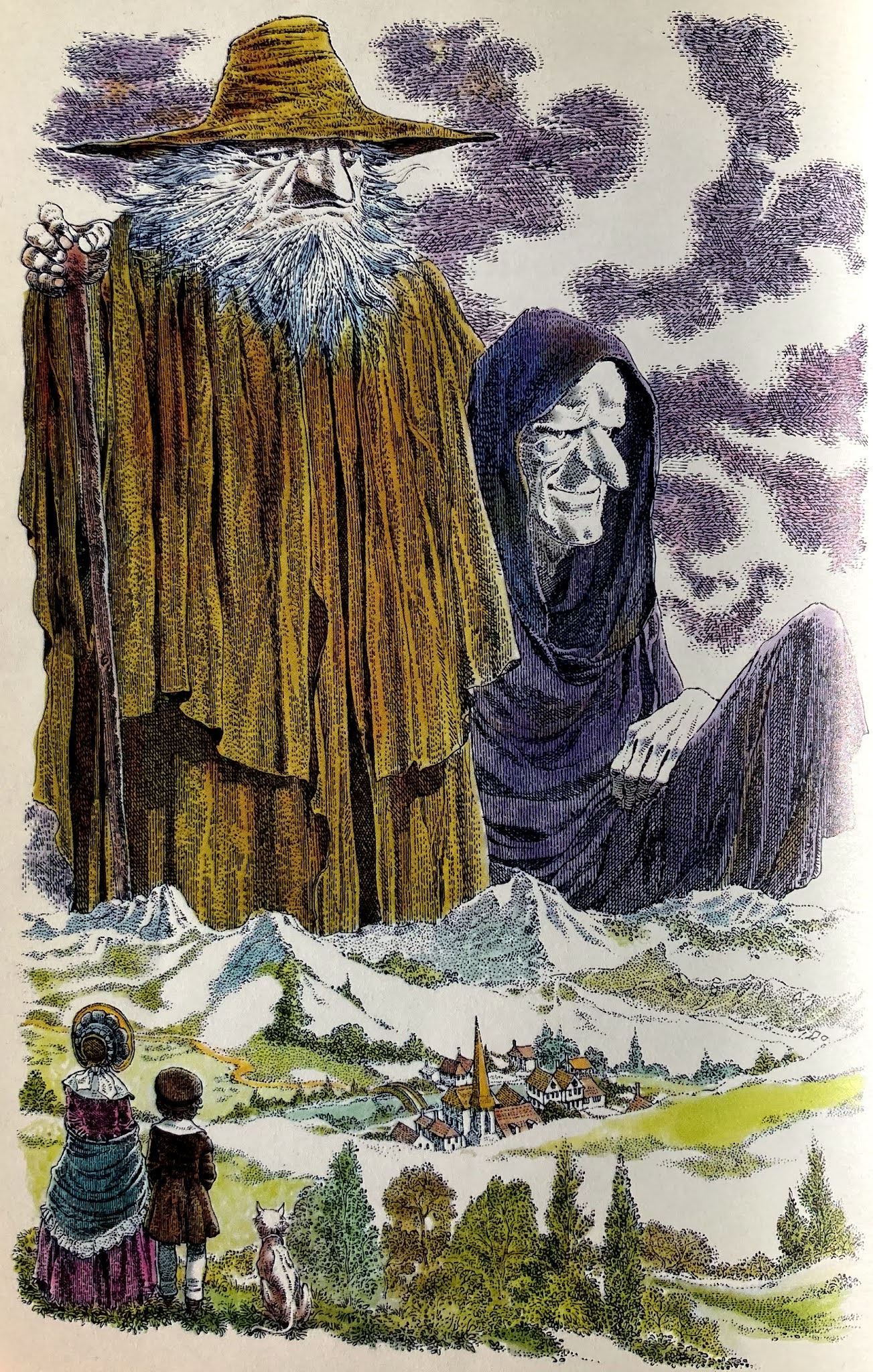
I can't believe I've never shared this fabulous and trippy Robin Jacques cover illustration for 1978's A Book of Marvels and Magic by Ruth Manning-Sanders. Jacques, who was in his late 50s when he did this illustration, clearly reveled in imagining and drawing all sorts of humans and oddball fantastic creatures. (But is it really that far-out, when you consider how folks in the United Kingdom were dressing in the 1970s, between the professionals and the punks?)

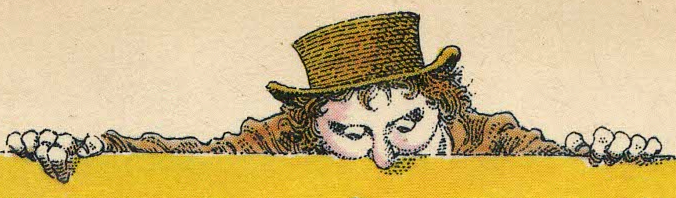
I'd love to read a book or watch an animated film featuring these two characters who are half-hiding on the cover.
Last night, I read the tale "The Hill Folk" from this book. It's from the North Frisian Islands, and its primary moral is "always be kind to animals," which I can get behind. The secondary moral is "never be dismissive of a gift, no matter your thoughts on its worth." Dear readers, if you ever find a fairy tale unfolding around you and a magical being gives you a gift in thanks, hold onto it.

To close, here's Robin Jacques' frontispiece from A Book of Marvels and Magic. If you ask me, I'd say it's his sly take on Ingmar Bergman's The Seventh Seal.

Saturday, August 21, 2021

Headlines during Week 76

Deep sigh. If you use the arbitrary date of March 11, 2020, as the start of the COVID-19 pandemic — that's when the World Health Organization officially declared it to be such — then we're in Week #76 right now, with no clear end in sight. There have been 4.4 million global deaths and the United States passed 628,000 deaths today. (I'm writing in the morning for a post to go up in the evening, and there's no doubt we'll pass from the 627,000s to the 628,000s today.) 

COVID-19 takes up most of my workdays. Monitoring the news and latest developments. Editing letters about the pandemic. Rejecting letters filled with dangerous misinformation. Editing columns about vaccines, masks, schools, governors, health care workers, children, nursing homes and more. It's grim and stressful and frustrating. We didn't need to be in this bad of a spot in Week 76. 

This piece by The New York Times' Jamelle Bouie caught my eye this morning. In "On Freddy Krueger and Our Current Nightmare," he writes:
"But if there was anything that stood out to me after watching all seven movies, it is how within the universe of the films, the adult characters went from concern and terror over the brutal and mysterious deaths of their children to virtual indifference. When a young woman is killed at the start of the first film, it becomes a town crisis, reason to mobilize every available resource to find the killer. ... The adults of the 'Nightmare on Elm Street' franchise just don’t seem to care that much that kids are dying; and in the same way, we live in a society that can’t seem to muster the energy to protect kids from needless death and suffering, whether from gun violence or a deadly pandemic."
It's a depressingly apt comparison, even if it's drawing lines between supernatural fiction and reality. The bummer in pointing out there parallels is that movies have always served as an escape from reality. Especially when reality is at its most crushing. Many people have doubled-down on their love and viewing of horror films during this pandemic, as a way of coping. I think it's a nuanced (and fascinating) topic, and we shouldn't say there's any singular biggest reason for the surge in horror fandom. But this excerpt from a March article in Psychology Today by Juliana Breines speaks to one aspect of the trend:
"Fans of horror movies reported feeling lower fear and anxiety related to the pandemic, and that those with an interest in pandemic-related films in particular reported greater resilience — they were better able to find meaning and enjoyment in life despite what was going on around them, and to take the daily onslaughts of bad news in stride."
Personally, I've found solace in quieter films, such as those by Yasujirō Ozu and Agnès Varda, during the pandemic. But Ashar and I have also watched a lot of horror films, new and old, during the pandemic. There's been run on Boris Karloff films, for example. And there's always the comfort food of The Walking Dead, which returns this weekend. 

Last year, we planned out and watched a whole slate of horror to celebrate October as Halloween Month. We're planning the same this year, as there's a seemingly bottomless reservoir of horror classics he's never seen, including series Bouie referenced. 

This is a longer preface than I intended to sharing some of this week's terrible headlines for posterity. I have previously done this on March 25, 2020; April 25, 2020June 27, 2020; July 18, 2020; July 26, 2020October 6, 2020; and December 4, 2020. Amazingly, this year has just flown by (sort of) and I haven't done any collections of headlines, to the best of my knowledge. So here we go, for posterity:
  • ‘Nursing Is in Crisis’: Staff Shortages Put Patients at Risk
  • The F.D.A. is aiming to give full approval to Pfizer’s Covid vaccine on Monday
  • In Melbourne, Australia, a protest against Covid restrictions turned violent
  • LG Health raises staff vaccination rate, seeks to rehire former hospital nurses amid staffing losses
  • Manheim Township will require masks indoors to begin school year
  • Vaccine resistance in the military remains strong, a dilemma for Pentagon as mandate looms
  • A Texas GOP official’s covid-19 death went viral. Then came calls for vaccination — and bitter divides.
  • Finding reliable masks online can be tricky. Here are tips that can help.
  • Monoclonal antibodies are free and effective against covid-19, but few people are getting them
  • Covid reaches 'astronomical' levels in Louisiana
  • Health officials warn people not to take a drug meant for livestock to ward off or treat Covid-19
  • University of Virginia disenrolls 238 students for not complying with university's vaccine mandate
  • Analysis: Trump heads to Alabama but his Covid politics are everywhere
  • Hurricane Henri puts 42 million under storm alerts as it heads to Northeast coast
  • Variants likely to bring a fall and winter of mandates, anxiety...
  • Orlando mayor urges water limits because of surge...
  • Outbreak shuts entire police force in Illinois...
  • 48% Want Govt to Restrict 'Misinformation' on Socials...
  • Coronavirus live: UK death toll rises by 104; fears of ‘super-spreader’ Trump rally
  • Classrooms in England to get air quality monitors to help combat Covid
  • ‘This isn’t surprising’: Jacinda Ardern warns New Zealanders to remain calm as Covid cases rise
  • Quarter of New COVID Cases in Florida Among Those 19 or Younger
  • Dallas Hospital to Open 4th COVID Ward as Cases Surge in County
  • Hannity Called Out by CDC Chief Rochelle Walensky for 'False' Vaccine Claim
  • Over 1,000 Quarantining in Texas School District Fighting Abbott on Masks
  • Vietnam Deploys Military to Get Food to People Trapped by COVID lockdowns

Wednesday, August 18, 2021

Hideko Takamine caricature from "Kita no san-nin"

It's been difficult these past two days to get into the right mindset for writing about ephemera. One does not simply tune out the devastating earthquake in Haiti; the unfolding American evacuation and humanitarian crisis in Afghanistan; and the seemingly disastrous start of the American school year amid another COVID-19 surge and as some public officials seem determined put obstacles in the way of commonsense health measures. All this happening amid the ongoing drumbeat of extreme weather events spurred by global warming, myriad other pandemic concerns and a polarized political climate still stuck in the long shadow of Jan. 6.

So I'll just check in with this interesting ephemera trifle from an obscure movie. For a breather this week I watched the 1945 Japanese film Kita no san-nin. It's a propaganda film that was made very late in World War II and centers on courage and heroics of a trio of women who have been trained to be air traffic controllers/radio operators.Various English titles for the film are Three from the North, Three Women of the North and Three People of the North.

What's perhaps most notable about the film, beyond the plot, is that it co-stars Setsuko Hara (1920-2015) and Hideko Takamine (1924-2010), who went on to become two of Japan's most beloved stars of post-war cinema.1 Hara's films included central roles in what is informally called Yasujirō Ozu's "Noriko trilogy." And Takamine is best known for the anti-war film Twenty-Four Eyes, which I watched earlier this year. Further, the lives and careers of these two actresses are jointly considered to be the inspiration for the main character in Satoshi Kon's 2001 animated drama Millennium Actress

Anyway, the screenshot at the top of this post show's Takamine's character (Yoshie) in Kita no san-nin. At the end of the film, Yoshie must serve as the radio operator during a dangerous flight, and her fellow crew members (all men) give her the caricature as a show of respect and support. It's an enjoyable little moment in a mostly somber film; I wonder if that sheet of paper still exists.

Very little has been written about Kita no san-nin, but I did find a review at a great website called Japanonfilm. (It's a movie blog that I plan to take a deep dive into, now that I know it exists.) Here's some insight from that review:
"Obviously intended to encourage everyone to do their part even as the American bombers began arriving, it unintentionally becomes a proto-feminist document. ... As with American 'Rosie the Riveter' kinds of movies, the Japanese were inadvertently planting the seeds of modern feminism because the war demanded women take over essential jobs that were left open when the men went to battle."
Footnote
1. Kita no san-nin also has Takashi Shimura in a supporting role. He's best known for starring in most of Akira Kurosawa's films, including Ikiru.

Monday, August 16, 2021

Memories of the Epyx Fast Load Cartridge

Here's an advertisement that was packed in with some vintage computer stuff that Joan and Kaitlyn bought a couple of years ago. 

I remember this well and had my own Epyx Fast Load cartridge plugged into the back of my Commodore 64 in the 1980s. And my recollection is that they definitely made everything faster, back in those days of long loading times that would be unthinkable today. It helped to facilitate playing Ultima IV, Summer Games and California Games (both also from Epyx), Commando, Autoduel, SimCity and other games of that era I had. I don't think, however, that we ever got to the speed level of "leaping gazelle," as the advertising copy states.

Writing extensively about the cartridge on The Silicon Underground, David L. Farquhar explains that it "replaced the Commodore 64’s stock ROM disk loading routine with a more efficient routine that was about five times as fast. The result was that software that normally took three minutes to load often took closer to 30 seconds with the cartridge."

He also notes that the cartridge originally retailed for $34.95 in 1984, which is the equivalent of about $88 today. We spent some ridiculous amounts of money on our 8-bit computing in the 1980s! 

Sunday, August 15, 2021

Teachers are awesome

On a sad weekend, this was a Postcrossing arrival in the mailbox that made me smile. It's from Alina, a teacher in Russia who wrote this note:

Hi Chris! My name is Alina. I'm from Russia. I work as a kindergarden teacher. And so I'm closely connected with the topic of folklore, fairy tales and children's literature. I read a lot to children, we put on theatrical skits and play role-playing games. Children love stories about princesses and princes, dragons and knights, warriors and kings and many other fairy tale characters.

We often make up fairy tales ourselves. We draw, model or construct a character and make up stories about them. Childhood is a wonderful world! 

I'm learning to learn about the world together with my children. Unfortunately, as adults we lose the ability to fantasize and enjoy little things. 

I wish you new discoveries and experiences this summer! Have a great mood and all the best!

Listen to Alina, everyone! And listen to your teachers, remember what they taught you and be thankful for them. Also, let's show her that we adults can still use our imagination and are capable of enjoying the little things.

Saturday, August 14, 2021

Farewell Mr. Bill, aka Billbo Baggins, aka Ohdabu daBill, aka many things

It's been a rough week. We said goodbye to our oldest cat, Mr. Bill, and helped him peacefully cross the rainbow bridge. 

Our beloved family cat, who had oodles of wonderful quirks and personality — moments that will have us reminiscing and laughing as family for years — was a big contributor to Papergreat, too. (He also starred in a Twitter thread gently mocking his silly sleeping positions this year.)

Longtime readers have seen him plenty of times. There was a Christmas cats photo gallery. And, perhaps most notably — and nearly 10 years ago — Mr. Bill appeared in Happy Halloween: Witches and zombies and scarecrows! Oh my! He was my Halloween front-yard decoration co-conspirator in that one. It's the first image below in a "tribute reel" for Billy.
Circa 2012. From left: Mr. Bill, Salem and Huggles. In the foreground: Mitts. All four of them are now hanging out together again, in the warm sunbeams.

Sunday, August 8, 2021

Snapshot & memories: The Phillies are hot, and so was I

In the overwhelming majority of photographs that exist of me as a child, I'm wearing some sort of Philadelphia Phillies T-shirt. This includes, to my mother's chagrin at the time, at least two official school photos. I've considered putting together a post that's simply a gallery of all the "young Chris in a Phillies T-shirt" snapshots that I could find, but nobody needs that. (Heck, there's few of you reading the actual posts these days.)

Anyway, I thought I'd share this tonight because the red-hot, first-place Phillies have just completed a three-game sweep of the New York Mets, thanks to the complete-game pitching of Zack Wheeler and solo home runs by Jean Segura, J.T. Realmuto and Bryce Harper.

All four of those players were born roughly a decade after this photograph was taken. Yes, folks, I'm officially getting old. This snapshot, based on my height, is almost certainly from the summer of 1981. Forty (gulp) years ago. I'm in the backyard of our Willow Street house in Montoursville. I'm very hot, probably from running around the backyard in circles or something similarly unproductive. The tank top + cut-off jeans shorts is no longer a look that I can or should attempt to pull off. And it's been a long time since I've had that much hair; not even during the height of the pandemic, when I'd gone months without a haircut, did I have that kind of mop atop my head.

When I posted this picture on my Facebook page in 2014, Mom's only comment was: "I remember the chives, but forgot about the grill.......! You look hot, literally!"